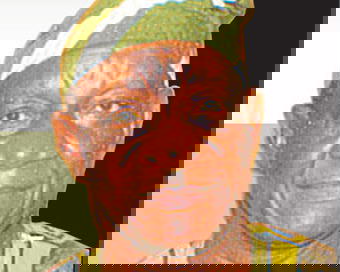
Dele Sobowale
“Thank you, Dele. Nobody in the last three years has given me so much money as this. The last time one of our old friends gave me money was about three days ago. He gave me 500 naira; and then told me to ‘go and see Dele.’ He gave me your address. I have been begging for money or food for almost a year now. This amount will last me for two weeks. After that, I will just stay in my house until the end. See you at the graveyard my friend” – Gboyega, September 13, 2024.
He shook my hand vigorously and walked swiftly away. He is still alive; but, just barely. He was born into one of the elite families in Lagos Island. His father, Alhaji Ilumoka, not his real name, was such a great socialite; three different leading musicians of that era waxed records to praise him. Like most of the rest, he was a polygamist – four wives, uncountable concubines and a luxury bus load of children. There was apparently no problem taking care of all of them until Alhaji suddenly died at age 55.
Then the calamities unfolded. Each of the mothers had to face life as if a great flood had swept their lives clean of support. Gboyega, among his children, was in my age group. We started Primary School together and continued until I left for Igbobi College from Standard Five; instead of waiting to complete the sixth year. We remained friends despite that. The big break occurred in 1964, when I left for the US for ten years.
We met again in 1975; by which time he was in public service as a Level 10 officer. He was ‘getting on’ as people said about civil servants living well above their legitimate income. He was as proud as any true-blooded Lagosian can be. He never begged for or borrowed money. Instead, he was a mini-ATM for his family, friends and associates – until he was retired after serving 35 years. Then, the ‘money tap’, which life in the Nigeria Ports Authority, NPA, had provided, was turned off. Fortunately, he had built four houses in various parts of Lagos at a time when tenants were afraid to owe landlords rent.
Gboyega moved on; but as the Nigerian economy took a turn for the worse, under Buhari in 1984, his fortunes also took a nose dive. He never recovered fully until disasters struck. He sold one building in 2022 to stay alive; then another building inexplicably collapsed. It was his biggest cash-cow. By then, he was in a bad shape. His two wives have left him and his children were in no position to help. Tenants had become more defiant of landlords and seldom paid on time; his ailing health bills were drilling wider holes into his pockets. “Subsidy is gone”; uttered by Tinubu on May 29, 2023, meant nothing to him at first.
In fact, he campaigned for Emilokan and was ready to bet any amount that very soon Nigerians would smile again under Tinubu – if only he had money. He sent the nephew living with him to the nearly filling station three days after; gave the guy the usual amount for five litres of petrol. He received a slap in the face. First, there was no fuel in the station and the black market price was 300 per cent higher. Involuntarily, he let loose maledictions against those in government. Then the prices of everything else shot through the roof.
There has been a steady decline in the fortune of somebody born with silver spoon in the mouth since May 29, 2023. He feels betrayed. March 2024, another of his buildings was demolished for obstructing a drainage system… No compensation. Visit to a private doctor was affordable years ago. Later, the General Hospital, with the crowd of other have-nots, served his purposes. Prescriptions had to be bought and they became gradually more expensive as time went on. Adjustments were made to expenditures in order to accommodate the bills for drugs. “While there is life, there is hope”. That was the explanation. February 2023 brought an end to the General Hospital patronage.
Buhari and Emefiele had conspired to create the worst cash scarcity in Nigerian history since Buhari created one previously as military Head of State. There was no money to procure food and drugs; he resorted to herbal medicine which could be bought in small quantities. Surprisingly, he survived the change from orthodox to traditional medicine; only to discover that there is no alternative to food. There was also very little money for that. He was not alone. All his old friends were suffering from the same affliction – HUNGER – which persisted and brought him to my house. Names were reeled off; some known from our childhood; others when we became adults and socialites ourselves. Few had or are having happy endings to their lives.
THE PROMISE OF LONG-RUN RECOVERY
“In the long run we are all dead” – John Maynard Keynes, 1883-1946.
Remarkably, without exception, the first downturn occurred since 2014; the real crunch came from May 29, 2023. Gboyega and most of the rest of us descended into a manhole which opened suddenly under our feet. President Tinubu might have a plan for economic recovery in mind. His latest announcements, made in far away China, would have been better made here in Nigeria; and the details should also have been provided regarding how and when we can expect to reach certain mileposts. As it is, what we have are more politicians’ promises. History, meanwhile, has taught us that it is easier to destroy than to build. The World Trade Centre, in New York, which required years to build, from concept to launching, was demolished in one day by Osama Bin Laden’s terrorists.
The Nigerian economy has been savagely demolished by governments before this one. More destruction has taken place since last year. The promise of a better long term rings hollow to those 70, 80 or 90-year-olds – particularly, when there is no credible road map to recovery and no deadline. Gboyega was not impressed with Tinubu’s pronouncements. He was certain that the promises will never be fulfilled in his life time. So, he has developed his own plan. “Dele, when I am down to my last N1, 500, I will go to the restaurant near my house; order pounded yam, vegetable soup and goat meat. After eating the food in the evening, I will go to my house and never come out again. Let my children come and take me to the cemetery.” No vote of “no confidence” in the future has ever been more clearly delivered.
DSS BEWARE – THE BATTLE DOES NOT ALWAYS FAVOUR THE STRONG
“Brute force without wisdom falls by its own weight” – Horace, 65-8 BC, VANGUARD BOOK OF QUOTATIONS p63. Read online.
Every new appointee to high office wants to “hit the ground running” – despite the fact that most of those using that expression don’t know the risks involved in that undertaking. Tinubu certainly hit the ground on May 29, 2023; but, instead of running, his government has been stumbling from one step to another. The latest is the fuel price controversy. Dangote petrol, which most Nigerians naively expected would crash petrol price, has hit all of us like ten tons of bricks – crushing businesses and hope for relief from hardship. Most Nigerians are too cowardly to join the protest against the pervasive hardship felt across the land. But, deep in their hearts, most support it. Anyone, truly or falsely perceived as fighting for the people against oppressive policies, is now seen as a hero.
The leaders, not just the President, are now cast in the role of villains. Unfortunately, the primary role of the DG-DSS is to protect government as well as the nation. There is seldom any dilemma in discharging the two responsibilities simultaneously; if the government and its policies are generally popular. Trouble arises when both are demonstrably unpopular – as our current national experience indicates. We have a President unwanted by 66 per cent of the voters; and whose economic, political and social policies have eroded even the 34 per cent support he enjoyed on Election Day. The security organisations – Police, Armed Forces and DSS – are undoubtedly compelled to protect him until the next election. That is their constitutional role; and nobody in his right senses can argue against that. There is a problem, however.
PERSUASION OR PERSECUTION?
“Most of the problems a President has to face have their roots in the past” – US President Harry S Truman, 1884-1972.
“Being a President is like being a jackass in a hailstorm. There is nothing to do but to stand there and take it” – US President Lyndon B Johnson, 1908-1973.
In every country, not just really democratic, from time immemorial, the Head of Government has inherited problems having “their roots in the past”. Tinubu is no exception in that respect. And, as Johnson said, the person who willingly sought office must be prepared to “stand there and take [the flak]”. In his own case, Tinubu was mostly responsible for Buhari who handed power to him. It is like Usain Bolt insisting on who, on the relay team, would hand over the baton to him; and the fumbler drops the baton before handing over. Tinubu resurrected Buhari from political exile; the man bequeathed to him a totally ruined economy. Emilokan has two options. He can try to persuade Nigerians that his measures are in their best interests, or he can try persecution. Persuasion is more difficult but more rewarding. Unleashing the DSS is quicker but more risky. Many dictators are either in detention or exile. A word is enough.
Disclaimer
Comments expressed here do not reflect the opinions of Vanguard newspapers or any employee thereof.