Life on earth has been saddled with waste generation due to the lifestyle, production schemes, and human behaviors.
Obviously, the issue of waste management cannot be ignored knowing the tons of waste generated annually in municipal counties (Jamilatun, Pitoyo, & Setyawan, 2023).
In fact, waste is synonymous with humanity and most of the waste generated ends up in landfills with the expectation that it will degrade naturally.
Typically, wastes are in diverse forms such as ferrous metal, paper/cardboard, construction and demolition, plastics, food, horticultural, wood, ash and sludge, textile/leather, used slag, non-ferrous metal, glass, scrap tires and others (National Environmental Agency, 2024).
Unfortunately, not all the wastes dumped on landfills can biodegrade. Thus, leading to the emission of greenhouse gases that pollute the air, land, and water ways alongside the biosphere within those environments (Paleologos, Caratelli, Amrousi, 2016).
The question that comes to mind is that why are there too many wastes in the society? Basically, many household products are produced with the intent of take-make-use-dispose. This behavior has led to the accumulation of wastes in the environment.
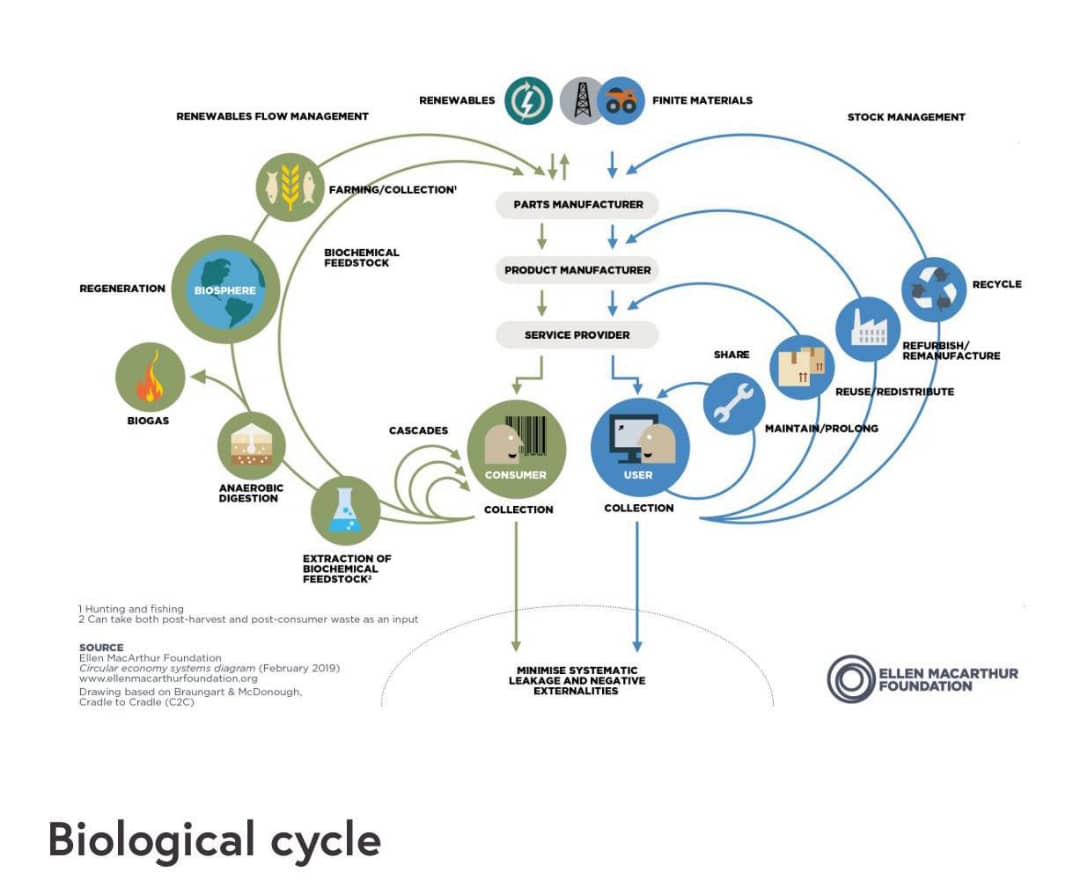
To effectively manage wastes, scholars and practitioners alike have proposed the concept of circular economy.
The essence of circular economy is to minimize waste by adopting a production model of redesigning, sharing, recycling, buying back, repairing, leasing, refurbishment schemes.
It is worthy to note that in a circular system, the waste generated becomes input to other systems thus recycling or reusing the waste thereby minimizing waste generation, resources depletion, and environmental degradation which are associated with linear systems.
Webster (2015) posited that circularity is a call for climate action because it has the potential to reduce the amount of raw material extraction and the associated greenhouse gases emitted.
Besides supporting climate action, circularity also reduces the cost of operation and consequently improves a companys financial bottom line.
From the principles of circular economy, there are several ways to forestall or minimize waste.
In this paper, I intend to evaluate three circular economy strategies namely: recycling, waste to energy, and natural resources accounting mechanism.
First, evaluating circular economy from the concept of recycling waste, more especially plastics.
One of the key objectives of circular economy is to minimize waste as a tool to alter the global trend on climate change.
It is obvious that our environment is littered with waste and by circularity principles, waste has the potential to become wealth through recycling.
Notable amongst the waste generated in our society are plastics. In our contemporary society, the use of plastics has become an integral part of our lives.
Plastics are all around us, from food packages, waste disposal, shopping bags, containers, just to name it.
Our lifestyles are continually driving us toward the dependence on plastics.
Besides using large quantities of plastics, we also do not reuse it or dispose plastics appropriately consequently leading to huge quantities of plastic wastes ending up on landfills and marine environments that has several environmental implications.
Considering our relationship between plastics, it becomes unrealistic to ignore that plastics are not part of our environment.
Consequently, researchers have coined a word plastisphere which is a form of the sphere where the habitants are plastics and the microorganisms around it, more especially in the marine environment.
This just buttresses how plastics have partially or completely overwhelmed the environment.
Besides the environmental hazards associated with plastics at landfills, the environmental consequences when plastics are disposed on our water ways remain very profound.
One of the shocking revelations of the effect of plastics, especially in our rivers and oceans, is the amount of plastic surface area exposed to sunlight and the associated affect effect.
In a study conducted by Dr. Sarah-Jeanne Royer of Queens University, Australia, she found that when sun light heats up exposed plastics, the plastics generate tremendous amount of greenhouse gases.
So based on that finding, we can imagine the GHGs contribution due to plastic wastes littering our water ways.
Others have also reported that the zooplankton ingest microplastics as food, and then pass it out as microplastics into the marine food chain.
This becomes distributed in the global ocean network and the associated marine life.
With this distribution, microplastics becomes part of the marine food chain and finally we have on our dining tables fish that had consumed microplastics.
In fact, whales consume thousands of these zooplanktons.
Knowing that whales are natural carbon sink, we can estimate the potential consequences of plastic disposal in our water ways.
Indeed, very colossal consequences on humanity and the environment, therefore, to mitigate this trend, there is the need to recycle plastics through incentivized programs between manufacturers and customers.
That is converting the plastic linear economy to circularity by reusing the plastics.
Besides recycling, converting wastes to energy is another circular economy sustainable development strategy employed by countries to mitigate climate change.
Haraguchi, Siddiqi, and Narayanamurti (2019) noted that to avoid this continual environmental degradation caused by waste disposal, most municipal council leadership have taken the initiative to provide waste management system to protect the environment by generating energy from waste.
One of such cities worth noting here is Singapore. Singapore is a small city of about 730 square kilometers; however, the city is densely populated.
According to the Department of Statistics Singapore (2022), the population of Singapore as of June 2022 was 5.4 million.
Data from the Singaporean National Environmental Agency (2024) revealed that in 2022 approximately 7.39 million ton of solid waste were generated in Singapore of which 4.19 million tons were recycled and the rest sent to either landfills or other forms of energy conversion process.
Due to this large quantity of municipal solid waste generated in Singapore, the city leaders developed a policy on how to integrate waste management into circularity.
The Singaporean waste management policy is a five-step hierarchical order of prevention, minimize, reuse, recycle and energy recovery (McCrea, Tan, Ting, & ZuoA, n.d).
The hierarchical structure of the policy is likened to the integrated solid waste management framework as proposed by the United States Environmental Protection Agency (EPA). Remarkably, the Singaporean waste management policy hinges on three fundamental principles namely: (a) minimize waste at source, (b) recycling to reduce waste at both incinerators and landfills and, (c) reduce waste volume through incineration (McCrea, Tan, Ting & ZuoA, n.d). From the hierarchy order, it is obvious that prevention is the first preference while waste to energy is the fifth priority.
Our interest in this circularity approach to municipal waste management is to convert waste to wealth through electricity generation.
Typically, the choice of waste-to-energy (W-t-E) system is influenced by the type of waste generated, emissions generated and regulation, feed-in tariffs, capital expenditure, technology, and other associated collection fees (Jamilatun, Pitoyo, Setyawan, 2023).
Therefore, it is obvious that in selecting the type of W-t-E system, it is imperative to conduct cost benefit analysis to evaluate the various factors before making the decision on what type of W-t-E system that would be appropriate for a municipality.
Considering the composition of waste associated generated by most cities, the W-t-E systems of interest are incinerators, anaerobic and gasification and their respective cost benefit analysis are evaluated accordingly.
Incinerators are W-t-E systems that combust waste to generate heat, which then boils water to generate steam for driving steam turbines to generate electricity.
The process is associated with the emission of greenhouse gases (GHGs) which has a negative environmental impact. Similarly, anaerobic W-t-E system is a thermal W-t-E like the incinerator, however, it uses a biological means to generate energy from the waste and it has minimal adverse environmental impact.
In terms of waste conversion to energy, anaerobic W-t-E is only applicable to biodegradable materials, therefore, all other waste must be separated before digestion, gas recovery, and residue treatment processes would take place (Klein, 2002).
The biogas generated is then used to generate electricity. For gasification W-t-E systems, the operation principle is through a thermochemical process where synthetic gas is produced, which is a gaseous fuel for power generation (Rahman, Azeem & Ahammed, 2017).
Notably, each of these W-t-E systems has its corresponding type of feed stream, cost, and benefits that determines its suitability.
One of the ways to determine the type of W-t-E is by evaluating the feasibility through the following cost and benefit components.
For cost, the components are private cost and external cost which are elements of the total social cost.
Private cost is the sum of capital cost and operating cost while the external cost is the cost associated with emission penalties.
Thus, the total social cost equals total private costs plus total external costs.
Whereas the benefit is evaluated from the perspective of private benefit (benefits associated with the generation of electricity) and the external benefit (avoided environmental cost associated with electricity generation), which are elements of total social benefits.
Thus, total social benefit equals total private benefits plus total external benefits.
The net social cost equals the total social costs minus total social benefits.
For the foregoing, it is imperative to evaluate the various cost components through empirical evidence.
Data from available study (McCrea, Tan, Ting, & Zuo, n. d) showed that for incinerator, the private cost ($58.5) per municipal solid waste per ton which is a combination of incineration cost ($53.30) and land fill cost ($5.20).
The total external cost ($6.05 to 18.93) per municipal solid waste per ton, which is the cost of missions from the incineration plant.
Therefore, the total social costs ($64.55-$77.43) which is the sum of the total private costs plus the total external cost.
For the benefits per ton of municipal solid waste. Private benefit ($41.01) which is the electricity generation and the external benefit ($23.31) which is the avoided environmental cost associated with electricity generation.
Therefore, total social benefit ($64.32) which is private benefits plus external benefits.
Consequently, the net social costs which is total social costs minus total social benefits becomes $0.23 to $13.11per ton of municipal solid waste (MSW).
Part of the cost component worth mentioning is the emission cost which revealed incinerator as non-environmentally compliant W-t-E system.
For the anaerobic system, the private cost per municipal solid waste ($75.08 to $91.78) which is a combination of annualized capital costs ($36.87 to $45.07) and yearly operating costs ($38.21 to $46.71).
The total external cost ($6.05 to $18.93) per municipal solid waste per ton which is the cost of emissions from anaerobic digestion process.
Therefore, the total social costs ($81.13 to $110.71) which is the sum of the total private costs plus the total external cost.
For the benefits per ton of municipal solid waste. Private benefit ($10.41 to $16.22) which is the sum of electricity generation ($4.71 to $10.52) and sale of composite ($5.70).
While the external benefit ($2.68 to $5.98) which is the avoided environmental cost associated with electricity generation.
Therefore, total social benefit ($$13.09 to $22.20) which is the sum of private benefits plus external benefits.
Consequently, the net social costs which is total social costs ($81.13 to $110.71) minus total social benefits ($$13.09 to $22.20) becomes $68.04 to $88.51 per ton of MSW.
The results of the net social cost revealed that anaerobic W-t-E system is more expensive when compared with the incinerator, although it has less environmental impact.
For the gasification system, the private cost per municipal solid waste ($40.79 to $49.89) which is a combination of annualized capital costs ($24.23 to $29.65) and yearly operating costs ($16.56 to $20.24).
The total external cost ($2.61 to $5.39) per municipal solid waste per ton which is the cost of emissions from anaerobic digestion process.
Therefore, the total social costs ($43.40 to $55.28) which is the sum of the total private costs plus the total external cost.
For the benefits per ton of municipal solid waste. Private benefits ($64.55) which is the benefit from electricity generation.
While the external benefit ($36.70) which is the avoided environmental cost associated with electricity generation.
Therefore, total social benefit ($101.25) which is the sum of private benefits plus external benefits.
Consequently, the net social costs which is total social costs ($43.40 to $55.28) minus total social benefits ($101.25) becomes -$57.85 to -$45.97 per ton of MSW.
The results of the net social cost revealed that anaerobic W-t-E system is more expensive when compared with the incinerator, although it has less environmental impact.
From the foregoing cost benefit analysis, it is obvious that the gasification W-t-E system is a better waste management system for the municipal cities, and it has the potential to position a city towards the part of sustainable waste management in addition to bridging the gap between sustainable waste management and energy supply.
Thus, supporting the call for climate change initiative and sustainability.
The essence of circular economy is to minimize waste to improve material usage and that suggests that the inflow and out flow of natural resources accounting in an organization is a key circular economy principle.
For an organization to continually use natural resources like water, energy, and minerals without accounting for want the organization uses negates circular economy principles.
The reason for this assertion is that most of the natural resources have fixed quantity and continual use might lead to depletion beyond their regeneration capacity.
As an effective sustainable material management, it is imperative for an organization to measure their inflow and outflow of materials: inflow such as energy, water, minerals, materials; outflow such emission, waste etc.
The essence is to ascertain what the organization is taking out of the environment in addition to what the organization is releasing to the environment.
As part of circularity, it is imperative for all organizations to measure the inflow of resources from the environment to the organization and the outflow of the waste and emission to the environment.
According to Blomsma and Brennan (2017), knowing the potential inflow and outflow of materials within a companys boundary is a plan towards circular economy.
It is obvious that to assess the materials inflow and outflow within the companys boundary would require understanding the appropriate circular metrics to adopt.
Some of the potential metrics of interest are (a) GHG emissions in CO2 equivalent, (b) total amount of solid waste discharged, (c) total water consumption and (d) energy consumption.
These metrics are chosen in concurrence with the Bellagio Principles which grouped circular economy indicator into four key groups: Environmental footprint, material and waste, socioeconomic impact, and policy and process implementation (United Nations Economic Commission for Europe, 2021).
By ascertaining the inflow of natural resources, and the outflow of emission and materials from the organization to the environment, will provide guidance to organizational leaders to monitor and implement corrective actions toward circular economy agenda. Certainly, when industry leaders understand the implication of the inflow of natural resources to the organization and the outflow of emission and waste from the organization to the environment, there would be no doubt that they would apply precautional principles in their decision with respect to the production of good and services.
The continual emission of GHGs and the associated climate change has drawn the attention of scientist, scholars, and practitioners alike to proffer solutions to abate the potential consequences.
Most often, the solutions tend towards efficiency of power generation, and how industries can effectively engage in a sustainable production, specifically material efficiency.
To this end, the concept of circular economy has emerged as a process to minimize the emission of GHGs by using less of materials to produce more products.
One fundamental question about circular economy is that, is it possible to produce more from what has been used? Yes, however, on the condition that we understand material flow for the industrial sector.
This we can perform by conducting material input and out analysis of the industrial sector, the value chain of materials, and then ensure that the outflow of one industry becomes an inflow to another industry.
In a circular economy business model, more products are produced from the same material thereby reducing the need for extracting virgin natural resources.
Typically, the waste to electricity concept typifies the concept of where the output of system becoming the input of another system, thus encouraging reuse of material and consequently minimizing the extraction virgin material.
It is worthy to note that although circular economy has the potential to reduce the global trend on climate change because of it numerous benefits; however, it also has its own challenges that must be overcome. For example, implementing circular economy involves funding research into new material, production technology, new production line, operational expertise and so on, which may negatively impact the bottom line of organizations.
Certainly, if the company does not have the finances to pursue the above requirements, it will be challenging for the company to adopt the concept of circular economy.
It thus implies that an economic incentive may motivate companies to adopt the concept of circular economy.
On that note, government incentives such as funding schemes, subsidies, and tax reliefs to companies might motivate companies toward implementing circular economy.
When that happens, companies can use the funds derived from the incentive schemes to fund the research into alternative materials, technology, manpower, equipment, and processes required to implement the circularity of their operation.
It is obvious that in the decarbonization effort, the need to include policies related to effective material management becomes a significant requirement. Thus, the reuse of waste remains as a circular economy principle to enhance sustainability in this era of climate change.
By Krakrafaa Bestman, PhD
Disclaimer
Comments expressed here do not reflect the opinions of Vanguard newspapers or any employee thereof.