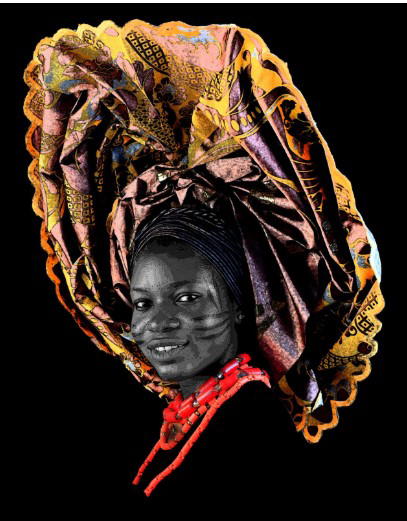
Ancestral Radiance by Olaniyi Atolagbe
By Ebri Kowaki
This woman’s gele is so big, forget what Tems wore to Oscars. Olaniyi Atolagbe is an effervescent Nigerian with a palate for overlarge geles. The headscarves, which dominate his Crown of Identity series. They also relish being bold-hued, contemporary yardage patterns.
Atolagbe’s style is as intriguing as the geles, and we would return to those wild nightmares. Consider this one, in Ancestral Radiance, the magic of light, which is the exact lack of it; her darkness is her body. The rest of the Crown series is rendered in bioluminescent lighting or black and white. He accordingly invests high contrast in the visual dynamics; the mood in the dark woman’s frame is directed in a grayscale face, which, beyond its emotional conveyance, retains Olaniyi’s signature, like a wink, ‘I am not a portrait artist,’ even as he centers portraits in his composites. The ability to pull off such paradoxes makes him an exciting artist. His editorial choices lead to an image Yinka Ajayi describes as ‘poetic resilience’, phantasmagoric ambition, edgy even, in singular moments. The moods remain unsettling without being out of balance; the artist’s math background is divulged in composition.
Atolagbe’s spreads the visual rhythm of the aso-oke scarves with the reckless boldness of color, wild painter, regal headgear adorned by brides and deserving bride mothers. His grand allusion in the Crown of Identity series is that the gele is, well, a crown.
No, not in that symbolic way, picture fevered editing, double exposure like half finished sentences, picture him saying it between his teeth, ‘The Gele is a crown.’
Picture that force flaring hypermedia stoned adorned headpieces as they enfold three-quarters of their frame. The wearer’s expressions are indiscernible, the faces are either vague or vacant, the broadest smile would not look at you, the portraits go off to some peculiar pleasure of their knowing. The contempt for centering faces spreads to Night Time in Bariga, the series Yinka Ajayi had referred to, on which he had been preoccupied with crepuscular clouds and other nocturnal aesthetics.
After the red bead hoodwink, Ancestral Radiance rises through unsurprising greyscale to bezel pleats, purple and maroon accents, intricate damask bearing the prints of precise fingers. Knotting a gele is an art that transforms the expert’s friends into middlemen of a connect.
The Ankara flare is an add-on, floral and metallic motifs intertwine illustrations pulsating highlighted pleats. When she turns the other way, it swivels like a totem above the eye line. Olaniyi works like a paintbrush. The crown rises like a warm golden orange bud in distant green, holding to the wind, wings beating back the wind, tail feathers of okin, the peacock blooming atop darkness, a royal peacock, the beaded big crown veiling the Alaafin’s face. The extravagantly projected headgears overwhelm bystanders at an exhibition, one could zip up the passion in celebration, a ziploc bag for the complexities running over themselves. But no one’s mother ever broke out her chest of damask for a mean reason. As Odetara’s Generational Gele holds, the gele is a symbol of self-discovery; his vision is inspired by the aboriginal Yoruba socialization system, a bequeathed crown from mother to daughter, and so on, watching on. The symbol of self-discovery is a big crown of glass beads to veil lower men from beholding the face of one who carries such power.
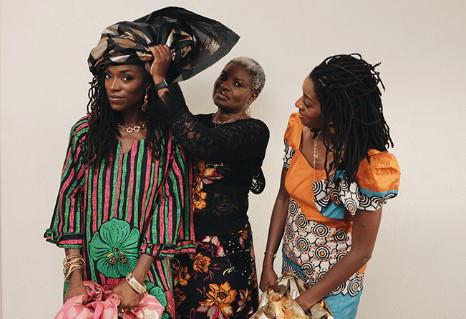
The interest in hats is the same in civilized societies. From the elaborate wigs of ancient Egypt, headdresses may have developed out of dual needs for environmental protection and a glorification of psychic environment. Let me explain, a developed man in the task of subduing and adjusting his ecology to encourage and facilitate his ideals finds a civilization in the process. This is essentially a stratum of cultures that fuel artistic ambition, the ideals of the inner world he has found in the process of development. Art is ultimately the photograph of an interactive mind built outside ours to mirror ours, detailing moments of the collective unconscious as patterns and motifs. For no reason other than because a king loses his freedom a moment after holding it, art is the roadmap and protection, and accordingly, printed on everything. The English hat traces to a Germanic ancestor wer, ward, wardaz, warden. A different head related critique examines a precursive element of metaphysical civilization, spotlighted in Odetara, hairstyles.
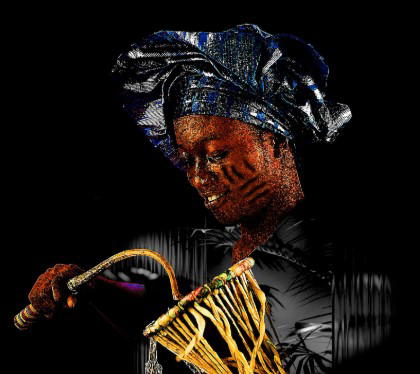
Atolagbe’s study apprehends the society in later stages of development, geles magnify and twirl complete gestures of intuitive understanding. For instance, the indigo chromatic palette in Guardian of Tradition holds weight in Aso Oke dyeing traditions. The strong light treatment suggests deliberateness in placing the image astride material and metaphysical planes. A textured metallic sheen serves to separate the human head and crown from the image while implying a postmodern interpretation. The manipulation raven calls the blur between kinship and solitude. Why have an inexplicably delighted head literally jutting out of nothing, darkness, whose wedding are we dancing to? Ignore the music for a moment; we have to determine what holds up this image. The photographic realism appears disconnected from wherever the lower region’s texture compositing is headed. Palm tree motifs blend into gradients, lettering, this is an exactitude in negative space. This time, the darkness is a genealogy of women becoming the torso of the gele, the genealogy of contorted activity, even a three-legged figure straining to save the talking drum from tipping; the darkness is really what holds everything. The music would not be heard beyond Agbo Ile, says Atolagbe. If he succeeds in stimulating us to the imposing grandeur of this remnant of a psychic civilization forcibly erased at the turn of the last century, perhaps some bystander may return in dreams with courage to attempt what no Alaafin ever dared; to look into the crown he wears, to countenance the orisha encircling the stratosphere of the people he leads face to face. Such an action was death. It would be too much light, so Olaniyi expresses in darkness instead, yet every century, audacious bystanders emerge to confront the magic of light head-on. They are scarified. Their legacies, the roadmaps to their knowledge, become words scribbled between tribal marks.
Ebri Kowaki is an arts and culture expert. His reviews and opinions have appeared in The Republic, UbuntuAfrica, Afrocritik, African Writer Magazine, and elsewhere.
Disclaimer
Comments expressed here do not reflect the opinions of Vanguard newspapers or any employee thereof.