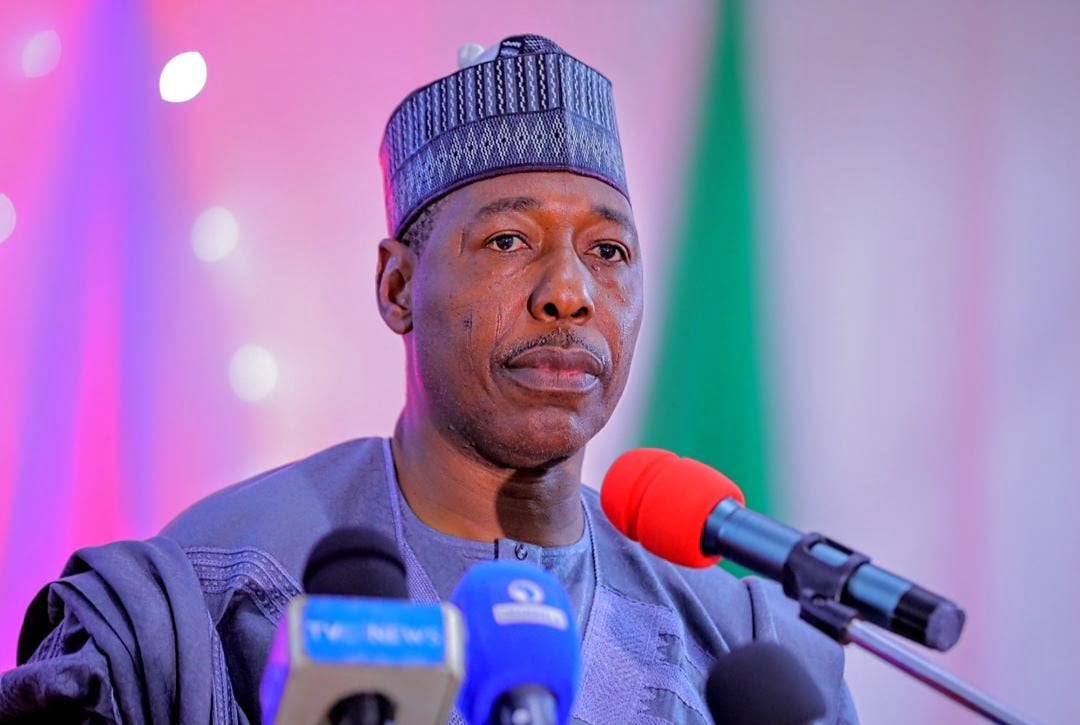
Gov. Zulum
By Ndahi Marama, Maiduguri
Borno State is witnessing a remarkable transformation in the education sector under the leadership of Governor Babagana Zulum, a professor of agricultural engineering.
Since his administration came on stream in 2019, Zulum has built upon the foundation laid by his predecessor, Vice President Kashim Shettima.
Supported by lieutenants, led by Deputy Governor Usman Umar Kadafur, the state chief helmsman has taken decisive steps to address pressing issues in the education system, aiming to uplift the state’s educational standards and provide a brighter future for its youth.
Zulum’s administration has undertaken an ambitious plan to overhaul the education system in Borno.
Central to this vision is the construction and establishment of mega-size Government Secondary and Primary Schools across the state.
These institutions are not just buildings but comprehensive educational complexes featuring 30 classrooms in two-storey buildings, administrative blocks, laboratories, sporting facilities, and alternative 10kva solar power installations. These schools have been established in Maiduguri Metropolitan Council, Jere, Biu, and almost all of the 27 local government areas of the state.
In addition to infrastructure, the administration has focused on vocational training institutes and the recruitment of thousands of teachers.
This multi-faceted approach aims to ensure that students receive quality education and that teachers are well-equipped to deliver it.
Competency
On May 6, 2024, Zulum unveiled the first phase of a free training programme at the College of Education, Waka-Biu, in the southern part of the state targeting incompetent teachers.
This move was aimed at informing the public about the true state of education and taking steps to rectify it.
During the event, which was attended by notable figures such as the First Class Emir of Biu, His Royal Highness Alhaji Mustapha Umar Mustapha, and Senator representing Southern Borno, Ali Ndume, the governor made a resolute declaration: “We will not continue with the mess; there is no going back in redeploying incompetent teachers to their proper place to change the narratives associated with decay in the education sector.”
The government approved N1 billion for the training of unqualified teachers from across the 27 Local Government Education Authorities (LGEAs).
The first phase of training included 1,949 teachers who had failed to meet the standards set by the 2019 Verification and the 2022 Competency Tests. The comprehensive training regime aims to enhance their skills and ensure they meet national standards.
Zulum said his administration did not take the steps to right the wrongs in the education sector lightly.
He said a needs assessment was carried out in 2021 which prompted the competency test for teachers across the LGEAs between January 5 and 20, 2022. The results were revealing: 10,566 teachers out of 15,823, representing 66% of all Borno primary school teachers, failed the test and are not qualified to teach. Consequently, the administration approved N1 billion for the training of 2,730 teachers, who will undergo a rigorous three-month programme at the College of Education Waka-Biu and Umar Ibn Ibrahim Elkanemi College of Education, Science, and Technology Bama.
The governor emphasized, “The primary objective of this training initiative is to tackle long-standing issues surrounding remuneration, retention, and most importantly, the competency of teachers by national standards.”
The training is provided free of charge, and participants receive a monthly stipend of N30, 000 in addition to their regular salaries. Successful completion and passing of the competency test will lead to a wage review, further incentivizing teachers to improve their skills.
Systemic challenges
The state Commissioner for Education, Lawan Wakilbe, highlighted the systemic issues plaguing basic education in the state.
He noted that the problems had escalated since the discontinuation of the direct absorption of primary school teachers from Teachers’ Colleges.
The lack of a structured employment approach resulted in salary scale discrepancies and the hiring of unqualified persons.
The verification exercise conducted in 2019 and the subsequent competency test in 2022 exposed these issues.
Misinformation
Contrary to misinformation circulating on social media, Wakilbe clarified that 796 teachers had been consistently receiving their salaries.
However, 121 teachers are experiencing issues with salary payments due to various factors such as multiple workplaces, discrepancies in age documentation, incomplete assumption of duties, and certificate-related matters.
Addressing these challenges is a priority for the administration, as they work towards a more efficient and effective education system.
On May 20, 2024, the second phase of the training programme was launched in the Bama local government area, in central Borno, with 781 teachers participating. These teachers, who had also failed to meet the 2019 Verification and the 2022 competency tests, are part of the over 2,740 educators slated for training. At the Umar Ibn-Ibrahim College of Education, Science and Technology (UIICEST) in Bama, Governor Zulum, represented by his Deputy, Dr. Umar Usman Kadafur, reiterated the administration’s commitment to revitalizing the education sector.
“This programme underscores the pragmatic policy initiative of this Government in the critical sector of education. It is strategically pertinent to note that the Government allocated a substantial sum of one billion naira (N1 Billion) for the training of 2,730 teachers,” Kadafur stated.
The three-month training programme encompasses a sandwich programme for 1,884 teachers and a full-time NCE programme for 846 teachers. Participants are provided with a monthly stipend of N30, 000 in addition to their regular salaries, and an additional sum of N50, 000 to ensure adequate preparation.
The successful completion and passing of the competency test will lead to a review of wages, further driving the professional development of teachers.
Structural reforms and fans
“Governor Zulum’s efforts go beyond immediate training and address broader structural reforms,” Wakilbe emphasized.
The Commissioner stressed the importance of a structured employment framework to mitigate the challenges faced by the education system.
“The challenges facing basic education in our state have reached critical levels, particularly following the cessation of the direct absorption of Primary School teachers from their Teachers’ Colleges. The absence of a structured employment framework has led to various issues, including discrepancies in salary scales and the recruitment of under-qualified personnel”, he said.
To address these issues, the Borno government has authorized the reassignment of untrained personnel from LGEAs to alternative roles, freeing up positions for qualified individuals.
This strategic move aims to ensure that only competent and adequately trained teachers are in the classroom, thereby improving the overall quality of education.
Collective efforts
The success of these initiatives is also attributed to the support from various stakeholders.
Dr. Gambo Saljaba, Provost of the College of Education, Waka-Biu, commended Zulum for choosing the institution as the venue for the first phase of training.
He assured that participants would receive the necessary educational training to be more effective in their roles as teachers.
The involvement of traditional leaders, such as Emir Mustapha and political figures like Senator Ndume underscores the collective effort required to drive these reforms.
Their support highlights the importance of community and institutional backing in achieving the administration’s education goals.
Looking ahead
Zulum’s administration is not resting on its laurels but is committed to continuous improvement and expansion of its initiatives.
Plans are in place to initiate Phase II of the teacher training programme, targeting those with diplomas and individuals who were unable to enroll in the initial training phase. Additionally, there are arrangements for further training through the Institute of Education at Borno State University (BOSU) for those requiring additional education and development in the area of using modern technologies and techniques of pedagogy.
There is no doubt that the administration’s approach is comprehensive and forward-thinking, especially as it addresses immediate competency issues, implements structural reforms, and plans for future training needs.
The administration is setting a robust foundation for a sustainable and high-quality education system in Borno.
Accountability
To ensure accountability in the entire process of teacher recruitment in Borno, the government has taken various steps to ensure that processes are not abused and procedures are not corrupted as was the case many years ago. One of the steps taken was the constitution of an ad-hoc committee to screen and verify submissions by LGEAs.
However, a change in the leadership of the LGEAs necessitated another circular from the management to the new education secretaries to revalidate and submit the earlier list.
The management of the education sector in Borno was written, through the Honourable Commissioner to the Deputy Director of Statistics, Ministry of Education, Science, Technology, and Innovation, by Zulum, requesting the submission of the list of NCE and graduate teachers with their current salary scales for appropriate placement, considering their experience and years of service.
“Once this data is collated, the committee will expeditiously work on it and submit it to the management for the board’s consideration and, ultimately, for government approval,” the governor said.
New dawn
Zulum’s bold and decisive actions are transforming the education landscape in Borno. By addressing the root causes of educational decay, investing in teacher training, and implementing structural reforms, his administration is paving the way for a brighter future for the state’s youth.
As the governor aptly put it recently, “We will not continue with the mess; there is no going back in redeploying incompetent teachers to their proper place to change the narratives associated with decay in the education sector.”
The journey towards revitalizing education in Borno is a testament to the power of visionary leadership, strategic investment, and community collaboration. With continued commitment and support, Borno is poised to become a model for educational excellence in Nigeria and beyond.
The meticulous processes of verification, the strategic deployment of resources, and the emphasis on teacher competency reflect a holistic approach that promises sustainable improvement.
As the ad-hoc committee continues its work and new educational leadership settles into their roles, there is a renewed sense of urgency and responsibility among education secretaries to expedite their actions. The comprehensive data collection on NCE and graduate teachers, coupled with the appropriate placement based on qualifications and experience, ensures that the right individuals are in the right positions to deliver quality education.
The appreciation and commitment from educational institutions like UIICEST, Bama, and the strong support from traditional leaders and unions highlight the collective effort to uplift the education sector.
Professor Kalli Tijjani’s assurance that participants will receive the necessary training to be effective teachers, alongside the supportive messages from the Shehu of Bama and other stakeholders, reinforces the shared vision of a thriving educational system.
Zulum’s forward-thinking approach, combined with community and institutional support, sets a robust foundation for a sustainable and high-quality education system in Borno State.
With a clear roadmap and unwavering dedication, his administration is not only addressing current challenges but also laying the groundwork for future successes. The path ahead may be challenging, but with continued commitment, collaboration, and strategic investment, Borno State is on the verge of a new dawn in education, one that promises a brighter and more prosperous future for its youth and the entire community.
Disclaimer
Comments expressed here do not reflect the opinions of Vanguard newspapers or any employee thereof.