By Prisca Sam-Duru
According to English philosopher, Francis Bacon, “Reading makes a full man; conference a ready man; and writing an exact man”.
Bacon nailed it! Reading good books offers a reservoir of knowledge on any topic; helps improve one’s communication skills; aids relaxation, etc.
It’s possible that if Malcom X were to be alive, by now, he would have taken back his quote that, “If you want to hide something from a Black man, put it in a book’. Clearly that’s no longer the case as Africans have long become champions of reading. The impressive number of legendary African writers makes nonsense of that notion since it’s difficult to become a great writer without first becoming a good reader.
Nevertheless, at some point, a decline in the reading culture of the people set in due to increase in the preference for screen and the internet. And to address that, several individuals and organisations began making strategic efforts to encourage people to not just imbibe the culture of reading, but most importantly, read quality books.
In addition to book fairs and book readings, there have been some literature prizes initiated to encourage reading as well as writers. However, many of the prizes have become extinct.
One notable initiative was the ‘Bring Back the Book Initiative’ launched by ex-President Goodluck Jonathan’s administration in December 2010. That effort at ensuring a sustainable reading culture, like those defunct literary prizes, couldn’t survive past President Jonathan’s tenure. It happened that successive governments failed to recognise the importance of reading.
Interestingly, the only literary prize that has stood the test of time is The Nigeria Prize for Literature. As it stands, the Prize sponsored by the Nigeria LNG, is Africa’s most prestigious and richest literary award. The Literary prize rotates among four genres, Prose, Poetry, Drama and Children’s literature. Nothing stopped the sponsors of the prize from focusing on the three major literary genres; Prose, poetry and drama but the inclusion of Children’s Literature in the annual competition is proof of the gas giant’s commitment to encouraging reading at an early stage.
The increase in entries for children’s literature which is the focus this 2014, is a testament to the increasing interest of Nigerian writers in the coveted literary prize. Also, it’s proof that people are reading.
Since inception, the impact of the Nigeria Prize for Literature and the Nigeria Prize for Literary Criticism, no doubt, has been felt in the book industry.
Annually, from the entries received, books are longlisted from which a shortlist made up of the best three and finally, the winner is selected. This affords book lovers the opportunity to savour the contents of these books which usually highlight diverse themes in the society, ranging from culture to politics, history, insecurity, values etc.
The prizes have also, in no small measure, encouraged more writers to come on board knowing the kind of exposure they get from submitting their works. The annual Book Party is one of the events that provide rare exposure to authors. Tagged, ‘NPL-CORA Book Party’, the event is usually held in honour of authors that make the longlist. Also sponsored by the Nigeria LNG and held in collaboration with the Committee for Relevant Arts, CORA, the Book Party gives the longlisted books the much-needed exposure as the authors enjoy a rare privilege of being in conversation with guests. It does not end there. In addition to the cash award, the winner of the competition also enjoys a book reading tour across the federation. All those are aimed at sensitizing people on the importance of literature to individuals and society at large.
The NPL is in its 20th year and this year’s competition as mentioned is focused on Children’s Literature. Already a total of 163 authors and 24 literary critics are jostling to clinch the coveted prizes which come with a cash reward of $100,000 and $10,000 for the Nigeria Prize for Literature and Nigeria prize for Literary Criticism respectively.
In 2019, 11 books were longlisted for the Children’s literature category. They included; A Hero’s Welcome by Ndidi Enenmor; Boom, Boom by Jude Idada; Buried Beneath the Baobab Tree by Adaobi Tricia Nwaubani; Double ‘A’ for Adventure by Anisa Daniel-Oniko; Ginika’s Adventures by Nnena Ochiche; Igho Goes to Farm by Anote Ajeluorou; Mystery at Ebenezer’s Lodge by Dunni Olatunde; Obioma: A Girl’s Journey to Self-Discovery by Nkiru Uzoh; She Calls Him Daddy by Oladele Medaiyese; Spurred Surprises by Lami Adejoh Opawale; and The Great Walls of Benin by O. T. Begho.
2011 saw 6 authors making the longlist out of 126 books in the same Children’s literature competition. They were; Eno’s Story by Ayodele Olofintuade; The Missing Clock by Mai Nasara; The Great Fall by Chinyere Obi-Obasi; Uche Peter Umez’s The Runaway Hero; Philip Begho’s Aunty Felicia Goes to School and Thelma Nwokeji’s Red Nest.
Past winners in the children’s literature prize were Professor Akachi Adimora-Ezeigbo (2007), author of the joint-winning book, My Cousin Sammy, Mabel Segun (2007) with her book, Readers’ Theatre: Twelve Plays for Young People; Mai Nasara (2011) who clinched the prize with his book, The Missing Clock, and Jude Idada (2019) with his book, Boom Boom. These books and more not mentioned here, all make interesting read.
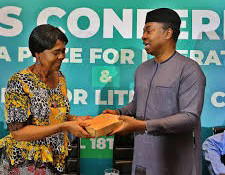
During the handover ceremony of the 163 entries received for the 2024 competition, Chair of the Advisory Board for The Nigeria Prize for Literature and the Nigeria Prize for Literary Criticism, Prof. Akachi Adimora-Ezeigbo, lauded the Nigeria LNG for not just initiating but sustaining the Literature prize for two decades.
Prof. Adimora-Ezeigbo described the NLNG as an ‘adorable company’ which has displayed high regard and commitment to the promotion of literature and reading culture.
Recalling how many other literature prizes have become extinct, the Advisory Board Chairperson praised the NPL sponsor for excelling and motivating Nigerian writers to keep writing.
She noted that the way NLNG has sustained the prize to its 20th year is amazing, adding, “There are a number of prizes that have died in Nigeria; Cadbury’s Prize, Etisalat Prize for literature, Spectrum Prize, etc; they are no more. They did not sustain the effort. We want to thank Nigeria LNG. 20 years is not easy.
We thank them for what they’re doing for Nigerian literature; for what they’re doing for Nigerian writers, for motivating Nigerian writers. Look at the number of submissions for this year’s prize; the highest so far. This means that Nigerian writers are very conscious of the opportunity they’re given by the prize, and they’re trying to improve their writing and submitting their works.”
The increase in the number of entries this year according to Ezeigbo attests to the massive interest in children’s writing by Nigeria writers. “We want our children and grandchildren to start reading as early as they can, because reading and reading good books are very important. Those of you that started reading early, you know what it did to your life. So we’re very proud that this year is for children’s literature and we received so many entries. We look forward to what the panel of judges will do.”
Also, the General Manager, External Relations and Sustainable Development (NLNG), Andy Odeh, who first highlighted The Nigeria Prize for Science and The Nigeria Prize for Literature, which were established in 2004, as NLNG’s flagship Corporate Social Responsibility (CSR) initiative, with the addition of The Nigeria Prize for Literary Criticism in 2018, added that “The Nigeria Prize for Literature is worth USD100,000 in award money while the Nigeria Prize for Literary Criticism has a N10 million cash reward.”
Both prizes he noted, “celebrate literary craftsmanship and seek to bring the literary works of Nigerian authors to the world’s attention. Generally, the prize aims at improving the quality of writing, encouraging reading of excellent literary works, and enhancing the literacy outlook of the Nigerian people.”
Odeh also expressed happiness at the warm reception the prizes continue to receive among Nigerian writers, as a testament of their commitment to improve writing in the country.
He described the handover of entries as a “Celebration of the commitment and hard work put forth by every participant. It is a reminder of the importance of fostering a culture that encourages innovation, critical thinking, and artistic expression. It is also an opportunity for us to recognize the dedication and support of those who have mentored and guided these individuals, providing them with the resources and inspiration to achieve greatness. We look forward to the outcome of the adjudication process, and the eventual announcement of the winners of the prizes, come October 2024.”
Regarding the adjudication process which began immediately after the handover of entries, the line up of a panel of judges and international consultant as explained by Adimora-Ezeigbo can produce nothing less than excellence. She has the support of other members of the Advisory Board; Prof. Olu Obafemi and Prof. Ahmed Yerima, to ensure the best author is laurelled in October 2024.
Professor Saleh Abdu, a professor of English at Federal University, Kashere, Gombe State, chairs the panel of judges for this year’s literature prize and the literary criticism competition. He has taught courses mostly in literature at various levels. Other panel members include Professor Vicky Sylvester and Dr. Igudia Osarobu. Professor Sylvester is a writer who has been teaching at the Department of English, University of Abuja. Her prolific writing career has produced numerous award-winning novels, poems, and academic works, While Dr. Osarobu is a Doctor of Philosophy at the Department of Library Archival & Information Studies, University of Ibadan, Oyo State.
The International Consultant for the 2024 edition of the Prize is Professor Christopher Okemwa, a lecturer of poetry and drama at Kisii University, Kenya. Prof Okemwa has published over 10 children’s books, winning the 2015 Canadian Burt Award for African Literature (Kenya) with one of the books. He is the founder and director of Kistrech Children’s Literature Association (KICHLA) of Kenya.
Disclaimer
Comments expressed here do not reflect the opinions of Vanguard newspapers or any employee thereof.