By Victor Ecoma
Prof. El Anatsui turned 80 in February 2024; he is a contemporary African artist with global reputation whose art practice is a model for study.
His works have elicited consensus opinion among world’s leading art experts as a global artist whose works have peculiar expressions and revolutionary consciousness, and among the most inventive and experimental in the 21st century which defines sculpture in new ways of what can be an installation, a painting, textiles or tapestry of some sort.
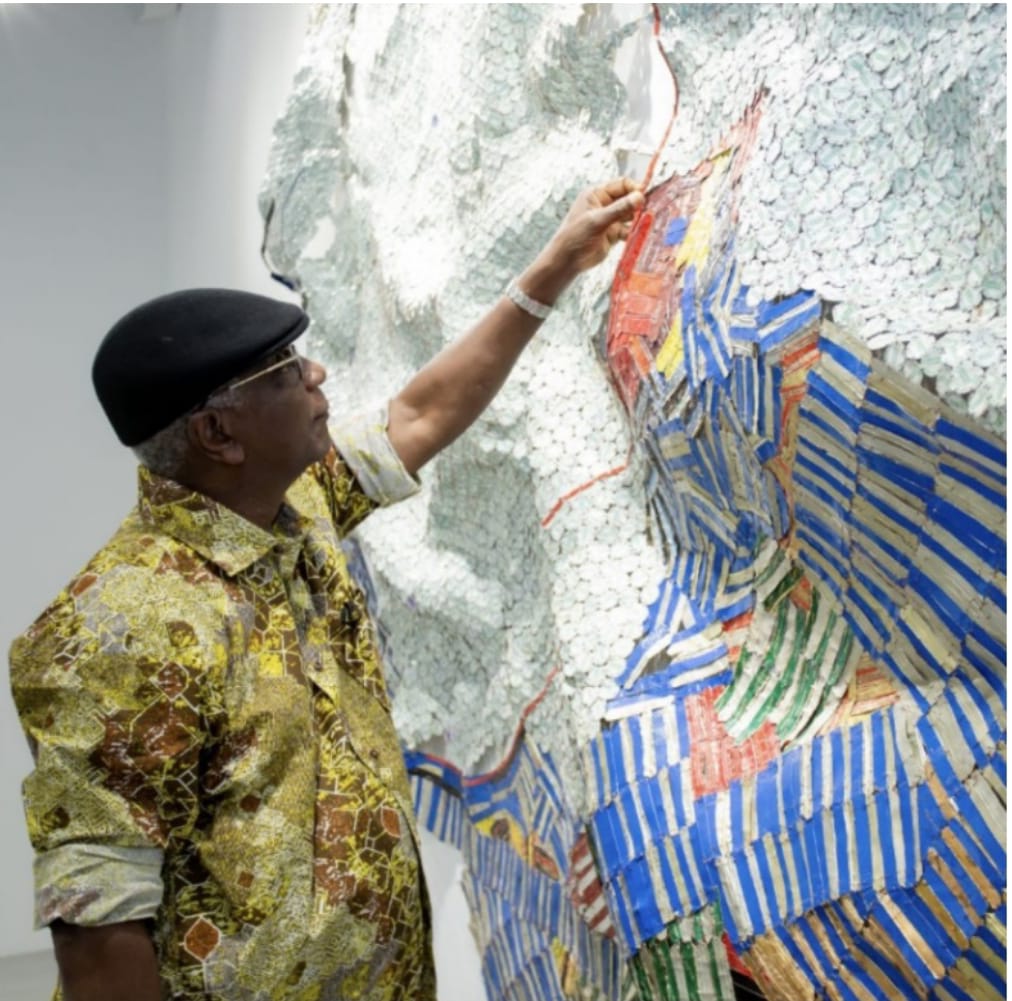
His career has been crowned by the Golden Lion award in 2015 at Venice Biennale for life time achievements in art and he was included in the 2023 Time 100 list of the world’s most influential people.
El’s art career spans over four decades with exhibitions across all continents of the world harvesting honours, awards and works in major collections of the world’s greatest museums, galleries and institutions such as The British Museum, Museum of Modern Art, NY, Metropolitan Museum of African Art, NY, The Centre Pompidou, Paris, The World Bank, Washington DC., Osaka Museum kunst palast, Dusseldorf, Osaka foundation of Culture, Osaka, Smithsonian National Museum of African Art Washington DC, and several others including Nigeria’s national gallery of art.
Anatsui hails from Ghana and spent most of his teaching career at the University of Nigeria, Nsukka where he taught sculpture. I first encountered his carved wooden panels in 1987 exhibition of the Aka group of artists held at the Institute of African studies of the University, the same year I was admitted as a direct entry student in Department of Fine & Applied Arts. The exhibition made a lasting impression on me as the first highly organized professional art exhibition I had ever seen. The Nsukka Art School beyond research, explorations and experimentations into Igbo uli motifs developed the exhibition and its catalogue system as central to the art programme, and as a critical tool for highlighting the social value of art and placing it in public spaces.
The principles that sustainably unleashed El’s ambitious successes were not simplistic as he journeyed through long valleys that preceded his peaks. He developed skills and competences through trials of different materials, media, tools and techniques that gathered momentum over time and have crystallized into acute lessons for generations of artist to follow. His non-linear professional evolution was characterized by studio work habits of investing most of his time in studio productions resulting in corpus of works in sculptures, ceramics sculptures and installations which yearned to be exhibited.
READ ALSO: NUGA Games: UniJos gets new sports complex
He exhibited his corpus of works right from the rural Nsukka environment to Enugu urban, to metropolitan Lagos and to cosmopolitan cities across the globe London, Paris, Dusseldorf, New York, Tokyo, Venice, Seoul, Sydney etc, etc. Art exhibitions remained the high point of his career success and contributions to art with unremitting regularity which transitioned from months into years and decades of production and networking in the art world. In 2005 when I was writing an article on the Aka group I visited him in his university residence, I enquired how his art career got to the point it had.
He asked if I had exhibited in Lagos, I said no, he said you should. In 2014, while I attended the world anthropological conference at The British Museum, I took time off to visit the October Gallery which promoted El’s works and met Elizabeth the artistic director and we met again at Nsukka in the exhibition in honour of El Anatsui as an Emeritus Professor.
Anatsui’s oeuvre was inspired and shaped by Zik and Nkrumah’s Pan Africanism ideology which also found expression in the motto of University of Nigeria, Nsukka, “knowledge to restore the dignity of man”. In Anatsui’s creative search to restore the dignity of man he drew his central theme from African history, its cultures, peoples and ecology through exploring a range of traditional symbols, cultural materials of wooden trays, broken pots, drift woods and modern sculptures carved with chainsaw, burnt, incised and painted and later metal caps which were either crushed, folded or crumpled and sewn together with copper wire which metamorphosed into an assemblage of monumental metallic cloth wall.
His oeuvre spoke eloquently about Africa’s contact with the West, the slave trade, colonialism and westernization. Most Africanist scholars, including my humble self have maintained that the contact remained lopsided in favour of the West, and disruptive of indigenous ways and means. However, in his creative enterprise El has produced prodigious masterpieces such as Leopard’s paw prints and other stories 1991, Erosion 1992 and the series of works shown in Gravity and Grace exhibition 2010.
Anatsui’s search for creative freedom found expression in decolonization which emphasizes creative use of local materials in his immediate environment. He constantly advised against the burden imposed by the use of imported art materials which are not readily available and expensive. El proposes the idea that artists can do better if their expressive means are readily found in their immediate environment and at a minimal cost, and that such advantages can up scale the size of their works in a most expressive way that daze spectators.
Visual arts education is not limited to learning how to read and write but also training in the use of the hands and the mind to think. This is highly exemplified in Anatsui’s works in his application of critical thinking by being observant and finding workable means of dealing with various materials. To Anatsui nothing is useless, it is a matter of reasoning out how it could be repurposed with new life and meaning. He positions the sculptor as a critical thinker who must think creatively in using objects around him to seek new interpretations. He picks up discarded bottlecaps, plans in his mind the purpose it could serve, arranged the colours into interesting schemes and blew up their sizes into an assemblage of compositions that shocks the world.
El is an enigma documented in several books, art exhibition catalogues and films whose monumental bottlecaps installations have created jobs and markets for many young people and families in Nsukka environment and beyond. We pray that Almighty God grants him long life in good health to artistically continue to engage humanity.
Prof. Victor Ecoma FRAI, FSNA, FIIA
Department of Fine & Applied Arts,
University of Calabar.
Calabar.
Disclaimer
Comments expressed here do not reflect the opinions of Vanguard newspapers or any employee thereof.