By Ayo Onikoyi
Amid the rising tide of global innovation powered by artificial intelligence and data-driven science, a Nigerian physicist is making a profound mark in the United States with cutting-edge research that blends theoretical physics, computational modeling, and AI to solve some of the world’s most complex challenges.
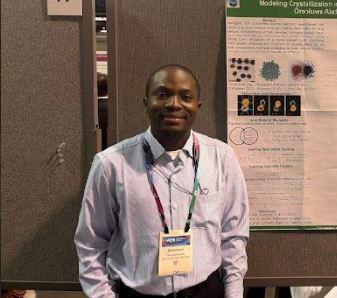
Oreoluwa Alade, a Ph.D. student in Physics at North Dakota State University (NDSU), has emerged as one of the few young African scientists pushing the frontiers of computational soft matter physics and artificial intelligence.
Sharing his story with our reporter, Alade detailed how his academic journey from Akure, Nigeria, to North Dakota is fueled by a singular mission: to use science and technology as tools for building a smarter, more resilient future.
At the heart of Alade’s research lies the simulation of compressible microgels — tiny, soft particles with applications ranging from biocompatible implants to climate-resilient construction materials. In crowded environments, the behavior of these microgels becomes increasingly complex, posing major challenges for researchers worldwide.
Alade’s work aims to decode this complexity using high-level computational modeling and predictive analytics to simulate their interactions with unprecedented accuracy.
“These materials can adapt, heal, and respond intelligently to their environments,” he explained.
“My simulations help us understand how to optimize their properties for real-world applications — whether in medical implants that integrate better with human tissue or in smart materials that repair themselves after stress or damage.”
But his scientific contributions extend beyond the microscopic realm. Alade is also making strides in computer vision and artificial intelligence. His recent work on AI-based object detection enhances how machines interpret distorted or warped images — a major challenge in autonomous navigation and security systems.
His algorithms — designed to improve detection in fisheye lens imagery — have been submitted to IEEE and could impact the development of smarter, safer autonomous vehicles and advanced surveillance technologies.
Alade’s work has already caught international attention. He has presented at multiple prestigious conferences, including the International Soft Matter Conference, the APS March Meeting, and the APS Global Summit, where he showcased his findings to global scientific audiences.
His presentations have been praised for their depth, clarity, and relevance in today’s fast-evolving scientific landscape.
Despite his demanding research schedule, Alade remains deeply committed to community and mentorship. He serves as the President of the Community of Nigerian Students at NDSU and is also the Vice President of the Graduate Physics Student Club (Grad Phi) — a role in which he helps foster a collaborative and supportive environment for fellow graduate students.
Beyond campus, he mentors junior researchers and volunteers as a judge for international science fairs, encouraging younger minds to pursue careers in STEM.
Reflecting on his journey, Alade says his drive comes from a desire to change narratives — both about Africa’s role in global innovation and about who gets to shape the future.
“We belong in these spaces,” he says.
“We’re not just users of innovation — we are creators of it. And our ideas are shaping the future of science and technology in ways the world is just beginning to see.”
Disclaimer
Comments expressed here do not reflect the opinions of Vanguard newspapers or any employee thereof.