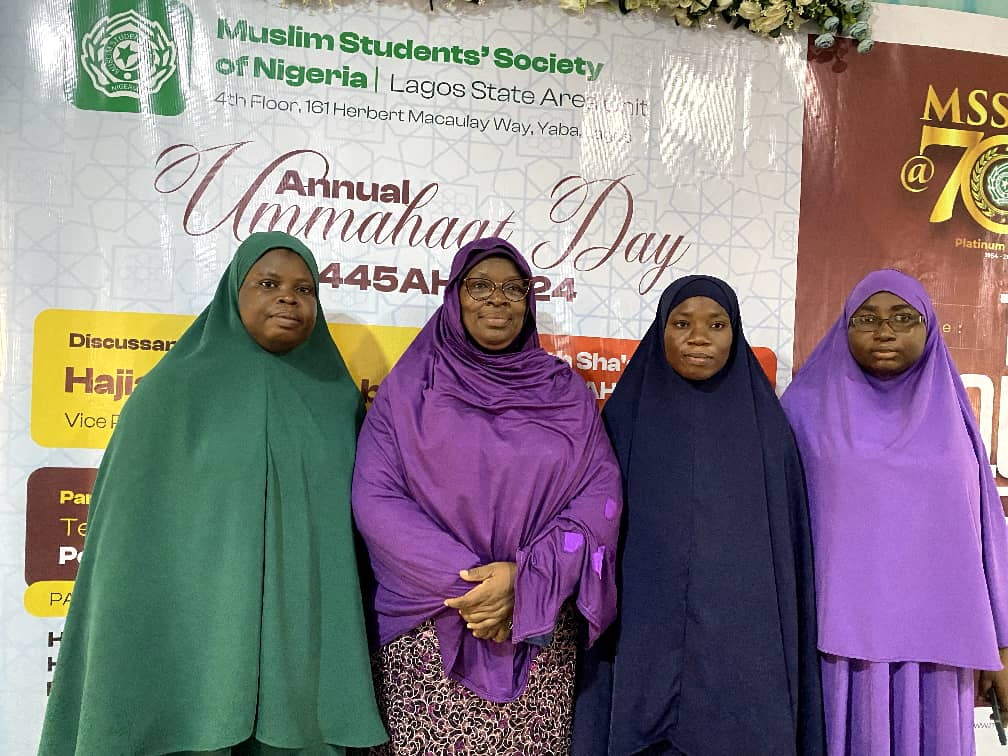
*Urges Mothers to set priorities right
*As MSSN holds Ummahaat day
By Zikrullah Balogun
Mothers have been advised to set their priorities right and consider good parenting as the bedrock of stable and developed society.
The advice was given by Muslim women professionals during the annual Ummahaat organized by Day of the Muslim Students’ Society of Nigeria (MSSN), Lagos State Area Unit held at the AS Badeh Event Centre, Nigerian Armed Forces Resettlement Centre (NAFRC) in Oshodi recently.
Different speakers who spoke at the event concluded that good parenting would help in creating pathways to leadership deficits plaguing the country, adding that the children of today if properly trained will become good leaders of tomorrow.
The guest lecturer, Hajia Basirat Rabiu said Muslim mothers have to be unique because Islam provides a guideline for them to work with to do things differently.
“The unique shepherd we have come to discuss here uniquely means parenting; doing what other parents are not doing to achieve success. As Muslims, we are unique because we have a manual that we work with. By so doing, we are bound to do things differently from what other people are doing.
“The Prophet has made us understand that we are all shepherds. Specifically, he gave the role of child upbringing and management of the home to the mothers. So, it’s a unique responsibility handed over to the mothers. Men can of course be of assistance, but the women have the duty. The mother should guide, nurture, train, discipline, inspire and educate the children.
“To become a unique shepherd, Muslim mothers need to first of all train themselves. They need to prepare themselves for motherhood before the children start coming. If not, one will be learning on the job and making a lot of accidental errors. So, we need to train ourselves and get counsel before getting married, to know the task ahead, ” the guest lecturer said.
“Every mother needs to bring up their children with good values. Look at the case of Prophet Isa (A.S), from his grandmother to his mother and himself. That shows the implication of doing the right thing. If you raise a girl badly, she ends up being a bad mother. So, we all need to be conscious of this. We should take motherhood as a priority.
“However, for Muslim sisters to achieve all these, they can’t do it alone. No one lives in isolation. We need to revive our communal lifestyle and become a shoulder for each other to lean on. Of course, there are bound to be challenges in raising children, even the prophets of Allah faced challenges. So, we need to seek help. The era of being shy to seek help is gone. We need to speak to the right people to get solutions to whatever challenges we are facing.
“Above all, there is no way a Muslim mother can become a unique shepherd without relating positively with Allah. Our relationship with Allah must be good. He is the one that provided us with the children.”
Also, in a panel discussion, speakers dissected the topic: “The Unique Shepherd: Nurturing our Teens and Tweens,” offering deeper perspectives to the issue.
Hajia Shafi’i Bushrat, a panelist, said mothers need to set their priorities right, bearing in mind that their primary assignment is to take of the children.
“There is no gainsaying we need money to take care of them. But we should put money and the economy in their rightful place, and not place them above training our children. While we were growing up, it’s not that most of our parents were very rich but the little they had, they were able to manage and they succeeded in training us. Women, especially, need to set their priorities right. They should give quality and enough time for the children. They should not allow materialism to prevent them from contributing positively to the lives of their children.”
Also, Hajia Sekinah Surakah Aderibigbe said there are still more gaps to cover in terms of parenting in the country.
She said Muslims need to understand the kind of family they want to build and the children they want to raise. All these should inform their choice of marriage.
“Mothers should not just be spiritual alone. They have to be aware emotionally, physically, socially and learn a lot of things that have to do with parenting. Even the best parents also learn. Learning is a continuous process. Ultimately, we also need to pray to Allah for guidance. Children of prophets and righteous ones also misbehave. So, we should turn to Allah to seek help.”
On her part, Hajia Ameenah Yunus Alli posited that most parents did not prepare for the impacts of digital technology in their lives and families.
“People don’t have time for one another in the present world. We assume that when we Facetime, Snapchat and WhatsApp, it’s enough as a contact, but there is a lack of human connection. So, quality time between people is missing, and of course, quality time between parents and children is missing. We are currently dealing with this hustle culture that everybody has to make it. So, we are not paying enough attention and showing enough affection for one another,” she added.
Earlier, Naibatul-Amirah (Umma haat Affairs) and Ummahaat Coordinator, Hajia Balqees Owolewa said the theme was chosen after consideration of the high level of moral decadence and criminality in the society.
This year, we are privileged to delve into a subject that resonates deeply with every parent’s heart “The Unique Shepherd: Nurturing our Teens and Tweens.” As we embark on this journey together, let us begin by acknowledging the pivotal role that mothers, the ummahaat, play in shaping the future generation of our ummah(society). In the fast paced and ever changing world we inhabit, the challenges of parenting adolescents often seem daunting. However, it is precisely during these critical years that our guidance and support are most crucial.
According to her: “There is kidnapping like never before, robbery, prostitution, fraud and all sorts of immoralities and crimes. Those found guilty of all these immoralities were once children who grew up in particular homes. It means their parents failed in proper parenting. We hope to bring the awareness of people to proper parenting with this conference,” she said.
Disclaimer
Comments expressed here do not reflect the opinions of Vanguard newspapers or any employee thereof.