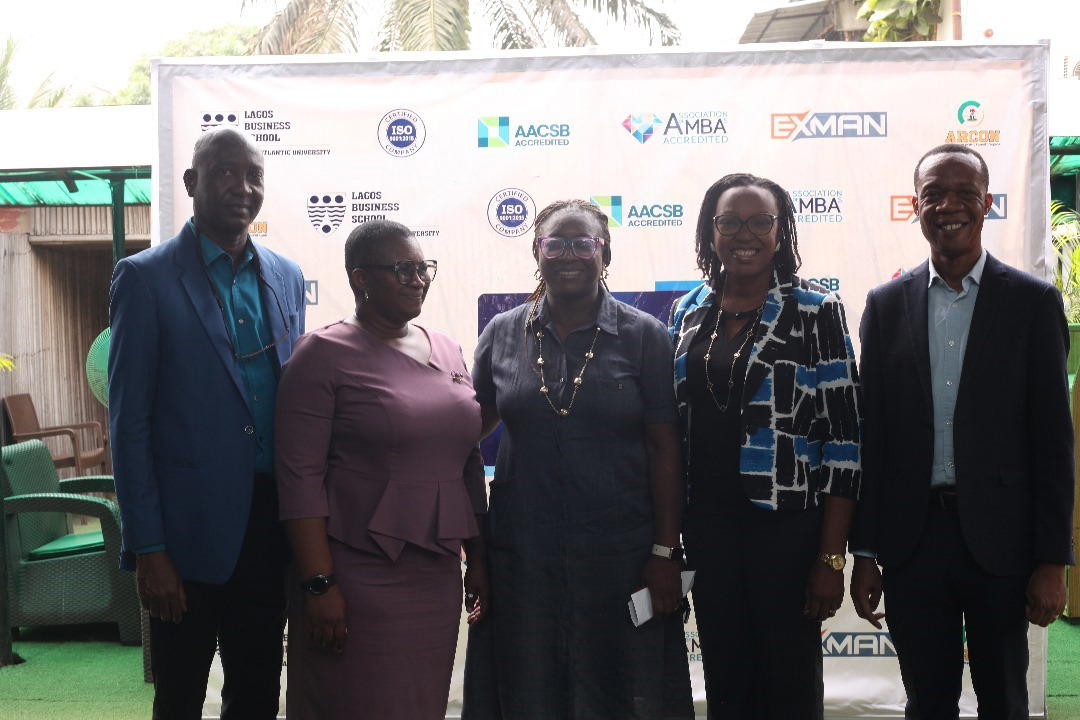
-From left: Ndanusa Amihere, Financial Secretary; Angela Makinwa, Vice President and Tolulope Medebem, all of the Experiential Marketers Association of Nigeria (EXMAN) and Nsima Ogedi-Alakwe, Chief Marketing Officer and Prof. Uchenna Uzo, Academic Director, both of the Lagos Business School, at the press conference to announce the partnership between EXMAN and LBS in deepening knowledge of the former’s sector, in Lagos.
By Tunde Oso
The experiential marketing industry is facing mounting challenges globally and in Nigeria as it works to establish itself as a critical part of the marketing mix.
A lack of understanding of what experiential marketing entails and its value proposition has hampered broader adoption. Many marketers and brands still view it as a novelty rather than an essential strategy. This knowledge gap has made it harder for agencies to win clients and justify budgets.
“Most time we have to actually start explaining what experiential marketing is to people. A lot marketing people, a lot of client and brand people need to understand what experiential marketing is all about,” said Tolulope Medebem, President of the Experiential Marketers Association of Nigeria (EXMAN), during a recent industry event.
The issues hampering the industry have been compounded by Nigeria’s economic downturn. With consumers more selective in their spending, brands have tightened budgets. For experiential agencies heavily dependent on events, concerts and activations, the impact has been severe.”One of the challenges we faced in 2023 as an ecosystem was actually financing,” Medebem noted.
The squeeze on margins and rising costs have forced some agencies out of business. The number of briefcase agencies has proliferated, as individuals seek any work they can find. This casts the industry in a poor light.
To strengthen the industry, EXMAN has partnered with the prestigious Lagos Business School (LBS) to launch an Experiential Marketing Management Programme. The first of its kind, the curriculum aims to equip agencies, brands and young talent with the knowledge, skills and insights to excel in experiential marketing.
Areas covered include strategy, creativity, research, data analytics, return on investment, new technologies and more. A key goal is providing the expertise to deliver memorable consumer experiences and quantifiable business impact.
According to LBS Professor Uchenna Uzo, the programme will achieve three objectives: “The mindset shift which is working with all the key stakeholders of this ecosystem of the experiential marketing to embrace new knowledge and insight about what it takes to be precise in capturing these Nigerian consumers.”
The second is collaboration, by bringing together the industry’s various players to find common ground. The third is action, arming participants with strategies to implement immediately and succeed.
For EXMAN, the programme is an opportunity to professionalize the industry and raise standards. “At the end of the day, we say EXMAN is actually a body of core professionals who believe in what they do and stand behind their mess,” said Medebem.
The programme also aims to develop local talent. With over 70% of Nigerians under age 30, experiential marketing presents an avenue for employment and entrepreneurship.
“This gives us the opportunity to teach young people about experiential marketing, help them through experiential marketing to create wealth, have a purpose, because every opportunity can be turned into a gold mine,” noted Angela Makinwa, EXMAN’s Vice President.
As the industry evolves globally, new challenges are emerging. Experiential agencies must incorporate digital elements and data-driven insights. Some fear AI could make human creativity redundant, but players believe the personal, sensory nature of experiential marketing ensures people remain at the center.
“Robot is just garbage in and out, they can’t think outside what you process for them meaning that our job is still creatively secured and we can think outside the box,” said Olayiwola Jegede, EXMAN Publicity Secretary and Managing Director, IMMind Limited.
With its immersive brand experiences and memorable consumer engagement, most industry leaders believe experiential marketing’s potential is just being unlocked, and see growth ahead if the structural challenges can be addressed.
This is considering that in today’s crowded marketplace, brands face an uphill battle connecting with consumers and differentiating themselves. This has indeed, elevated the importance of providing memorable and shareworthy brand experiences.
Indeed, experiential marketing has emerged as a critical strategy for brands seeking to engage consumers on a deeper, more personal level and foster brand loyalty. By activating across touchpoints like events, pop-ups, immersive environments and more, experiential campaigns trigger powerful emotional responses and give consumers agency in interacting with brands.
According to studies, over 80 percent of consumers say a positive brand experience influences their perception, while 72 percent will share these experiences with others. In effect, consumers become brand ambassadors.
For brands, experiential marketing drives more word-of-mouth promotion, increased sales and stronger affinity than conventional ads alone. Active participation also means consumers develop a personal stake in the brand.
In Nigeria’s youthful, expressive culture, experiential marketing resonates strongly when done right. Brands like Guinness, Airtel, Pepsi and Red Bull have created defining experiential campaigns targeting new consumer segments.
As Medebem, notes: “With anything that has to do with experiential, EXMAN is very well known in Nigeria. In this harsh economy time, they have an important role to play because they are the one who are very close to the heart of the customers in terms of how they create experiences that will encourage more patronage and feedbacks to the brands.”
Yet, despite its advantages, experiential marketing faces hurdles going mainstream in Nigeria. A lack of understanding of its strategic value proposition persists among marketers and brands. It is still viewed as a novelty by some.
That is why the partnership with the LBS has been seen as the right step in the right direction. For EXMAN Vice President Angela Makinwa, the curriculum will enable practitioners “retain that seat on the table” with brands by delivering data-led ideas and “making our bottom line better.”
Disclaimer
Comments expressed here do not reflect the opinions of Vanguard newspapers or any employee thereof.