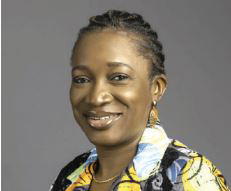
Nnoli Akpedeye
Engr. Nnoli Akpedeye is the Chief Executive Officer of Contego Servo Limited, an organisation that provides project management, mediation and training services in the energy sector; and Perfectus Laundi Limited, a major player in high-tech, specialized dry-cleaning and laundry services. She also serves as Director on the boards of an NGO, a shipping company, and two real estate organisations.
She is a graduate of Civil Engineering and holds a Masters’ degree in Business Administration. She is a COREN registered engineer, a Fellow of the Nigerian Society of Engineers,FNSE, a Project Management Institute-certified Project Management Professional (PMP), among others.
Nnoli Akpedeye is a past President of the Association of Professional Women Engineers of Nigeria (APWEN) and a passionate Science, Technology, Engineering and Mathematics (STEM) ambassador.
In 2013, she launched the “Introduce a Girl to Engineering” programme for secondary school girls in Nigeria. Her passion to impact Nigeria’s business landscape by motivating and mentoring young people especially females to develop and commercialise innovative technology solutions is embedded in her 37 years experience.
Why do you think there are more female entrepreneurs today?
Actually, we have always had a significant number of female entrepreneurs in the informal sector; and it is great to see the huge uptake of women-owned businesses in the formal economy.
Firstly, with the high unemployment rate in Nigeria, most people have defaulted to entrepreneurship, simply for survival. The new generation of females are challenging traditional expectations of the past and the global focus on DEI is forcing our society to recognise and value diverse perspectives, thus giving female entrepreneurs enhanced visibility, support and promotion.
There is a plethora of ring-fenced, women-focused funding initiatives by corporate and government agencies, as well as crowdfunding and angel investor platforms specifically targeted at female entrepreneurs. Also, with the advent of digitisation and advancements in technology, several opportunities exist for women to start businesses with fewer barriers and constraints. Work-life integration is easier for female entrepreneurs as they can create businesses that give more flexibility and autonomy. Additionally, entrepreneurial role models are more visible, which serves as inspiration for others.
Although progress has been made, female entrepreneurs still face challenges of access to funding due to inadequacy or the seemingly unachievable pre-requisites/pre-conditions. Unfortunately, gender bias, discrimination and sexual harassment are still rife in many sectors; and government policies in support of female entrepreneur are lacking or, where they exist, ineffectively implemented.
Is the increase in the number of female entrepreneurs a positive shift or a way of hindering more women from being in the boardroom or attaining management positions?
The increase in female entrepreneurs is definitely a positive shift and not a way of hindering women from reaching boardrooms or attaining management positions. I daresay this reflects a broader trend toward greater gender equality and empowerment.
A female business owner will invariably be the managing director which automatically makes her a board member; and as CEO, she occupies the most senior leadership position in the company. What we need now is an exponential increase in the number of women in executive leadership and boards of male-owned companies!
The rise of female entrepreneurs is a welcome development that is critical for the economic growth of Nigeria. However, it should not view as a hindrance to women’s advancement in traditional leadership roles. Instead, efforts should be ongoing to promote gender equality across all sectors, ensuring women have equal opportunities to excel in entrepreneurship, executive leadership, and on boards of directors.
Gender inequality in the workplace is huge. As a CEO, why do you think, this is so?
As a female CEO, I cringe when I see companies that have all-male board of directors and c-suite executives. This is happening in many Nigerian organisations where DEI (diversity, equity and inclusion) is ostensibly a high priority in their business strategy!
Gender inequality in the workplace is a complex issue that is deeply rooted in social, cultural, and organizational factors. These include unconscious bias, stereotypes and societal norms, discrimination and sheer lack of representation of females in leadership positions.
I am a standard-bearer for gender parity, promotion of equal opportunities and the deliberate, relentless implementation of DEI policies. I applaud and celebrate women in leadership and I am confident that the days of male-dominated leadership teams shall become history in this decade.
How close are we to surmounting gender bias?
In Nigeria, one requires an engineering degree from a university to qualify to practice and be referred to as an Engineer. At university, there is no difference between what is taught to the female and male students, so we all receive the same education to become engineers. This then begs the question, why should there be a distinction between female and male engineers since as far as academic qualification goes, there is no difference? The tensions or challenges principally arise from perceptions, stereotypes, gender discrimination, and cultural issues; and in some cases, lopsided organisational policies and practices.
Unfortunately, even in today’s world, some people (male and female) still believe that engineering is not a good career choice for females because they perceive the profession as being too rough and strenuous for women. This erroneous view derives from their perception that engineers mostly work in harsh, remote environments without the comforts they believe women need. Such people are still actively discouraging their female children and wards from becoming engineers.In our culture, ‘the man is the head of the household’, so when a female engineer becomes a leader/manager, some male subordinates have a hard time deferring to her authority.
This category could either try to circumvent the female leader’s instructions, display passive resistance or actively work against her. The lack, inadequacy or poor implementation of policies/contract provisions is also a challenge. For instance, where remote site accommodation does not provide for separation of men and women, it becomes a hindrance for female engineers to get very crucial practical experience. In some cases, such provisions are absent from policies/contracts or where they exist, are not being enforced/implemented.
Disclaimer
Comments expressed here do not reflect the opinions of Vanguard newspapers or any employee thereof.