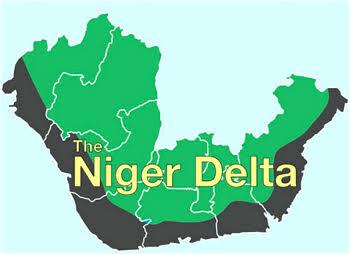
Delta State map
By JEROME-MARIO UTOMI
AN African proverb states that ‘from the way the chimpanzee walks, seamlessly reveals that it is not a happy animal’. Likewise, if a visit is made to the crude oil bearing communities in the Niger Delta region of Nigeria, such a visitor will discover without doubt that they are not happy people. This visible unhappiness is rooted in lingering underdevelopment, degradation and brazen neglect by state actors and private interests, which characterises the environment.
Essentially, this concern over the poor environment partially explains the repertoire of literature covering the various epochs of the region. Part of the literature is written objectively to ‘genuinely address the development challenges of the people while part of the literature was tilted to satisfy some sectional and personal interests’.
To arrest the drifting situation and address the protracted underdevelopment, successive Federal Governments in the country at different times and places created institutions to assist in tackling the underdevelopment and other challenges that characterize the zone.
These institutions and agencies (past and present) include (but not limited to) the now rested Niger Delta Development Board, NDDB, created in the 1960s; the Oil Mineral Area Development Commission, OMPADEC (also rested); the Niger Delta Development Commission, NDDC; the Ministry of Niger Delta Affairs and the Presidential Amnesty Programme, PAP; among others.
The above efforts and initiatives notwithstanding, analysts believe that the frustration, marginalisation, alienation and poverty in the region stems from, and have their root in a piece legislation that makes oil minerals the sole property of the Federal Government of Nigeria in section 44(3) of the 1999 Constitution which, in part provides that the entire property in and control of minerals, mineral oil and natural gas in, under or upon any land in Nigeria or in, under or upon the territorial waters and exclusive economic zone of Nigeria are vested in the government of the Federation and shall be managed in such manner as may be prescribed by the National Assembly.
In fact, there are signs that unless something is done to holistically serve and save the people of the region from infrastructural backwardness and other multifaceted challenges such as galloping youth unemployment, chances are that in the near future, crisis that may unnerve the people and cause the region to erupt in rebellion may occur.
What the above information tells us as a nation is that more work needs to be done and more reforms to be made, particularly by the government to assist douse the doubt which presently flourishes within the region.
The facts are there and speak for it.Take as an illustration: At a recent summit held in Delta State, with participants, drawn from the academia, specialised groups, presidential amnesty beneficiaries, students at various institutions of higher learning in the country, among others, to proffer solution to the Niger Delta challenge, the gathering queried the Federal Government’s current non-participatory approach to development in the region, as well as its protracted inabilities to embrace a broad-based consultative approach that will give the people of the Niger Delta some sense of ownership of their God-given resource.
While noting that the challenges confronting the Niger Delta as a region dates back to the 15th century, the gathering submitted that to effectively resolve the Niger Delta crisis, government and other Nigerians should begin to see the problem of the Niger Delta as a national one and not restricted to the region.
Participants were particularly not happy that greed, selfishness, tribalism and brazen absence of political will arising from poor leadership in the country, has become potent factors that derailed the well-conceived Presidential Amnesty Programme, PAP, created to tackle youth restiveness resulting from galloping unemployment in the region as well as hindered the actualisation of Federal Government proposed but now abandoned modular refineries in the region.
Noting that for the challenges presently confronting the region to be frontally tackled, the Federal Government must take both practical and pragmatic steps to hold a sincere conversation with Niger Deltans aimed at operationalising modular refineries in the region anchored on the tripod of receipt system, transparent pricing and supervised via a statutory body established by enabling acts for that purpose/objective.
They further regretted that 14 years after the presidential proclamation, the programme has neither dealt with the fundamentals of the Niger Delta struggle nor faithfully addressed the three pillars of the Amnesty Programme: Disarmament, rehabilitation and reintegration; but painfully left the targeted beneficiaries of the programme more as victims of political deceit and manipulation by selfish politicians and other non-state actors that have recently hijacked the programme.
While they observed that the amnesty programme had become a cesspool of corruption and avenues for revenue leakages which must be blocked for efficient management of the programme, the group argued that the Presidential Amnesty Office must stop giving handouts to beneficiaries and in its place develop a workable and democratised roadmap that will ensure that all amnesty beneficiaries are gainfully employed or adequately empowered.
The gathering, therefore, called on the Federal Government to strengthen PAP to achieve its original Strategic Implementation Action Plan designed to massively develop the Niger Delta, which unfortunately has been ignored for a very long time by the Federal Government.
Still on the urgent need to have PAP revamped for optimum delivery on its mandate, this piece considers it imperative that the Federal Government and other relevant stakeholders critically x-ray the concern recently expressed by Alabo Nengi James, second National Vice President, Ijaw National Congress, INC, at a function held in Warri, Delta State where he, among other fears, noted that PAP is failing in its responsibilities because it was executed with militarisation,
•Utomi, the Programme Coordinator (Media and Public Policy) at Social and Economic Justice Advocacy, SEJA, Lagos, wrote via: [email protected]
Disclaimer
Comments expressed here do not reflect the opinions of Vanguard newspapers or any employee thereof.