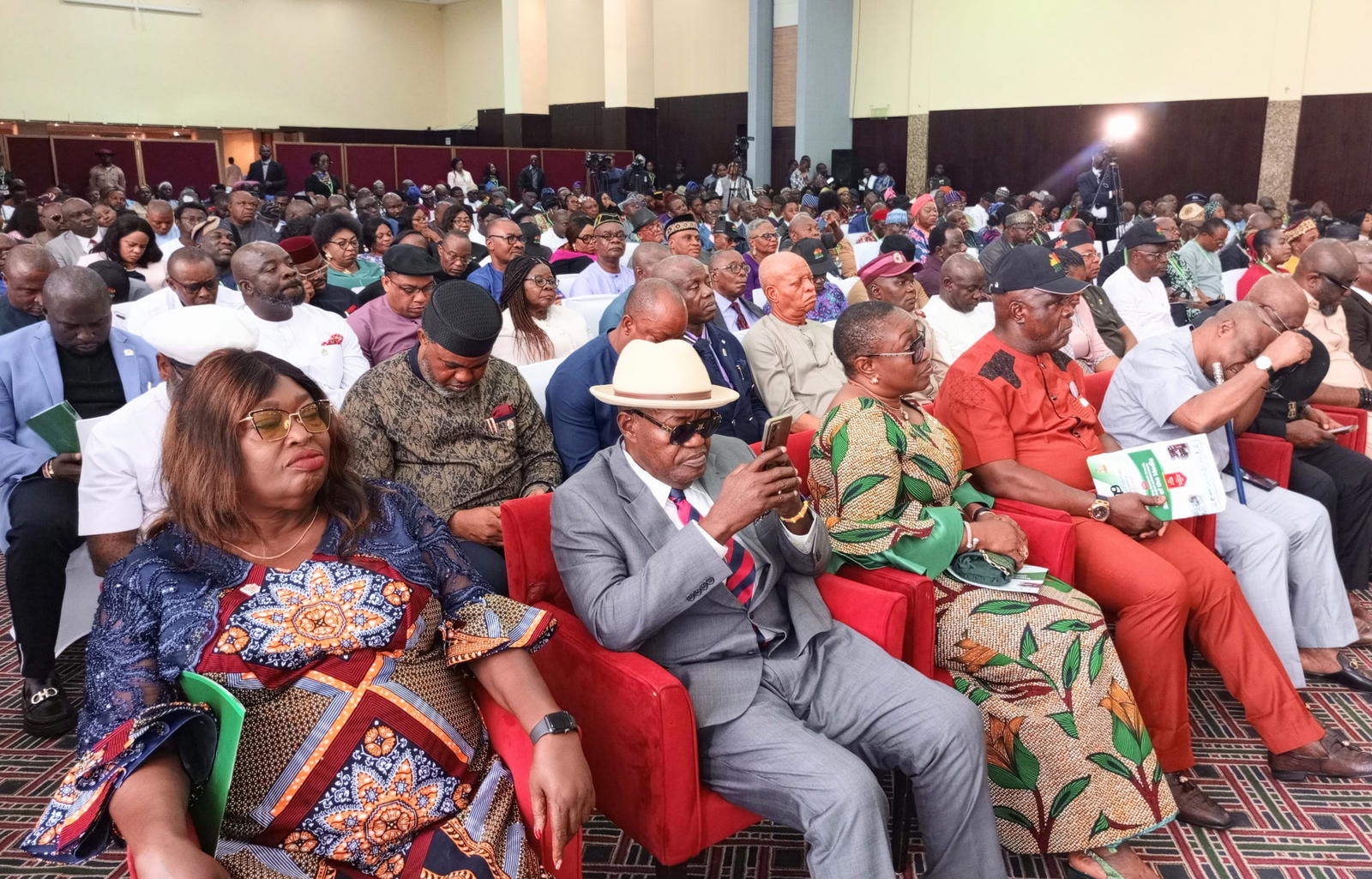
Cross Section of Participants during 19th All Editors Conference in Uyo Akwa Ibom state Yesterday. Photo. Nwankpa Chijioke.
•More security operatives being killed than civilians over Nigeria’s insecurity -Ribadu •Politicians, greatest threat to Nigeria’s electoral process – Amadi •Stakeholders seek respect for media ethics, rejig of NBC law, regulations
By Egufe Yafugborhi & Chioma Onuegbu
UYO – Stakeholders at the ongoing 19th annual conference of the Nigerian Guild of Editors, NGE, yesterday interrogated national security, threats to elections, and media reforms, with the National Security Adviser, NSA, Mallam Nuhu Ribadu, saying security agencies were paying the price, losing more men than civilians over the raging insecurity in the country.
The NSA addressed participants on Day 2 of the conference in Uyo, Akwa Ibom State, said the trajectory of the nation’s insecurity was allowing Boko Haram, banditry, Niger Delta and South East unrest to fester too long.
He also noted that in the dynamics of insecurity in Nigeria, kidnapping had replaced armed robbery because people no longer carry cash about.
He pointed that oil production was under 1.2mbpd due to the security situation in the operating environment, Niger Delta, before the coming of President Tinubu and that just over five months after, production had leaped to 1.7mbpd.
“This insecurity has and still benefitting some persons, no doubt. They feed from it, but there are also people who are working, honest, staking their lives, the security agencies and others. The president is committed to changing the narrative and being transparent.
“I can tell, because I know, that in this fight, more soldiers, police and other security agencies are being killed than civilians. That is a fact. People are placing their lives on the line. Some of us may not appreciate this because we don’t know, but I know, and they are working. We are working.
“Going forward we intend to run an open and transparent government. We also appeal to you (Media) for support. We are all this together”, he asserted.
Sharing the blame on elections of rancour
Setting the ball rolling for the first paper of the day, “2023 General Elections Assessment of Political Landscape: Election Monitor’s Perspective”, Chairman of the Session and Founding Partner, Newswatch, Ray Ekpu, noted that though elections were over, the avoidable chaotic fallouts had refused to go away.
Ekpu said: “The elections are gone but the remnants are still there, the vituperation still there, and Nigeria is struggling to overcome it. Our (media) role in the election is as important as the role of other people involved in it, the security people, INEC, the Judiciary and so on.
“In our various publications we used to say ‘all eyes are on INEC’. And as elections were over we then shifted it and say ‘all eyes are on the Judiciary’. Now at the national level the Judiciary has finished with its job. And I think we never said, all eyes on the media’.
“But there were number of eyes on us and the point is, did we do our job properly fairly, ethically, professionally? That is something we need to talk about because that affects the trajectory of our profession and the perspective of our profession.
The paper presenter, activist and political scientist, Chima Amadi, said politicians, drunk on ‘winner takes all’ mentality, posed the greatest challenge to the electoral process and democracy in Nigeria.
Amadi also knocked security agencies, the media, judiciary, the Independent National Electoral Commission, INEC, and civil society organisations, CSOs, for lapses in the discharge of their duties which also compromise the elections process.
He said: “It is ironic that politicians pose the biggest threat to the democratic process. The winner takes all nature of our political system means that politicians gain the most incentives to subvert the process. And over the years they have demonstrated the willingness and desperation to subvert it.
“The ingenuity deployed by politicians to subvert, to seek out the loopholes in the legal and regulatory framework is enormous. And their determination to find the gaps in the process cannot be over-emphasized.
“It is the politicians that have designed the process of vote buying to circumvent innovation of card readers and BVAS. It is the politician that offer monetary inducements to stakeholders in the electoral process including the security agents and staff of the electoral commission.
Amadi, who thanked the leadership of the Guild for inviting him to give the presentation at its 19th ANEC, said such conferences were important because they helped shaped the national conversation.
Assessing the role played by key stakeholders in the election processes in the conduct of the 2023 elections, he said: “Stakeholders that worked in the electoral ecosystem can be categorized into about six groups – the media, the electoral umpire, security agencies, civil society organizations/observer groups, politicians and the judiciary.
He noted that lack of capacity in one of the groups, however, does not stop others from functioning, blaming all for failing in one way or the other in their role in the process.
Particularly for the media, Amadi said mainstream media gave too much room for social media to bombard the political space with fake news, propaganda while also knocking media for concentrating reportage of less important issues with minimal focus on key issues that could have averted a lot of irregularities observed and experienced in the elections, an observation faulted by some unconvinced Guild members.
While commending the positive role some CSOs play during elections, especially in encouraging voter turnout, carrying out voter education and sensitisation ahead of election, Amadi regretted that there were instances some CSOs promoted fake news or attacked political opponents and , thus heightened tensions.
Other presentations included that by Richard Akinnola who dwelt on ‘Media Law, Ethic And Imperative of Professionalism and a panel discussion on the Broadcasting and National Broadcasting: Identifying Areas for Reforms.’
Both presentations in the last session tasked editors and their respective media teams to remain guided by ethics, especially the principles, doctrines of fairness and balance, in carrying out the social responsibility of mirroring society and holding government accountable to the people, even against the burden of existential threats to the survival of the media..
In brief opening remarks, Founder/Publisher of Vanguard Newspapers and Chairman of the Conference, Sam Amuka, appreciated participants for active participation.
“It is nice that we all waited for this second day. After this meeting, we should all work together for the good of the country,’ he said.
A communique is expected from the deliberations ahead of Day 3 on Friday (today) on the event which will feature the Guild’s inspection of projects of host Akwa Ibom State and a Gala Night.
Disclaimer
Comments expressed here do not reflect the opinions of Vanguard newspapers or any employee thereof.