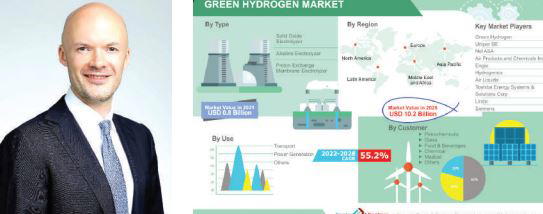
Fedotov
By Prince Osuagwu, Hi-Tech Editor
Green hydrogen is one of the world’s great keys to meeting growing energy needs. Strong hydrogen demand growth and the adoption of clean technologies for its production are set to drive global decarbonization efforts, particularly in more challenging sectors, such as heavy industries and transport.
The Middle East and North Africa appears to have latched on the opportunities to not only develop their societies but to keep their environments green and safe.
The regions are playing major roles in the development of the global green hydrogen industry and supply chain.
A MEED Intelligence report, shows North African nation Egypt has invested in projects worth $63.8 billion, while Oman follows with projects worth $48.9 billion. Saudi Arabia and the UAE have invested in projects worth $10.5 billion and $10.28 billion, respectively.
The Gulf is already home to some of the largest and most advanced hydrogen projects; from the NEOM Green Hydrogen Project in Saudi Arabia which is touted to have the capacity to produce 1.2 million t/y of green ammonia for export, to Oman’s green hydrogen auction process, which awarded five large-scale projects in its first round, totaling $30 billion investments and 750 ktpa green hydrogen production.
Egypt recently signed an MoU to build a green hydrogen factory in the Suez Canal Economic Zone, which will produce 20,000 tonnes of green hydrogen a year, with investments worth $8 billion.
Such investments will not only generate regional income streams and help secure energy supply, but also promote economic diversification.
However, in a recent chat with senior vice-president and head of Europe, Middle East and Africa at AVEVA, Mr Evgeny Fedotov, he mentioned that while huge natural resources in Middle East and Africa can help drive the global energy revolution, only cutting-edge technology and particularly data connectivity will retain the rescillience.
He shared his views, towards a decarbonized future: “In future, hydrogen-powered vehicles could improve air quality and promote energy security. Hydrogen can also store energy from renewable sources, making it a crucial component of the transition to a low-carbon economy. Ultimately, a globally sustainable and reliable non-fossil fuel energy system could be realized through hydrogen, using renewable energy sources instead of fossil fuels like natural gas.
Yet, given the diverse networks within the global energy ecosystem, ushering in the green hydrogen era will require a considered approach. How we produce, transport, and consume green hydrogen needs to be broader and encompass more stakeholders. Such efforts call forrigorous regional and global collaboration.
Challenges of supply to large markets
The global green hydrogen economy is challenging because it is as yet uncharted. To succeed, its burgeoning ecosystem will need to be able to adjust to unique requirements and many unsettled elements. Optimizing production will rely on visibility across the value chain. Ultimately, it will be down to data connectivity to optimally power global green hydrogen.
Leveraging data for ecosystem visibility
Improving how green hydrogen is processed and ultimately used by the consumer will require extrapolating insights from existing plant projects, learning more about the yields from our most viable technologies, and deciding the role that utilities companies will play in tomorrow’s green hydrogen ecosystem.
Today’s software solutions can help save costs and optimize hydrogen plant efficiency by collecting and measuring operational data of plant infrastructure through embedded IoT devices. These data inputs are used to recreate digital-twin models of plants to optimize operations and yield improved plant performance. Across the world, swathes of individual industrial plants are already incorporating digital twins into their daily operations.
An example can be seen in German engineering giant Thyssenkrupp, which has been commissioned to construct an 88-megawatt water electrolysis plant for Hydro-Québec – one of the largest hydropower suppliers in Canada. The plant will produce 11,100 metric tons of green hydrogen annually. Both the hydrogen and the oxygen, a by-product of the electrolysis process, will be used to produce biofuels for the transportation sector.
ThyssenKrupp’s engineering team is using AVEVA Engineering software in green hydrogen plant design, together with AVEVA PI System data to optimize operational design. By using data visualization tools ThyssenKrupp is able to increase operational efficiency, improve collaboration and drive sustainability throughout its design process and project execution.
Connecting up dots for green hydrogen
On a regional and worldwide scale, connecting up the hydrogen ecosystem creates a path to quicker plant set up, cost-effective operations, and production efficiency.“Engineering advancements today have to be matched with a unified common data infrastructure to create positive outcomes for everyone. Through optimized data flows and accessible data across the value-chain, the Middle East’s green hydrogen ecosystem will be given the best opportunity to flourish.
Disclaimer
Comments expressed here do not reflect the opinions of Vanguard newspapers or any employee thereof.