By Chukwuma Ajakah, edited by Osa Amadi
Tuesday, 15 August 2023 was a day of joy for the entire Lagos State University, and specifically for Prof. Bolanle Olaitan Opere, Professor of Microbiology at the Department of Microbiology, Faculty of Science, Lagos State University. It was the day Prof. Opere delivered her inaugural lecture titled “Microbes in the Environment: Unseen Femmes Fatales and Virtuous Saviours”.
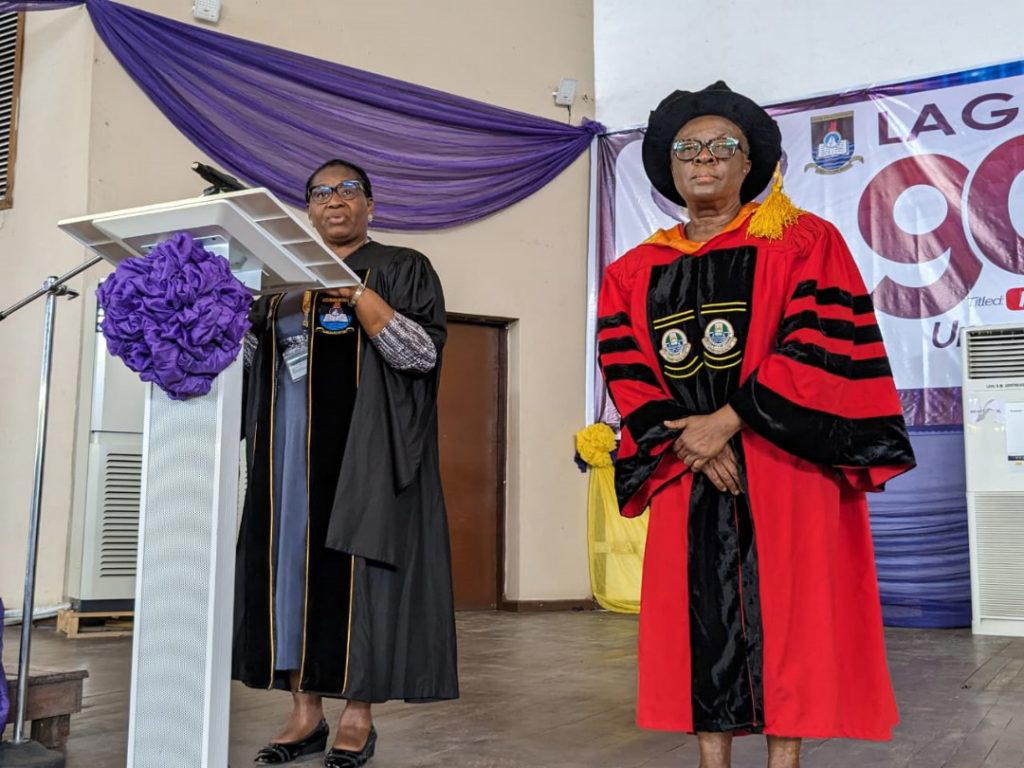
An inaugural lecture is a public academic ceremony which celebrates the lecturer’s appointment to professorship.
While speaking at the inaugural lecture (which is the 90th in LASU) held at the Buba Marwa Auditorium of the university, the eminent academic revealed that microbes are more of virtuous saviours than what she called femme fatales (deadly or lethal) as widely believed.
“As a microbial ecologist, my research on Microbial Diversity in soils, foods, plants, as well as inanimate objects that man often gets in contact with through objects such as computer keyboards and mouses, telephones, shopping charts and door handles, has shown microbes to be femme fatales as well as virtuous saviours, but more of saviours than femme fatales.”
From extensive field studies she has conducted in her discipline, the renowned scholar revealed that “microbes, which are the smallest living things and ubiquitous, have found applications in several fields, including medical sciences, agricultural sciences, engineering and geology.”
She explained that factors such as changing lifestyles, industrialisation and rise in population have culminated in the advent of pollutants that cause deterioration in the environment and human health.
Notwithstanding the overwhelming ecological challenges, Opere maintained that many microbes are indeed beneficial, a few detrimental, and the majority harmless or free-living. “In a possibly depressed economy, it is time to exploit the vast opportunities in the field of microbiology for national development as it is not possible to escape the microbial world,” she counseled. “Microbes will remain relevant to us in several ways such as food, food supplements, drugs and antibiotics, source of fuel, electricity, green chemicals, and normal residents of our bodies,” she said.
Prof. Opere observed that although microbes notably cause problems in many sectors, they are agents for the restoration of contaminated environments and treatment of diverse man-made wastes. She argued that microbes create opportunities that could be harnessed through collaborative research among various disciplines, as it provides businesses and jobs for microbiologists, agriculturists, lab scientists, doctors, nurses, pharmacists and engineers.
With regards to the harmful aspects of pathogens, the erudite scholar recommended that food vendors, health workers and their customers, as well as the generality of the people, should cultivate healthy lifestyle, including being hygienic. “Regular sanitization, using chemical cleaners is important in the prevention of pathogenic microbes from contaminating telephones and computers, and should be done periodically in companies, banks and other institutions,” Opere said.
Furthermore, based on her findings which revealed that large number of persons such as food dealers in open markets (bukas) and meat sellers at abattoirs rarely observe basic tenets of hygiene, Opere implored the government and regulatory agencies to put appropriate measures in place in order to checkmate the activities of individuals and institutions who contribute largely to the prevalence of such pathogens and environmental pollution. “The government should put in place measures to safely dispose of antimicrobial waste from food, human health, animal health systems, and manufacturing facilities,” she advocated.
Prof. Opere also suggested that “there should be a reduction in the amount of antimicrobial waste entering the environment, and safe disposal of antimicrobial waste from food, human and animal health systems, farms, manufacturing facilities, hospitals, and other sources.” She argued that fewer chemical fertilizers should be used to increase agricultural production in a more economically and environmentally sustainable way.”
Dignitaries at the auspicious event included the Vice Chancellor, Prof. Ibiyemi Ibilola Olatunji-Bello; the Registrar, Emmanuel A. Fanu; Deputy Vice Chancellor (Academics), Deputy Vice Chancellor (Administration), Provost of the College of Medicine, Dean of the Faculty of Science, deans and members of other faculties, guests from diverse walks of life as well as students of the university.
Disclaimer
Comments expressed here do not reflect the opinions of Vanguard newspapers or any employee thereof.