
International advocacy group Global Citizen held its annual thought leadership forum: Global Citizen NOW Summit last month at The Glasshouse in New York City where the group launched a refocused climate action campaign known as Power Our Planet. Bringing together a powerful and diverse group of stakeholders and interests on a global level, the campaign indeed has the vision and framework to re-invigorate efforts around climate change and action existentially.
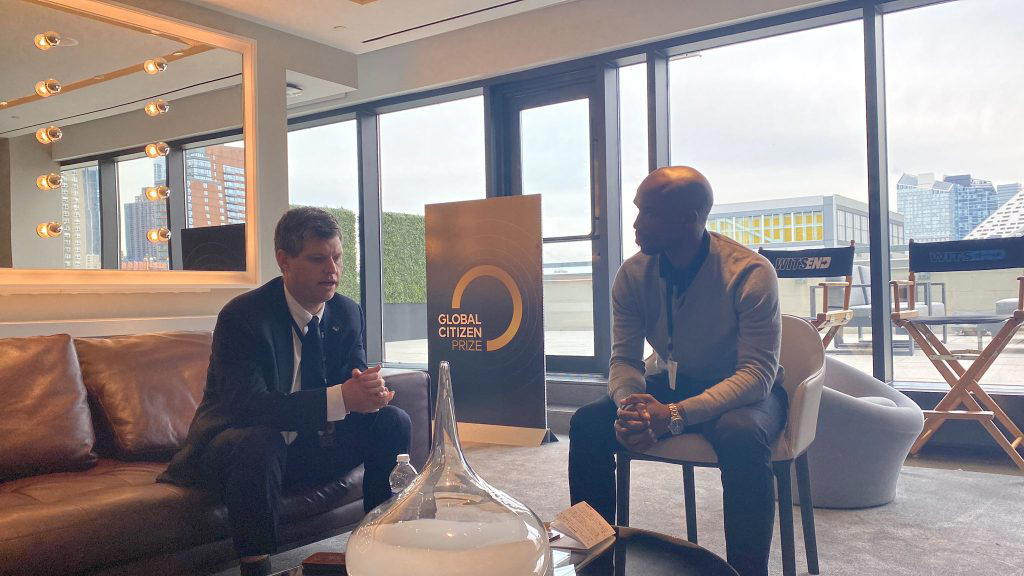
Special Projects Lead at Vanguard Media; Tuoyo Amuka was present and had a discussion with Michael Sheldrick (Co-founder & Chief Policy Officer at Global Citizen) on expectations of the new campaign and current happenings in the global climate action sphere.
Good morning Michael, firstly kudos to yourself and the rest of the team on the launch of this laudable initiative. As Global Citizen refocuses its overall strategy to spearhead climate action pointedly with the ‘Power Our Planet’ campaign. What has informed this?
Michael: Well, I’ve always had the belief that climate change and ending extreme poverty are two sides of the same coin, right? This whole idea that, you know, one is somehow separate is really a false dichotomy. Let’s take Malawi for example, which only last month experienced the longest-lasting hurricane in history, Cyclone Freddie which lasted an incredible five weeks and killed over 1000 people. It struck at the same time that Malawi was also experiencing its worst ever outbreak of cholera. And so, these injustices of climate change twinned with injustices of health inequity are really at the root of the Power Our Planet campaign, which is premised on the recognition that they come down essentially to the same thing; the basic lack of solidarity in our global financial system.
To give countries the means to be able to address both climate change and extreme poverty. Because if we don’t do that together, you can’t address extreme poverty, without taking action on climate change. Why? Because climate change, as it gets worse, will disproportionately impact the world’s poor first and foremost. I’ve seen farmers in Sierra Leone, in Zambia and other places talking about the impact of unpredictable rainfall. I’ve met with farmers in Fiji who talk about increased extreme weather events and the impact on their crops right. At the same time when we talk about action on climate change which is about fundamentally reducing emissions, reducing our carbon footprint, that cannot come at the expense of also giving people energy access, because energy is life.
You need energy to power near everything. And right now, there are 600 million people across the African continent alone who live in energy poverty and don’t have access. So really, the fundamental idea behind Power Our Planet is how we can address climate change in a way that also doesn’t mean we have to trade off people’s economic development. And this means being able to give them access to the money needed in order to provide citizens with clean, affordable electricity. Thus the two twin pillars of the Power Our Planet campaign, are to give countries access to the funds they need to quicken their transition to clean energy, while also enabling them to develop their resilience to be able to withstand natural disasters. First and foremost, we are now asking countries to keep the promises they have already made.
The pledge of $100 billion was to have been met three years ago. It’s still not been delivered. It’s led to a whole rupture of trust between the Global North and Global South. And it’s very hard to ask countries in the Global South to adopt access to clean energy without meeting our own promises to enable them to do it.
Prime Minister Mia Mottley of Barbados who spoke yesterday made the comment that she’s going to have to exploit and extract her country’s natural gas because that is critical for their revenue structure, now unless someone is going to pay her to keep that gas untapped and in the ground. She may simply not have a choice. And so, we all have to recognize that action on climate change and extreme poverty go hand in hand and it starts with making sure countries have access to the funds they need in order to adapt and mitigate.
Climate finance is evidently a very critical element of the climate action matrix. So how does Global Citizen intend to secure greater commitment from the private sector in its drive to really engender climate action?
Michael: The private sector, first of all, has a key role to play in reducing our carbon emissions. 80% of the world’s industrial emissions come from the private sector. And that’s why Global Citizen over the last few years has been calling on companies to sign on to the race of zero. What is the Race to Zero, what it’s really saying is we need you to commit to reduce your carbon footprint in line with science . We’ve had some of the world’s largest companies respond to that and agree to sign on; Delta Airlines, Procter & Gamble, Cisco also.
Now we’re seeing companies start to publish Transition Plans, actually saying, okay, this is how this is how we’re going to do that. But our point is, it doesn’t stop there. Companies also should see themselves as playing a role in helping to meet the finance shortfall that emerging countries are facing in order to be able to reach their own climate targets. And so for example, we see opportunities for companies to come together and form coalitions that will enable them to obtain carbon credits from structured sources. What we’re saying is to source high-quality carbon credits from producers in the Global South; farmers in Zambia should have access to that finance because they are contributing to a global public good, if they are stewarding the land, if they are maintaining forests, they should be able to be compensated for that. And we see there’s a win-win situation for the private sector and the financial sector, Wall street and other places.
These institutions are big financiers of projects across developing countries The challenge is, if you’re a country like Barbados, and you have a loan with an institution, a hurricane hits, what happens, you’re responding to that hurricane, and you’re paying off your debt, It’s just not right, and it’s not fair. And so, we’ve been promoting this idea. You would have heard Prime Minister Mottley talk about it, Natural Disaster clauses.
The idea is that banks and others who make loans to countries in the Global South should basically agree in their contracts. If there is a hurricane or a drought or other extreme weather event that has a significant impact on our country’s GDP, then debt repayment should be paused for a period of time to allow that country to bounce back, to allow that country to be able to respond, and to ensure that that country isn’t trapped in a vicious debt cycle, where it means that they’re paying more on debt repayment than they are on say, education and all the other things public budgets are vital for and so we see an important role for the private sector to step up. Also ahead of President Macron’s summit in Paris, we have issued a robust call to action for the private sector to step up and respond. At the end of the day, it’s not just the right thing to do. It’s also smart business sense. Increasing number of published studies show a strong correlation between companies that have set ambitious climate-oriented goals and financial performance,
Is Global Citizen open to partnerships and alliances with other advocacy structures in achieving these lofty objectives? More specifically, shall I say UNITO or UNICEF Maybe UNDP?
Michael: Yes. Partnerships are as you’ll see here at the summit a core ingredient of our model. We have here civil society, artists, government representatives, foundations. Often, it’s not just about bringing different players together. It’s making sure they are playing the right and most impactful role. A good example of this is actually something that was birthed at the Global Citizen NOW summit last year and it’s a great example of the power of a convener like this. This is the gender menstrual equity accelerator.
This was launched onstage at the Global Citizen Festival last year. But it really had its genesis in conversations backstage with Procter & Gamble, the Gates Foundation, Miss Universe, India, and it was really around the fact how do we accelerate action on the fact that 500 million women and girls around the world live in period poverty; one in five girls who go to school here in the U.S don’t have access to sanitary napkins and tampons, believe it or not. And so often, this becomes a hindrance to their education. This accelerator, which was formed by these different partners is both about putting this on the agenda, and about really saying, Okay, how can we bring everyone together to solve this common problem. Our goal is to try and mobilize $50 million from the private sector and philanthropists towards that. But in that accelerator, Global Citizen is a facilitator bringing partners together around it. Saying this is the role you can play and that’s the effective part. And I believe that shows the power of bringing people together. This is another important point as well, the essence of partnership also means you may not agree with someone on everything. And that’s okay. You may not agree with everyone on this issue.
But at the same time on this issue over here, maybe you can create common cause and find a way forward. And I think that’s really important, especially in a divided world we live in, that we keep the channels open for dialogue. And so here at Global Citizen now, I’m thrilled that we also have quite a diverse gathering here of people from many different geographical locations, many different backgrounds, and many different types of organisations.
What challenges does Global Citizen currently face in moving the needle on climate action and how is it resolving this?
Michael: I think a big big challenge is the fact that this promise of $100 billion hasn’t been met. Part of the challenge is that it’s very hard when you speak to countries in the Global South about the need, because they also need to act on climate change and the reality is whether we like it or not. Although it may be unfair, if everyone followed the same pathway to industrialization that the West followed, we will burn the planet. And it seems very hard to get a consensus on action, without that trust being restored. So, I think one of the biggest challenges is the fact that trust is a scarce commodity these days, it doesn’t exist. A big part of our role is to rebuild. And what we’ve said to the COP28 presidency (which will take place later this year in Dubai) and President Macron is do not underestimate the significance of meeting that $100 billion pledge. It’s not enough. And we need, as you would have heard, we need to go from billions to trillions. But without meeting t all of these other promises will lack credibility. People just won’t trust them because they’re like, well, if you haven’t met your existing promises, how can we have faith that you will deliver on them? So, the good news is this, we’ve crunched the numbers. And this is achievable, you know, my own country Australia, announced a couple of weeks ago, $280 billion to purchase nuclear powered submarines. I’m not arguing either for or against the merits of that. But I would point out the cost of them meeting their fair share towards the 100 billion goal is less than the cost of just one nuclear powered submarine. So that’s what I say to my friends, colleagues in government in Australia, this is something we should be able to do.
2030 is seven years away, there remain a lot of gaps in the attainment of the Sustainable Development Goals. As well as the disparity between the Global North and South, some would say continuing to grow. What does the future look like in this regard? And how does Global Citizen see its role in this matrix?
Michael: I would say whilst 2030 seems a long way away – if you take climate change, for instance, you know that we have to half the world’s emissions by 2030. We still haven’t stopped the increase in emissions. They still haven’t peaked! So firstly, in the next two years, we really need to cap emissions. That is, they need to start decreasing and that’s going to be very hard. The President of COP28 in Dubai later this year has said we need to basically slash emissions 7% annually and this is an incredibly hard thing.
This comes back to what I’ve been saying and what you’ve been hearing which is at the root of the Power Our Planet campaign is this idea of financing, right. And those decisions are really decisions that need to be made now and the money needs to flow right now, it can’t be caught up in World Bank bureaucracy. The good news is, is we’re now seeing, a generation of leaders that understand this, new leaders as well, I’m optimistic that the US nominee for President of the World Bank; RJ Banga likely to be approved over the coming month, he said on his listening tour he’s heard that the World Bank could be doing more. For instance, through a number of reforms, the World Bank could be taking on a little bit more risk, which is okay. It could unlock – by some estimates – between 500 billion and a trillion dollars for the just energy transition.
At the same time, we need to make sure this doesn’t come at the expense of all the other development priorities. One of the organizations present here that we’ve been working a lot with is the International Fund for Agricultural Development. So, bring it out as a big partner there. They are here as part of their fundraising campaign to mobilize support as well. And if you look at what this constitutes, they’re looking at mobilizing support for farmers on the frontlines of climate change. So, they can obtain resilient crops, purchase equipment, have access to loans. I believe Agriculture is very important in the climate action sphere. Not only can it directly address the global food crisis, which was exacerbated by the war in Ukraine. But if we have more food being produced elsewhere, especially in Africa, which could become a major breadbasket, not just for the continent, but the world, it could also become a major source of income for jobs. The President of Zambia has talked in the past about how Zambia could be a net exporter and producer. So you see the solutions are there, in many cases, a very common sense, but we need leaders to get behind them and champion these common-sense solutions. Our challenge is making sure that this year, we move from promises to delivery on these pledges because we know what needs to be done.
COP27 saw the agreement to the establishment of loss and damage form, what does that truly look like and how achievable is it? Permit me to say when it comes to the climate discussion there have been a lot of commitments and deliverables that have not been met. What do you see the practical emergence of this loss and damage fund looking like? And if you would advise stakeholders? What would that advice look like?
Michael: The loss and damage fund is a commitment that is really yet to be realized. It’s an agreement to establish a fund that has no money and I think you know that without sustained pressure and advocacy; your loss and damage fund risks go in the same way as all these other commitments, it risks ending up like the $100 billion climate pledge or the commitment to double financing for adaptation or it could be met but actually the money is not new. It’s just money taken from somewhere else. It’s fancy maths and economics, shuffling of the decks. I think the real question around all of these commitments, including the loss and damage fund is where is the money going to come from? and that’s what we really have to crack this year. Some of that money might be concessional. But really what loss and damage is about at its core is compensation for countries and vulnerable communities that did little to contribute to the causes of climate change but are now facing the impact of it. So let’s just say a country experiences drought, a hurricane or some other climate induced event, it destroys its economy by more than 5%.
There is an argument that as well as concessional financing, said country should have access to grant-based financing. Such that it can rebuild and is not pushed behind. The idea is, it’s unfair to be pushed behind. Thus there are a series of proposals on the table right now because we need more money. Do we have to look at new forms of taxation? Do we have to look at taxation such as financial transaction taxes? There’s a whole number of proposals out there.
There’s the global solidarity tax, which focuses on fossil fuels, especially with record level profits currently being enjoyed. But regardless of where it is, the big question that advocates need to be asking is, where’s the money going to come from? We need to generate new sources of finance and we need to push our institutions. And this needs to be done with laser type focus and speed. Our biggest issue at the moment is we have a summit dedicated to this issue in Paris in a few weeks which President Macron is hosting and there is very little being said about it. I have been to capitals around the world; Toronto, São Paulo, Washington D.C.. no one is talking about this. So, if people’s awareness of the summit is low, how can we expect them to deliver on the money that’s needed. This comes back to the genesis of the Power Our Planet campaign. It’s a recognition that unless we citizens aren’t talking about it, raising our voice in our own cities, in our own countries, it’s very hard ultimately, to expect that a conference cart for negotiators to go in there with the mandate needed to deliver on the money, because at the end of the day, politicians will tell you, “I need permission to spend”. So, we need to give them permission to do that.
Final question. It’s really interesting how you segued into an awareness position. As my last question is; what role does the media play in helping Global Citizen and other stakeholders achieve these objectives?
Michael Sheldrick I would say the media plays a powerful role. I think if you look at climate change, it clearly has led to this sense of, okay, we’re in a crisis and we need to act. And I think the media on many levels gives us that sense of urgency but not on all issues.
For example, when the war in Ukraine started last year, there was an impact on African communities, as President Akufo Addo of Ghana said when the bombs fall on Ukraine, they also fall in Africa. From the perspective of rising hunger levels, the alarm bells needed to be sounded. That’s why it’s important, you have media advocates inform the citizenry. You can go to your local journalists, you can go to your local radio station,this is where civil society and advocates come from, and the media provides the platform.
I would say though, that now, you know, it’s great to raise the alarm bells. But we also need to be solution-oriented as we need to give people hope as well. Because there is a risk if we give people the sense that it’s over. And there’s no hope because it’s doom and gloom, and our fate is sealed. It can be very demotivating.
Then it’s hard to expect people to act and so we also need to share stories of success. And there are a lot of stories to be proud of such as the fact now that solar and wind energy is far cheaper to produce and deliver in the US than coal. The economics of coal mean that really in many countries around the world it is just not economically viable anymore.
The question is how fast does this happen? You’re also seeing countries switch to electric vehicles. Well, in some countries that have access, others still need access but you are now seeing a pathway where it is possible to imagine a society which is 100% powered by electric vehicles. We are starting to see major progress on the technology side and also witnessing these powerful forms of consensus being formed. The challenge is all about the speed with which it happens. But we do need to share those stories of hope and of optimism. We also need to share when we have wins as there is a need to report back on the impact as well. That’s one of the most powerful things we can do.
Katharine Hayhoe who wrote the book Saving Us, she makes the comment that when we take an action, and even if it’s in our own personal livelihood, one of the best things we can do is talk to someone else about it. Because you hear of someone else taking a positive action is likely to be one of the most powerful motivators for you to take an action as well. And so, I think the media by sharing our stories being solution oriented could play a powerful role.
Disclaimer
Comments expressed here do not reflect the opinions of Vanguard newspapers or any employee thereof.