By Nnamdi Ojiego
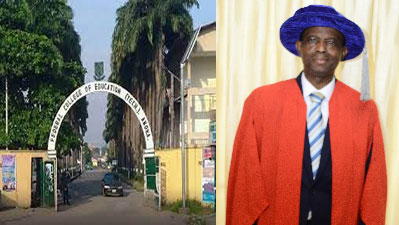
Dr. Wahab Ademola Azeez is the Provost of the Federal College of Education (Technical), Akoka, Lagos. He was appointed to head the foremost teachers’ college on May 26, 2019. In this interview, Azeez reveals that Nigeria is one of the countries whose education system is highly subsidized and cheap. He discloses why Nigerian teachers are resigning and leaving the country in droves while suggesting measures the government should put in place to check the trend.
The provost also lists the achievements of his administration in the last four years including new lecture auditoriums, laboratories, studios, and workshops, as well as the establishment of CEVTED and CEDAAR to encourage students to acquire practical skills to be self-reliant after graduation. Excerpts:
What have you been able to achieve since you were appointed the provost of this college?
Since I assumed office, I made sure that I keep to my vision and mission that I submitted and presented to the governing council that appointed me. First of all, the college is a College of Education, (Technical) first of its kind in Nigeria. It was established in 1967.
However, I noticed that there’s a missing link, which is focusing on why the college was established. The college was established to provide the vocational and technical needs of the country, which is seriously lacking in our business system.
So I make sure that this college under my leadership provides that professional and technical needs and fill in that gap so that at the end of the day, when our students graduate, they will have the opportunity of not only teaching but they can also be skillfully engaged anywhere they are employed or they can decide to establish on their own.
Have you been able to achieve this particular objective?
Yes, to a greater extent, because what we have done since I came in is to strengthen the academic programs of the college to make sure that most of our departments are better equipped and that lecturers and instructors are also giving adequate support in terms of teaching and learning facilities and materials.
We are also developing and solving the infrastructural needs of the college because, without infrastructure, there’s little or nothing a lecturer can do. You need to also use those infrastructures and facilities to enhance teaching and learning so that the students can also benefit maximally. Therefore, since I came on board, I make sure that such infrastructures are evenly provided across the five schools we currently have at the college.
Introducing CEVTED
Furthermore, barely less than a year after I assumed office, I introduced what we call CEVTED – Center for Vocational, Technical and Entrepreneurship Development, the first of its kind. Beyond teaching our students in Pedagogy, I also feel that the aspect of that practical skills is seriously missing. That informed the establishment of CEVTED and it is a directorate on its own with a director coordinating it.
So because the emphasis was on practical skills, we made it compulsory for all our students to register for any entrepreneurship skills of their choice which is different from the normal academic programs. Certain periods in the curriculum were marked for that course every Wednesday. So whether you are a science or business education student, you must go to that center for a course. The idea is to encourage students to learn a skill such as phone repairs, tiling, catering, etc.
We are not relying on our lecturers but on instructors from outside the institution who are well-established and have their workshops, offices, equipment, and so on. So it is not based on the acquisition of paper certificates but the acquisition of practical skills. It’s all about practicals. The program has been on for about three years now and many of the students have been practising what they have learned and are making money out of it.
It’s also an aspect that I feel that should be keyed into the establishment of the College of Education, Technical because we need that technical skills to be able to grow.
Where do you get the funds to execute these projects?
Honestly, it’s not been easy sourcing funds for what we are doing here. Most of the pieces of equipment we inherited in our studios and workshops were obsolete but since we came on board, we’ve been trying to acquire more modern equipment to meet the requirements of running NCE and degree in vocational, technical, and science education.
Fortunately for us, the TETFUND has been wonderful. If not for Tetfund, I don’t know where all our higher institutions would have been today. So we have been getting our funding from TETFUND majorly, especially in the procurement of equipment for academic programs. Not quite long, such pieces of equipment were also distributed to all the departments in science, technical, business and vocational education.
We’ve not got to the eldorado but what we are doing now is to make sure that every school has a new structure where the students can learn better in terms of skill acquisition. So we have built new technical workshops, new science and agricultural laboratories and new studios. We also have a new auditorium, or what we call lecture theatre because the students also need a very comfortable place to study.
How much private sector involvement have you been able to attract?
We are making efforts to attract private sector support. It is part of the reasons we initiated CEDAAR – Center for Endowment Development, Advancements and Alumni Relations. Again, it’s a directorate on its own and liaises with entrepreneurs and private organizations and so on. So it’s not been easy but we are relying on the fact that the college has goodwill to attract the support of our alumni scattered all over the place.
The alumni members are coming around and they are seeing what we have been doing with the little resources we have. If we are to be a degree-awarding institution fully, I’m sure that we would have got better funding because as it stands now, only a few parents want their children or wards to attend NCE programs.
Why is it that no parents want to have their wards in the College of Education?
The first reason is that no parents would want their children to go for the least educational program because when you look at the requirements, it is the same five O’level results that NCE students possess that the university undergraduates also process.
So if you go for JAMB and you score maybe 180 and above and you are given admission to the university, you will prefer that to the College of Education where you will spend three years.
You go for three years for NCE and later you go for another three years in the university making it six years while your colleague in the university will only spend four years. Ultimately, if Nigeria appreciates teachers’ education, NCE is good for the educational system of the country. However, the sad story is that even after spending six years, you don’t even get a good job, that’s the issue. So many of our NCE graduates are just there, roaming about the streets and being exploited by private institutions that are not paying them well because there’s no serious policy on ground to protect them.
The way forward
We have to establish a system that works, that also appreciates value. For example, to get a private tutor abroad, you pay per hour. So we have to also appreciate and value labour, either practical or intellectual. I don’t expect to find a university graduate teaching in our primary and junior secondary schools, it should be NCE graduates because they were trained for that purpose and they have the temperament. As a Ph.D. holder, you cannot ask me to be teaching in a nursery and primary school because I don’t have the temperament. So those people working at that level are meant to be paid well because they’re professionals. Sadly, we see them as doing nothing. If you move around schools, you will see how they take care of the children. It’s a lot of jobs that they do. So, we need to be paying teachers and our other professionals very well.
Talking about value, recently, Nigerian teachers were said to be leaving the country in droves. What effect will this development have on Nigeria’s education system?
Well, the effects are staring us in the face. You now have a situation where your best brains are leaving the system in droves. In fact, in the past two years, there’s been no month that a member of my staff did not resign for greener pastures abroad. It’s as bad as that. Until we are able to place value on those that we have trained and cater to them in terms of remuneration, the situation will get even worse. Yes, Nigeria is not paying the percentage recommended by UNESCO, the truth is that the Nigerian education system is highly subsidized. I am telling you this as an education administrator. Nigeria is one of the countries where you have the cheapest education. It’s debatable, yes. I can also challenge any of our activists in the university to tell me how much they are paying for what they use even in their offices. We don’t pay for virtually everything we use. How much are the students paying for accommodation? How much do they pay? Here, we are not even allowed to charge school fees. The government is doing a whole lot in subsidizing education but it’s not being properly coordinated for the country to get value for it.
For example, after training a medical student for six or seven years with taxpayers’ money but because there was no program to keep them, they are taken away from the country. The truth is an average Nigerian cannot train his or her child to read Medicine abroad. You must be somebody of the higher or upper class to train a child in Medicine or some other professional courses because it costs a lot of money. To check this, there must be a policy to make sure that our doctors and other professionals hardly leave the country and they must be made to sign some undertaking with the government not to leave the country for a number of years after graduation. There must be something on ground to keep them because it’s the taxpayers’ money that was used to train them. Most of us, our parents were not educated and wealthy but still, we were able to get a university education because the government made it possible. That means something, The only problem is the lack of coordination by authorities.
How are you coping with the mass resignations of your staff?
It’s affecting us but we are trying not to allow the system to collapse. The staff are not only resigning, they are also retiring and some have died. So we are short of staff, especially academic staff. And you cannot employ a single soul without the Head of Service’s approval. So you can’t replace those that have died, retired or resigned because there was an embargo on employment. In the system we are running now, everything is centralized. We hope that the situation will change and that if all institutions are given autonomy to run their programmes and generate and utilize revenues, things will be a lot better.
What do you think the government should do?
First of all, the government should have a database of graduates, it is very very important. If somebody is applying for a visa, the state should be able to know from the database everything about the person and their purpose of travelling abroad. So, we need that database. Again, the government should also put in place an efficient transportation system. Here, workers have to struggle to come to work from the meager salary. So how do you expect efficiency or effectiveness? The government should also have in place housing schemes for different cadres of workers so that as a worker, I don’t have any business knowing how much a bag of cement or sand is being sold. All those things affect productivity because there’s no efficient mortgage system.
Disclaimer
Comments expressed here do not reflect the opinions of Vanguard newspapers or any employee thereof.