By Rita Okoye
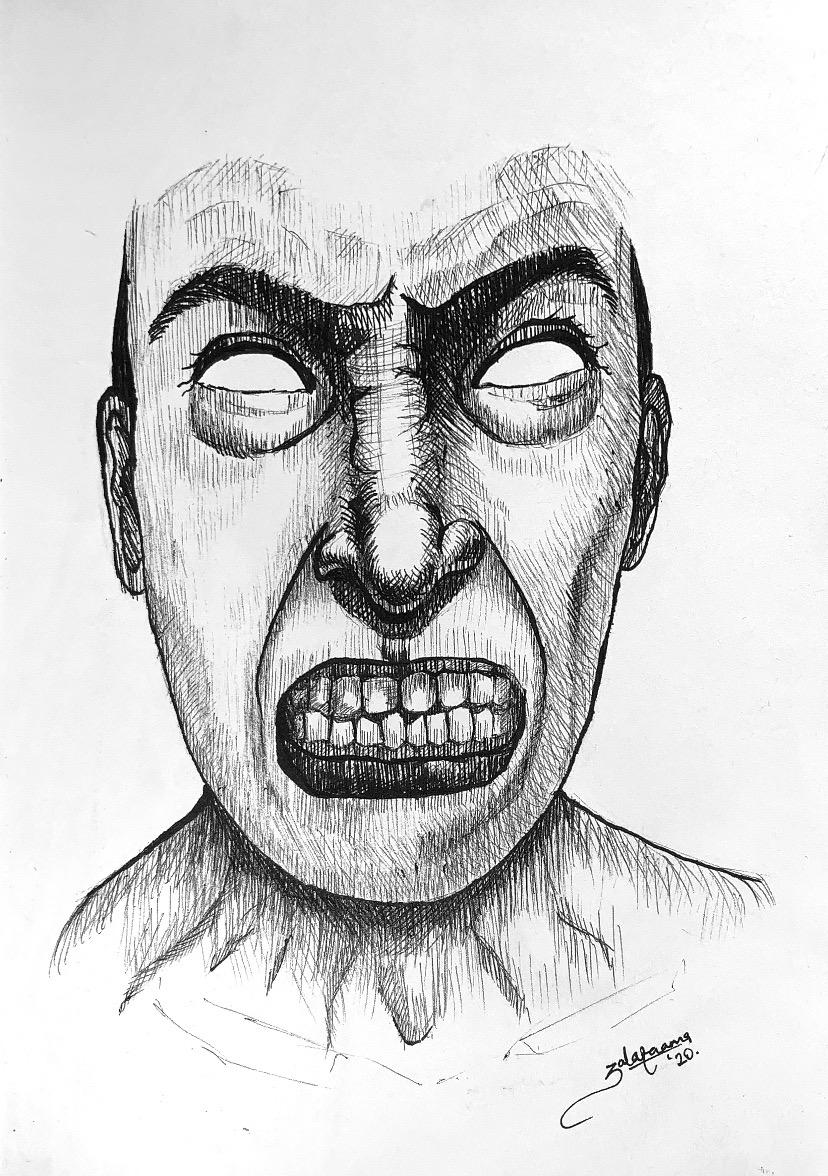
There is an honesty to Balafaama’s art that disarms you. Her works seem less like paintings and more like open wounds—chaotic, visceral, and unrelentingly human.
A self-taught artist from Nigeria, now based in the UK, she channels her battles with mental health and societal expectations into works that do not flinch. Her art, unvarnished and unapologetic, occupies a space of its own—untethered from the demands of beauty, comfort, or conformity.
For Balafaama, whose story reads like an extended act of defiance, art was never a natural choice. Growing up in Lagos, her earliest foray into creating wasn’t a burning, predestined calling but a childhood dare—a rival’s mastery of painting sparked a competitive instinct in her. Yet that small spark would soon ignite a more profound flame.
“At first, it was just about proving I could do it,” she tells me. “But then it became this place where I could dump all of my pain.”
That pain, unspoken but deeply felt, marked much of her youth. Lagos, for all its raucous brilliance, is a city of order and hierarchy, where the lines between aspiration and expectation blur into suffocating obligation. There’s a cultural tendency, particularly for creatives, to produce art that uplifts—reflecting the sheen of hope or the ideals of a life well-lived. Balafaama rejected this outright. Her work eschews the varnish of optimism in favor of chaos: splintered compositions, stark lines, and brooding palettes that unearth more than they conceal.
“For a long time, my art wasn’t just misunderstood—it was considered inappropriate,” she admits, brushing back the loose locs that framed her face. “People couldn’t reconcile what I was creating with what they thought art should be.”
In Lagos, those around her favored depictions of idyllic landscapes or aspirational portraits. Balafaama, on the other hand, painted storms: jagged, visceral landscapes of feeling that mirrored her own internal weather.
By necessity, her education in art was solitary. Without access to formal training, she combed YouTube tutorials and leaned on the generosity of her own persistence. “I made a lot of mistakes—some intentional, some not—but they became the language of my work,” she explains. Her self-motivation not only honed her craft but also forged a distinct voice: raw, unpolished, yet brimming with emotional clarity.
Moving to the UK in 2022 proved a seismic shift. It freed her from the social-religious expectations of her home country, allowing her to embrace the unvarnished intensity that defines her work. London became less of an escape and more of an incubator, granting her the space to focus on her art without the looming gaze of cultural judgment. “It felt like I could breathe for the first time,” she says simply.
Balafaama’s work, she notes, is not easy to pin down. To her, it is less painting and more translation—a vocabulary that evokes chaos yet pulls you into its storm. “When someone looks at my work and feels even a fraction of what I felt creating it, that’s when I know I’ve succeeded,” she says. Her art is profoundly experiential, resonating in ways that words cannot quite capture, which is perhaps why her themes—mental health, vulnerability, and the alchemy of survival—speak with such force to audiences far beyond the borders of Lagos or London.
Despite her relatively short time in the art world, Balafaama’s pieces have generated conversations in both African and European circles. Her exhibits—independent and collective—invite viewers into a space that refuses to shy away from the darker corners of human experience. These are not paintings of resolution or redemption. As she explains, “I don’t paint solutions. I paint the storm.”
Yet within the tempest, her work offers a surprising gift: connection. Balafaama’s art has become a medium for discussing what so often remains unspoken—particularly the stigma surrounding mental health in African communities. Her candor and willingness to inhabit uncomfortable truths are precisely what lend her work its power.
Balafaama’s ambitions for the future are both practical and profound. She envisions experimenting with new forms and mediums, not to dilute her voice but to amplify it. She sees her career not as an ascent but as a continuum—an ever-evolving conversation with herself, her viewers, and the unending well of human complexity.
“My work isn’t about achieving perfection,” she says, folding her hands in her lap, “it’s about making people feel less alone.”
At just 25, Balafaama has already made an indelible impression, her work vibrating with both the pain and beauty of being alive. In an art world eager to offer quick resolutions, she remains steadfast in her refusal to diminish the chaos. Perhaps that is her greatest gift: reminding us all that storms, though terrifying, are also honest, unyielding mirrors of ourselves.
Disclaimer
Comments expressed here do not reflect the opinions of Vanguard newspapers or any employee thereof.