• As 4 new cases are seen in LUTH every week
By Chioma Obinna
The pains and challenges of nine months of pregnancy naturally disappear the moment a baby is born. But in some cases the joy and the celebration that would have followed the safe arrival of the baby could also be shattered by a few words from the doctor, “your baby has a little problem.”
Such is the fate of Mrs Ogueri Ozoemena, Mrs Ann Alowele and many others a few minutes after they gave birth to babies with cleft llip and or palate.
In most cases, these women are shattered emotionally following the stigma and discrimination associated with the condition in a country like Nigeria where awareness about the condition is limited.
Apart from the emotional trauma, women like Ogueri and Ann, have faced many challenges associated with the care of a child with either a cleft lip and/or palate.
In some cases, they have been thrown out of their matrimonial homes or accused of infidelity by family members who claim that such a thing has never happened in their lineage.
This stigma continues to rob these children of their education, employment and marriage. In the worse scenario, barriers to care cause some of the children to be lost to malnutrition caused by inadequate feeding.
A Consultant Oral and Maxillofacial Surgeon and Coordinator, Smile Train programme at the Lagos University Teaching Hospital, in LUTH, Prof Gbenga Ogunlewe, said Cleft Lip and Palate are disorders that children are born with and are facial and oral malformations that occur very early in pregnancy.
The World Health Organisation, WHO says globally, one in every 700 children are born with the defect and a cleft occurs in one in 1,200 children in Africa while19,000 cleft children are born every year in Africa.
In Nigeria, Ogunlewe said though there are no current national data on the prevalence of the condition, hospital-based data showed that 1 in 2,000 live babies are born with cleft lip and palate in Nigeria annually.
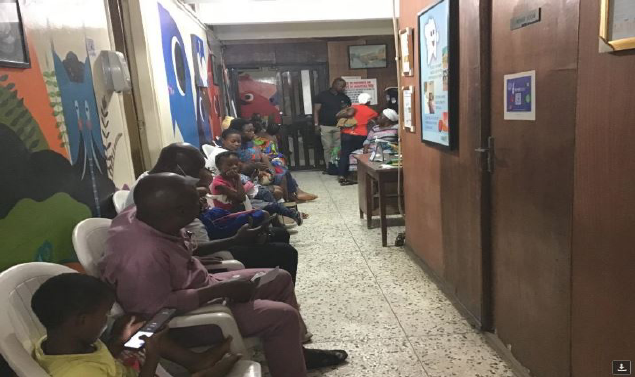
But, in LUTH, four new cases are seen every clinic day. and over 900 corrective surgeries have been done at LUTH courtesy of Smile Train. Only this year, 75 cases have been done.
For mothers like Ogueri, It was an experience not to remember. “I gave birth in one of the primary Health Centres in my area. She was my first child but unfortunately, I lost her out of ignorance. My baby became the topic in our neighbourhood. Everyone wanted to come and see and confirm what they were told.
Some came to sympathise while others only came to confirm what they were told. I was almost depressed.”
Unfortunately, Ogueri’s baby that was born with a cleft lip and palate did not benefit from the corrective surgery of Smile Train due to complications of malnutrition. The baby was said to have slipped into malnutrition.
“She could not latch on the breast very well. We tried our best but we lost her.”
Mrs Ann Anyanwili, mother of 7-year-old Esther, one of the beneficiaries of Smile Train programme at LUTH, also narrated a heart-rending story.
At three months, Esther stopped taking breast milk due to her inability to suck. Unfortunately, Ann had no information about how to feed babies with such defects.
As months passed, Esther continued to have more difficulty feeding. Sadly, neither Ann nor her husband knew what was wrong with the child.
“Sometimes, after feeding her, the food will come out from the nose. I did not know anything about the condition and what I should do, the food will come out from the nose after feeding her
“I kept praying but one day, one of my neighbours called me and advised me that we should do something about Esther.”
At this point, Esther was already six years old but could not speak well. “If she is pronouncing ’S’, instead of the air coming out from her mouth, the air will come from her nose, if she rushes her food, some oil or some thick stuff will come out through her nose,” Ann narrated tearfully.
“The pain of seeing my child like that continued to disturb me and my husband but there was no assistance.”
Their pain continued until her neighbour encouraged her to take action. “My friend raised N5, 000 for me to take her to Federal Medical Centre, FMC, Ebutte Metta.”
Getting to FMC, three different medical doctors examined her and discovered that she had a palate, and she was referred to the Lagos University Teaching Hospital, LUTH.
“I am jobless, and so is my husband, so we were just managing.”
Due to the inability to pay for the hospital bill there, doctors at the centre referred them to LUTH.
Even after diagnosing the child, there was no money to transport the child to LUTH. Luckily, the same friend raised another N5,000 for transport.
Luck finally smiled at Esther as she was given her life back. Esther was operated under the Smile Train programme at LUTH.
Smile Train is a nonprofit organisation, that provides corrective surgery for children with cleft lips and palate. Founded in 1999, Smile Train provides free corrective cleft surgery in 87 countries including Nigeria, training local doctors as well as providing hospital funding for the procedures.
In her narration to Vanguard, Ann said, “We were given an appointment date and admitted and the surgery was done free of charge. We were surprised when we were told to just bring the child. I was initially afraid that we did not even have transport money to come to LUTH.
“My family did not pay even N1.00 and the surgery was done. I give God the glory and thank Smile Train that making it possible.”
Like Ogueri and Ann, Mr. Ohori Oghenebowene felt the same way when they found their baby with cleft lip and palate.
For Mr. Oghenebowene Ohori father of 13 weeks old Destiny, it came as a shock. Destiny is awaiting surgery at LUTH presently.
Ohori said though he is learning to live with it, Smile Train is offering free corrective surgery at LUTH. Ohori advised parents with such challenges to bring their children out for treatment.
“Personally, I have seen the light that it can be corrected. I have vowed to take it upon myself that anywhere I see any case if it means bringing them here physically, I will do that because for Smile Train to take care of the expenses, I don’t think bringing them here personally is too much. So I encourage everybody to come out and do the corrective surgery.”
Expert reacts
For the Coordinator of Smile Train Programme at LUTH, Prof Gbenga Ogunlewe, there is a need to demystify cleft lip and palate.
Ogunlewe recounted that there are several factors responsible for children being born with these defects.
According to her, these include genetic factors which are inborn, and environmental factors acquired from things like radiation exposure and x-ray.
She said several studies have implicated folic acid as it is needed in development and studies have shown that mothers who give birth to these children actually lack folic acid.
“There are also some drugs that some mothers take during pregnancy that can cause it.”
Challenge of malnutritionOgunlewe who noted that affected children face many challenges in life without corrective surgery explained that apart from the social rejection, children born with the disorder will not be able to suckle properly and because the baby cannot get adequate breast milk, the child will not get the nutrients required to develop.
“Also, for the person with the palate, because there is a gap between the mouth and the throat food will be escaping and the patient will not be able to get a good seal for him to swallow and for the food to go into the system.”
She explained that some other children may have some other diseases that even when they are eating, it will not show on their bodies. “For these ones we call them the syndromic cleft/or palate and most times we refer them to the paediatricians to do further evaluation. This is essentially what leads to malnutrition in these children because of the inability to suckle the breasts and eat well. You need the lip to grasp the nipple. A patient with a defect in the palate cannot do that effectively. They require more energy to do it.
She said for such babies, mothers are advised to dedicate more time to them while breastfeeding because they require more effort.
“Nutrition of these children is important for effective surgery because they must attain a certain kilogram of weight before any corrective surgery is done on them. It also determines the outcome.
“Thanks to Smile Train, because they are also supporting these children’s nutrition when we noticed that they are not up to adequate weight or are malnourished, we support them because some of these mothers, their breastmilk doesn’t flow very well. So when they come to the clinic we teach them how to feed the children.
Treatment
Disclosing that it cost about N300, 000 to repair cleft lip and palate, Ogunlewe said treatments stretched till adulthood.
Ogunlewe explained that children with cleft lip and palate will not be able to speak well and will need a speech therapist, and can also have an ear problem, they may need to see the ENT surgeon, and some of them may have deranged teeth and will need to see an orthodontist.
She further explained that treatment for cleft and palate is done at different stages.
“For instance, we do cleft lip at three months, the palate at one and half years. Then, we will do the gum at seven years, Ear, Nose and Throat at the same time with the palate if the baby has a problem with the ear because it can also cause hearing defects if not treated. We also do the jaws and gum.”
She further stressed the need for the Nigerian government to begin to pay attention to cleft lip and palate and factor it into the budget as Smile Train will not be in Nigeria forever.
She disclosed that to build the capacity of more doctors to carry out surgery on these children, they are collaborating with Smile Train to train Post Fellowship doctors to acquire the skill.
She however advised mothers and caregivers to bring out their children for treatment saying giving birth to a child that, however,t lip and palate is not a death sentence, the child can live a normal life.
“All you need is to bring the child to LUTH and access care without paying a dime,” she stated.
Disclaimer
Comments expressed here do not reflect the opinions of Vanguard newspapers or any employee thereof.