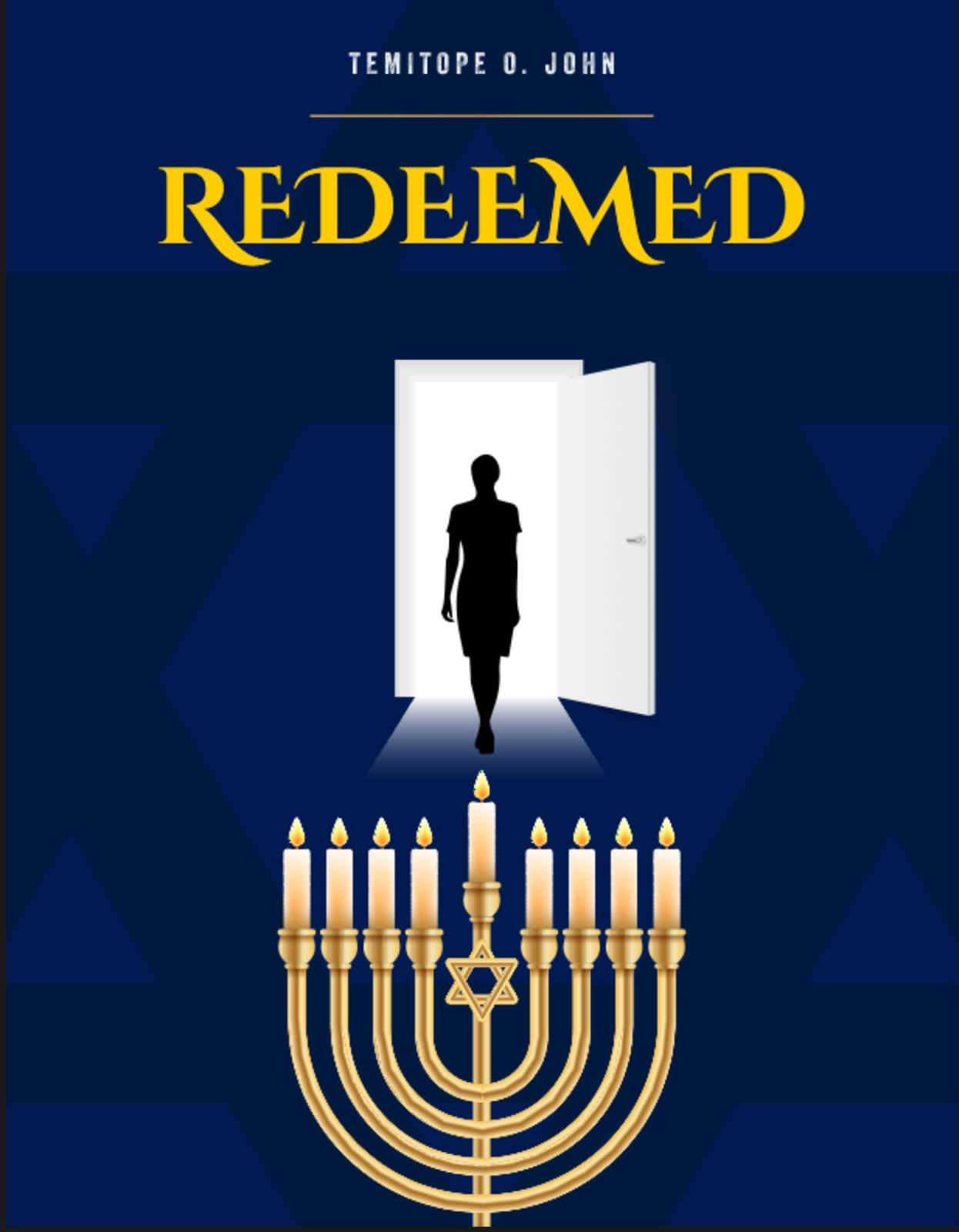
By Chukwuma Ajakah
Nigerian writer, Temitope O. John ingeniously infuses biblical allusions in the narration of a love story that evokes the socio-cultural realities of a Jewish society where religious piety, moral rectitude and disciplined lifestyle are uncompromisingly cherished.
Published in 2022, the book succinctly titled, “Redeemed” consists nine chapters of well-crafted prose, laced with incisive spiritual and moral lessons. Each of the 50 pages is replete with intriguing descriptions of scenery, characters and socio-religious activities.
The plot of the novel revolves around Hadassah, daughter of a Jewish priest, Abijah who is contentedly preoccupied with his priestly duties at the Temple of Yeshua. Although he is portrayed as a strict disciplinarian and devoted family man, Abijah inadvertently loses grip of his daughter in a manner that reminds readers of the failures of God’s devoted priests-Eli and Samuel, at the home front as their sons rebelled against the Lord, abandoning the long-cherished spiritual and societal values they were raised to conform with.
The antagonist is portrayed to fit into the mould of the devil, whose attributes as recorded in the holy book, include the ability to “transform himself into an angel of light.” Dothan is depicted as an extremely attractive young man with excellent manners and angelic disposition. True to type, he successfully tricks the protagonist right off the Temple. Conversely, Hadassah becomes a victim of the devilish antics of the Casanova whom she mistakes for a flawless angel. Her good nature, stern parental upbringing and determined dedication to Yeshua (God) prove to be ineffective in her struggle to resist temptation. Her mother’s warning, “You need to be wary of these Jerusalem boys. They are not always as you see them,” turns to be prophetic as she backslides and almost gets irretrievably ruined.
Ironically, the predator meets Hadassah right at the temple where she serves as a chorister and one of the celebrated virgins seen as ideal models to other youngsters. Although she knows all the rules and “…was careful because it was easy to be misunderstood, and rumours flew fast where they lived,” Hadassah falls like a pack of cards. She tries to maintain a pretentious pious disposition as the daughter of a priest and fool the world into believing that she is still a virgin, but has to give up and turn to God in genuine repentance.
Temitope’s Redeemed has diverse striking features that readily resonate with readers who are conversant with practices chronicled in Jewish holy books. Through its unique setting in the ancient city of Jerusalem with overt references to cities like Samaria and Galilee, iconic characters, Jewish traditions and festivals, marking symbolic events. The novel encapsulates a make-believe fictive world with the trappings of fascinating romantic-fairy tales. The author also creatively re-enacts momentous biblical conflicts such as the land squabble between King Ahab and Naboth and Korah’s rebellion against Moses.
As the sublime title suggests, Redeemed thematically focuses on the gift of salvation as a product of grace. Related subthemes embedded in the narrative piece include friendship, social inequality, conflict between light and darkness, betrayal of trust, infatuation, love of God and family life. The central theme is primarily realized through the protagonist whose personal efforts to please God and society by living righteously fail to yield the expected result until mercy prevails on her behalf. The book reveals that the devil is so crafty that human wisdom and willpower can never be enough to have anyone saved except there is divine intervention as instantiated in the life of Hadassah.
Exploring the central message of salvation further, the author portrays Hadassah as a symbolic character, representing a believer whose intimacy with God (Father-daughter relationship) depicts a level of closeness others consider unimaginable. One of her friends, Haggi cautions her against blasphemy, saying: “My Papa told me that Yeshua is terrible in his ways. He told me stories of how he destroyed Korah and his followers when they challenged Moses. Papa said that the ground opened up and swallowed everything related to Korah… How can you say the terrible Yeshua, feared by all of us, including the serving priests, is your friend and father?”
The novel features familiar Bible characters with subtle alterations to their original roles. Such characters include: Abijah, Hadassah’s father whose office as a temple priest is akin to that of the Bible, Deborah, Hadassah’s mother, a virtuous woman of exemplary character, a heroine in her own right, but unlike the Deborah of the Bible, does not lead men to war as she is contented as a housewife. Other characters whose roles vary from those portrayed in the Hebrew Bible are Adonijah, Haggi, Jochabed, Ruth, Rachel, Abihu and Seth.
One name with a remarkable effect in the narration is that of the antagonist, Dothan. The biblical account records that a stranger had directed Joseph to Dothan where he found his brothers who eventually conspired against him and sold him into slavery (Genesis 37:17). In a subtle allusion to that episode, the Dothan in Temitope’s Redeemed is presented as a stranger, whose villainous role exposes the tragic flaw, leading to Hadassah’s misfortune.
The novella mirrors the age-long conflict between light and darkness in a way that makes it an interesting read for diverse categories of readers irrespective of their religious leaning.
Disclaimer
Comments expressed here do not reflect the opinions of Vanguard newspapers or any employee thereof.