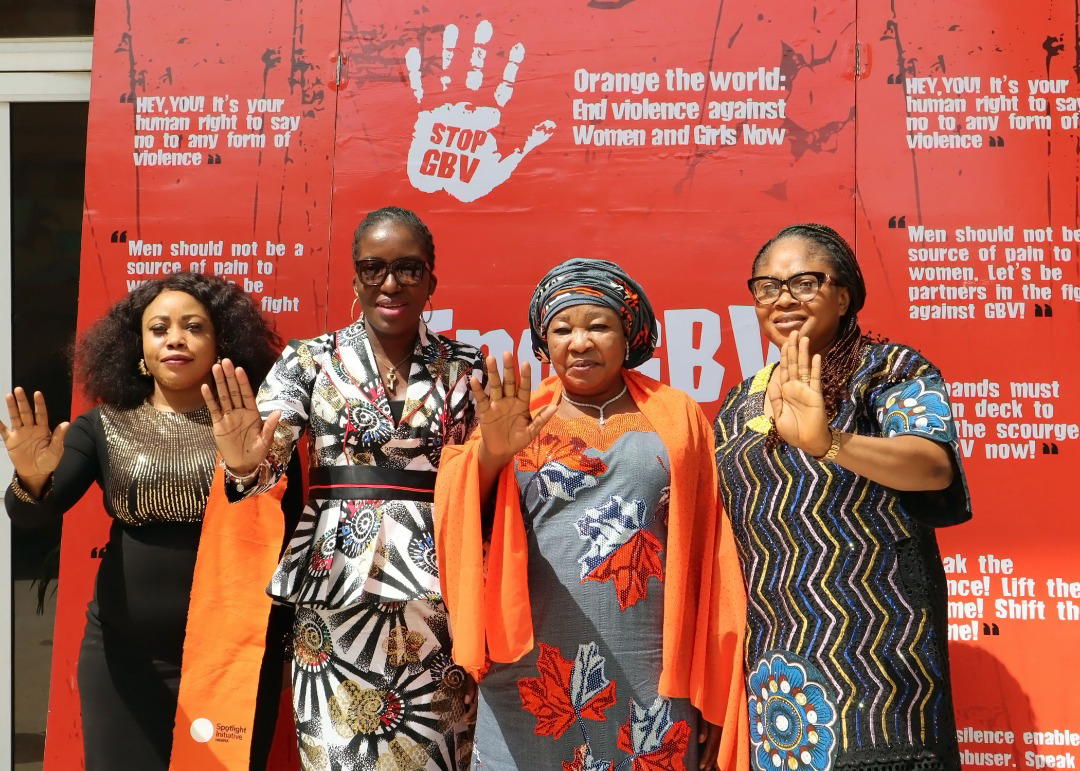
Closer collaboration between stakeholders and stronger activations at the grassroots have been identified as two of the major strategies needed to combat and defeat Gender-based Violence in the country. The Director General, National Agency for the Prohibition of Trafficking in Persons (NAPTIP), Dr. Fatima Waziri-Azi, stated this while presenting her keynote address during the symposium organised by the FCT Sexual and Gender-based Violence Response Team (FCTSGBVRT) in Abuja on Friday, 10th December 2021.
The event, which marked the end of the 16 Days of Activism Against GBV, drewed participation from voluntary groups, civil society organisations, memebers of the National Youth Service Corps, and government agencies. A representative of the Office of the Vice President was also in attendance. It was themed, “Accelerating Efforst to End Sexual and Gender-based Violence in FCT: Recognising the Influence of Key stakeholders.”
In her address, Dr. Waziri-Azi said, for real progress to be made in this fight, culturally sensible approach was required.
“Accelerating efforts to end sexual and gender-based violence in the FCT, will continue to remain a challenge if we (the stakeholders) fail to consciously and deliberately manage our strength and expertise in a patriotic manner. Collaboration can lead to superior outcomes that parties could not achieve on their own and continues to be the go-to solution for government. If only we could collaborate better, we could overcome a lot and achieve more and we will secure more convictions. When we have more accountabilities and fewer impunities, that is what sends the message to everyone that SGBV is not tolerated. Holding perpetrators accountable sends the message that we all are committed to zero tolerance.
“While we do our part from the center, most of the efforts to combat gender-based violence will occur at the grassroots level. These efforts should be scaled because grassroots initiatives are able to best respond to incidents with a culturally sensitive approach. We must see SGBV as a community issue that needs solving at the community level. Also, engaging men and boys in SGBV prevention efforts holds great promise. Focusing on effective and positive program practices that educate, support, and help men and boys develop healthy relationships is potentially transformative for both men and women.
“To our traditional and religious leaders, the role you play in tackling social issues because of your influence in society, as custodians of cultural norms and values, cannot be overstated. Which is why section 44 of the VAPP Act categorically and unequivocally mandates NAPTIP to collaborate with faith-based organizations. As traditional and religious leaders, you all are fundamental allies in ending all forms of gender-based violence and harmful cultural practices in Nigeria. Where patriarchal structures and traditional norms condone violence, true interpretation of religion has the power to break these discriminatory barriers. With your extraordinary moral authority, you can influence thinking, foster dialogue and set priorities for members of your communities and advocate for social and legal change.
“I believe we can all agree that there is a strong consensus across our religious beliefs that speaks to the fundamental dignity of all human beings, yet, all too often, with impunity, women and girls are entrapped in cycles of unending violence.”
The Mandate Secretary of the Federal Capital Territory (FCT) Social Development Secretariat (SDS), and Chairperson of the FCT Sexual and Gender-based Violence Response Team, Hajia Hadiza Mohammed Kabir, while giving the opening address, thanked all the various groups and donors for making concerted effort to end the scourge.
The event was organised with support from the Ford Foundation.
During her speech, Dr Waziri-Azi said to aide collaboration and ensure coordination, all government agencies with a role in the successful implementation of the VAPP Act have been invited to join the High-Level Multi-Agency Task Team (HI-MAT), a multi-agency platform. This comprises of core referral agencies of the Police, NSCDC, Federal Ministry of Women Affairs, National Centre for Women Development (NCWD), NHRC, NBS, NIMC, EFCC, Correctional Services, the Judiciary. These agencies are expected to work closely with NAPTIP to realise the implementation of the VAPP Act in the FCT.
“HiMAT members have their roles well cut out by their institutional mandates. For example, EFCC deals specifically with polygraph tests; NIMC leads on verification; NBS is the government body responsible for national data management in Nigeria, etc. The Ministry of Women Affairs and the National Center for Women’s Development have a dual role given their responsibility as protectors and preventers of SGBV; and as service providers because they provide counselling, shelter and socio-economic rehabilitation services for survivors,” she said.
Disclaimer
Comments expressed here do not reflect the opinions of Vanguard newspapers or any employee thereof.