By Johnbosco Agbakwuru
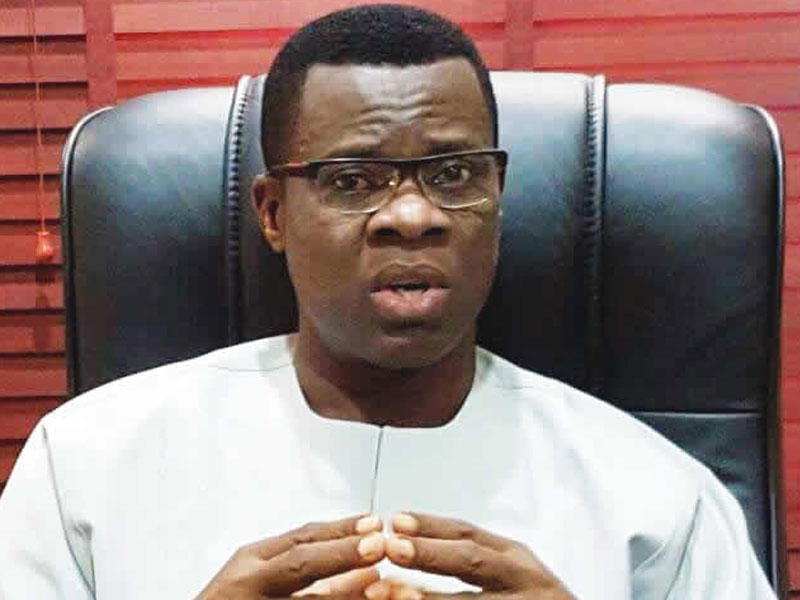
Mike Igini is the Resident Electoral Commissioner in charge of Akwa Ibom State. He is one of the few Commissioners in INEC who have conducted three general elections in the country.
In this interview, Igini warns that democracy in Nigeria is in grave danger, saying it may be killed by the judiciary.
He adds that political party management is unmitigated disaster. The one-time student union leader calls for the sack of corrupt judges. He also speaks on the readiness of the INEC to transmit results electronically. Excerpts:
The National Assembly in passing the Electoral Act Amendment Bill claimed that electronic transmission of election results is not possible now as some communities do not have data network coverage. Nigerians want to hear from you on this matter, how true and is that the end of the road for INEC’s aspiration on the matter?
How can that be the end of the road in our quest to ensure the sanctity of the votes of Nigerians? As a Commission, the National Commissioner and spokesperson, Mr Festus Okoye, has engaged extensively with details and specifics on this matter with unequivocal and firm assurances to Nigerians that the Commission, guided by the Constitution and extant laws, will safeguard the sanctity of every polling unit result across the country, despite the controversy over whether or not election results should be transmitted. As a Commissioner who has been in the system since 2010 and participated actively in the conduct of three general elections and several elections in-between, l call for understanding of all critical stakeholders on this issue and my intervention here with you is to provide additional background information to fill the gaps in the ongoing conversation on this subject matter.
Some of us decided to tarry a while as part of the umpire entity to allow the dust of partisanship to settle, given the dimension the issue of transmission of election result has assumed amongst politicians along party lines.
What many Nigerians do not know is the fact that INEC, since the return of the country to civilian democratic rule in 1999 starting with the late Justice Akpata as the Chairman up to the current leadership of Prof. Mahmood Yakubu, has been on a consistent trajectory of innovation to give meaning and purpose to the ballot as the best means of expression of the will of a people in a democracy. On record, you find that every leadership of the Commission introduced one form of innovation or the other that subsequent leadership built upon in getting to where we are today.
Thus, anything done to halt this gradual process of revolutionizing the electoral process, or completing all the stages of the Electoral Voting System otherwise called EVS that Justice Akpata started, will not be in our collective interest in our quest for electoral accountability.
So this Electronic Voting System project started since 1999?
Yes, it started 22 years ago, the late Justice Akpata of the Supreme Court was the first Chairman who conceived of and awarded the first contract for the installation and transmission of data via V-Sat but, unfortunately, he died before commissioning it. Dr. Abel Guobadia, who succeeded him, continued with the vision and created the ICT section first as a unit under the Chairman’s office and then as a full-fledged department with its purpose built office and recruited almost 90% of the staff across the states including the current Director of ICT, Mr Chidi Nwafor, and many others who have retired.
His leadership also introduced the geo-mapping of polling units using GPS as well as the first attempts at biometric capture of voters using OMR forms and scanning of biometrics of registered voters. Prof. lwu expanded communication and installed the V-Sat in the LGAs across the country for use towards the 2007 elections and also tried collation and transmission of results from LGAs via SMS, but the political elites conspired to ensure that these facilities that were procured with billions were not used. But the challenge has been the credibility of the polling unit results, whether they are the same results at the time of SMS transmission at the LGAs.
By the time of the leadership of Prof. Attahiru Jega that l was part of, he built on what he met by raising the bar, identified actual location of polling units, compiled the most successful biometric register that no longer contains names of foreigners like Mike Tyson with DDC machine assigned to each polling unit.
He also introduced the permanent voter card called PVC as well as the Smart Card Reader for PVC. Under Prof. Jega, the Commission successfully piloted the transmission of polling unit results from the ward level in the isolated 2012 governorship election in Cross River State when l was the Resident Electoral Commissioner.
The collation process of aggregated polling unit result from wards was real-time and we all observed the process with great excitement for the future. Again, like the issue raised with respect to the credibility of the polling unit result transmitted from LGAs under Prof. Iwu, we also had that issue of credibility of the polling results to be transmitted from the ward, whether they were still in the original form as declared at polling units or on the way to the ward collation centers they had been tampered with or altered? That had been the fundamental stage of the EVS that the current leadership has addressed.
Has it been addressed and in what areas has INEC improved under the current leadership of Prof. Mahmood Yakubu?
Absolutely, the current leadership of the Commission under Prof. Mahmood has successfully addressed it by going directly to the polling units where voters cast the ballots instead of LGAs or wards as previously piloted by his predecessors. Polling units where voters cast ballots and counted results that are declared openly are now the points where original results polling unit results are domiciled or stored in the cloud through our portal, real-time and visible to all collation officers given codes and members of the public.
Form EC8A series of polling units are now scanned, stored and domiciled as cloud data in accordance with our election operation manuals and nobody has issues with that given that it has not put any party at a disadvantage, and this is how it should be according to the law that all election results at polling units must be declared and published at the polling units, and every political party agents and observers should be able to observe the published polling unit result. All these initiatives and innovations have been piloted successfully through several off-season elections like the recent Edo and Ondo governorship elections.
This is what you people call transmission in the general parlance that has generated so much furore and bitterness in the country in the last few weeks. The word transmission seems to frighten people and they seem to have a wrong notion of one kind of continuous electronic transmission process that is susceptible to hacking. No.
The results of polling units are simply domiciled in the cloud as data after publishing in accordance with Electoral Act such that, as we speak today, Edo and Ondo governorship polling unit results in forms EC8A can be accessed right now through the cloud. All these innovations are without prejudice to the step-by-step manual process of collating the results as required by the Electoral Act.
In effect, you are saying that so much innovations have taken place and ongoing under the current leadership that should not be truncated?
With all modesty and responsibility, INEC is the most innovative and improved public service delivery agency in the country even though we are not where we should be in our goal to ensuring that winners of elections should be determined finally and conclusively at the polling units and not courts and tribunals.
The current leadership has just achieved a feat of a 25-year-old problem of inability to expand access of voters to more polling units with the establishment of additional 56,872 polling units to the old 119,973 to expand voters access to polling units creatively and seamlessly and, today, we have a total of 176, 843 where Nigerians are registering in the ongoing exercise nationwide to the satisfaction of all stakeholders.
Our online pre-registration system under this leadership is the first of its kind in Africa, submission of names of successful candidates after primary is now done online as well as accreditation process for election observation organizations.
On the sanctity of polling unit result, I repeat again, that what the Commission is doing is simply to domicile declared and published polling units results in the cloud just as it is today that if you lost your phone and you are given a new SIM card, once it is activated, automatically you retrieve all your contacts and previous messages delivered to your phone as data from the cloud. Unlike the early stage of the coming of GSM when people complained of losing contacts because they lost their handset phone, today the situation has changed because your contacts are in the cloud once you registered.
On this matter; we just have to understand ourselves through information on what INEC is doing with respect to ensuring the protection of election results especially from polling units up to the final stage of collation and declaration of the winner of election.
With this detailed background information on the gradual implementation of what you called EVS since 1999 by successive leadership of your Commission, why do you think INEC was not invited or the open invitation to engage the National Assembly withdrawn and what is your take on the issue of lack of network coverage across Nigeria?
On why the Commission was not invited to address the Senate, l really cannot speak to that or speculate on why the reported invitation was withdrawn. But on the issue of capacity, the Commission spokesperson has dealt with it extensively with specific details from joint assessment and report of both the Commission and NCC, showing that we have the capacity as demonstrated with several off-season elections that l have mentioned previously.
l take the view that those who have raised issue of network coverage should not just be dismissed but should be seen as people who have a shared commitment with the Commission and Nigerians who crave for domiciling results in the cloud called transmission. We all appear to be of the view that every polling result must not only be counted but also taken into account by whatever means of giving effect to it.
If that is the case, and there are possible places in the country where, for instance, you cannot receive bank alerts, and there are polling units located in such places, what we should do is to identify, map out and extend network coverage to those places which can be done this year and even before 2023 which is far away without subjecting INEC’s autonomy to determine how elections are conducted to other bodies or agencies.
Will INEC transmit election results in the Anambra election electronically?
The Commission will give full account of polling unit-by-polling unit result of all elections by storing or domiciling the results in the cloud for security or the sanctity of those results including the forthcoming Anambra election as it has done in several off-season elections including those of Edo and Ondo to the satisfaction of the people of those constituencies, states and all other stakeholders.
Processes and procedures for securing polling units results all through the various collation stages are operational matters that details should be left to the regulator to determine from time-to-time given the ever improving developments in the area of ICT. We have to be careful the way we are going about issues that border on the independence of the Election Management Body so that we don’t unwittingly undermine its neutrality with the involvement of those that elections are meant to vertically regulate making certain determinations.
That is the whole canon of Section 160 of the Constitution which says and l quote here verbatim the relevant proviso: “In the case of the independent National Electoral Commission, its powers to make rules or otherwise regulate its own procedure shall not be subject to the approval of any authority or the President” So you can see that the Constitution does not want those to be regulated by the regulator and manager of election, which is INEC, to be arbiters on matters that are meant to regulate them; we can share ideas but final determination should be the prerogative of the Commission according to the Constitution because elections are the hallmark of democratic authorization.
READ ALSO: Nobody can successfully rig election under my watch— Mike Igini
As l have said previously, we should not dismiss with a wave of hand those who have raised concerns regarding network coverage and that is why l have provided additional historical information background of the gradual implementation of the EVS to allay these fears about technical gaps on how to transmit digital text messages of who won elections and their scores in each polling unit. What we are doing is basically to domicile polling unit result that the law mandates us to publish at the polling unit to the cloud using the Z-PAD.
To be clear again, the law mandates INEC to publish election results at polling units as declared in the form EC60, to ensure further integrity of that result. And, finally, for security, the Commission stores polling unit result as cloud data using the Z-Pad, where there is no reception after it has been sent as soon as you get to network area it will be in the cloud.
This is what is currently regarded as transmission that has generated so much tension and needless name calling. Both chambers of the National Assembly should revisit this matter after resumption and take it from the point of view of detailed information that the Commission will provide for the good of the system.
What impact would the delay in the passage of the Electoral Act have on the conduct of election? Do you think the way things are INEC will be able to conduct credible, transparent elections in 2023?
Look, the Constitution has fixed the time for the conduct of the 2023 election. l will rather expect that we should be tackling or addressing some of the seemingly serious issues such as insecurity that we are faced with at the moment instead of so many talks about the next elections that is a constitutional matter already fixed.
But to answer your question directly, l will say that within the framework of the Constitution, the extant Electoral Act and the operational innovations that have been piloted successfully, the Commission, as the sole regulator and manager of election in this country, will still deliver a credible election even in the unlikely event that the current efforts at having a new Electoral Act fails. The only unfortunate impact so far at the moment is that some of these off-season governorship elections like those of Edo and Ondo and now Anambra could not benefit from some of the profound and revolutionary provisions that are contained in the bill that will sanitize political primary election process.
From what l have read in that bill, if passed and enforced fully, it will bring about internal party democracy to the political parties in their primary and convention processes. So far, the only contending issue at present is that of the misunderstanding about electronic transmission of polling unit results.
In the course of this interview, l have repeatedly told you that what the Commission is doing is basically to domicile polling unit results in the cloud for security, l don’t think any candidate in an election will object to the security of the votes cast in his favour by having those results counted, declared openly in the presence of their appointed agents entitled to duplicates of EC8A , publish same results with form EC60G and finally domicile the results in the cloud through our portal. It is lack of information and understanding by stakeholders that has created the gaps that has resulted in the quote and unquote “we versus them” syndrome over this issue that should be resolved in favour of the people. If credible elections is what we all genuinely want, then we don’t have to heat the polity over operational process that we have reutilized after several successful piloting over the years and now that we have drilled down to polling units successfully. If we continue to dwell on this matter that is already reutilized, the question will now be; do we all want credible elections?
What is your take on the controversy trailing party primaries in Anambra ahead of the November 6 governorship election?
What is happening in Anambra is emblematic of the overall picture of the state of political party management in the country. If after two decades of return to civilian multi-party democracy we are still having this unacceptable and very shameful inability to manage political parties, when are we going to stabilize the polity for the sustenance of our democracy?
Let me say this, people get admission to study courses in the university for just four years or at most eight years for medicine and they graduate to practice their profession and operate on human beings that are complex successfully but here we are, after over 22 years, our political elites have not been able to manage political parties and are unstable in their ways.
Regrettably, my constituency, the judiciary to which all arms of government, no matter how powerful, be they persons and agencies, must bow, has failed to stand up mighty in defence of the rule of law and democracy as expected, particularly the Supreme Court that should be a policy court. Clearly, if democracy will survive, it will depend on the judiciary and conversely, if democracy will die in Nigeria, it will die because of the unprofessional and unethical role of some judicial officers and lawyers. I feel ashamed and embarrassed as a lawyer over the unprofessional conduct of some of my colleagues, both at the bar and bench, not only over the current Anambra judicial anarchy but over time when it comes to political matters.
Let me be clear here, we have many good judges who are exceptional and shining examples in their professional conduct but a number of them are giving our profession a terrible image and should be shown the exit gate from this noble profession.
Let me say this, our profession is not just an occupation to earn a living but it is one that has a special relationship with society, a duty to protect and preserve the core values of society. Unfortunately, we are not doing so and have not lived up to our professional calling and duty to our society. It is hard to imagine that in a party primary that took place in Anambra, politicians, in their knack for forum shopping, aided by lawyers, instituted legal action in almost all the courts in the six geopolitical zones of the country.
Regrettably, judges in these courts of coordinate jurisdiction that in the first place have no legal or territorial jurisdiction granted all manners of orders on the Commission, thereby creating tension and uncertainty until the intervention of the Appeal Court Kano Division.
Is that the reason why you have always said you are unhappy with your constituency, the judiciary?
Let me remind you of our journey, we went through difficult periods under the military fighting to return the country to democracy and toward the end of that struggle the judiciary disappointed us over the role it played granting all manners of orders that assisted the military to scuttled the June 12 election. When l say l am unhappy with my constituency, l mean it because this has been the trajectory of the judiciary. What is still evergreen in my memory is it’s monumental failure and the shameful role it played during the period leading to the June 12 election and after its annulment when the notorious so-called Association for Better Nigeria (ABN) led by Arthur Nzeribe and one Abimbola Davies were just walking in and out of court rooms with all manners of orders across the country just as its happening in Anambra to scuttle the conduct of the June 12 election to the extent that Justice Bassey Ikpeme sat in the night to grant order to stop the election that eventually led to the still-born Fourth Republic.
We also recall that then military ruler, in his broadcast speech on the 23rd of June 1993, to the bewildered people of this country, adduced, amongst other reasons for the annulment of the freest and fairest election, that he wanted to save the country from judicial anarchy because of plethora of orders and counter orders by courts. What is happening in Anambra over party primaries and the role played so far by some judges is nothing but judicial anarchy.
The only fundamental difference here is that the judiciary will still be the institution that will determine the matter finally and conclusively unlike the 1993 episode when the military did not allow the judiciary to determine the June 12 crisis. But should lawyers and judges involved in the Anambra party primaries conduct themselves in this shameful and unprofessional manner?
There are many court judgments in respect of the authentic candidates of different political parties. Does it not affect the Commission in its preparation for the November election?
It does not affect our preparations per se but it creates unnecessary tension and crisis of confidence in the polity given that the Commission is expected to comply with these court orders, however bad they may be and granted without appropriate jurisdiction.
Until they are vacated or upturned by a superior court like the recent one by the Court of Appeal in Kano that led to the restoration of the candidate of the All People’s Grand Alliance (APGA), the Commission’s policy of obeying court orders may create the wrong impression in the minds of stakeholders and the general public that INEC is siding a group within warring factional groups in a party, which is not true as evidenced by the judgment of the Appeal Court in Kano and the compliance by the Commission.
The way some judicial officers have lowered the standards is worrisome and so bad that it appears politicians can walk up to you to seek your cooperation ahead for a court order the politician wants to secure by 12 noon tomorrow, some judicial intervention has become a political tool in the political arena rather than a remedy and regulator of aberrant political behaviour.
First you wonder how that could happen but surprisingly by the next day you read both from social media and mainstream media that a particular court mentioned to you yesterday by a politician had granted an order today in favour of that same individual that had approached you that certain act must be done.
Today in our country, politicians can secure as many court orders as possible to achieve any political end, that is why politicians are unwilling to conform to established rules of electoral regulation both for internal and external political party contestation.
Unfortunately, some unscrupulous judges in the midst of good ones have lowered judicial guards, some are at the beck and call of politicians and ever ready and willing to use hermeneutical interpretation, a cascade of conflations of the rules with contradicting interpretations to provide legitimacy to impostors as legitimate party officials with illegitimate party primary outcome. Judicial officers should be mindful of their professional calling and duty to the society in sustaining our democracy. If judges provide consequences rather than impunity, there will be legal and social harmony in our country, but if judges act in manners that encourage and foster impunity then we will all end up in an anarchic failure as a people and a country.
So you are concerned as a lawyer that the judiciary is not living up to its role as the pillar for the sustenance of democracy in Nigeria…
The situation is not entirely bad, so it is a yes in some cases and absolute no in a number of matters that the judiciary failed to live up to expectation when it ought to have stood tall and mighty in defence of democracy and the rule of law. Its intervention in a number of instances where aggrieved forces have maintained destabilizing and polarizing claims and counter claims brought about sanity and sustained order in our political system.
For example, the strength and pillar of the American democracy is its judiciary because hardly would an issue arise bordering on the American democratic system that is not determined timeously and strictly and not liberally according to the law particularly at the US Supreme Court that acts as both a court of justice and as a policy court.
We are all witnesses to the kind of judgment that the Supreme Court delivered in the 2007 most terrible presidential election that ought to have been annulled. How can the apex court of a country, by merely casting vote among themselves, uphold electoral outcome that its ballot papers were not serialized as required by law? In fact, as of the time of the said April 14, 2007 election, many of the ballot papers were still in South Africa
Disclaimer
Comments expressed here do not reflect the opinions of Vanguard newspapers or any employee thereof.