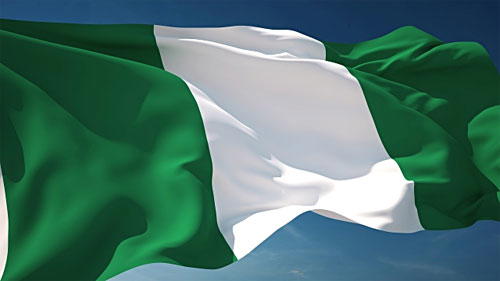
Nigerian Flag
By Gabriel Ewepu
BARELY 48 hours for the nation to celebrate her 61st independence from colonial rule by Britain on October 1, 2021, Civil Society Organisations, CSOs, Wednesday, reflected on impact made by the nation’s independence of 61 years on development, unity, peace, trust, equity, justice, fairness, security, governance, electoral process, advancement, true federalism, and other pertinent issues.
Also they x-rayed worrisome issues that have brewed over the years, hence have become clog in the wheels of progress, peace and prosperity based on the height of insecurity, agitations to break-up the country, insurrection, growing monster of insecurity, hate speech, nepotism, religion, decaying infrastructure, poverty, dwindling resources, corruption, and other vices that have eaten deep into the fabrics of national live, which have made the nation inimical to all kinds of unthinkable happenings across the country.
Nigeria on the precipice-CDNDC
Coalition in Defence of Nigerian Democracy and Constitution, CDNDC, Ariyo-Dare Atoye, said, “Nigeria is on the precipice, and this year, the independence day anniversary should be used as a mea culpa by leaders at all levels, led by President Muhammadu Buhari, to apologise to Nigerians for their shameful and painful failures.
“Nigeria is a viable geographical entity, beautiful and blessed with abundant human and natural resources, but led into doldrums and dire straits by bad leadership.
“The president should, after a moment of solemn speech, convene an emergency dialogue conference over the state of the nation, listen to opinion leaders across the nation and begin a process toward healing the country from the path of social justice.
“This is another opportunity for the leadership to reconnect with the people, seek their support and work together towards renewing their commitments to salvage a dying nation.”
61 yrs after, Nigeria’s like vehicle struggling to climb hilly road-OLF
The Founder and Global President, One Love Foundation, Patrick Eholor, said, “61 years after independence, Nigeria, like a vehicle struggling to climb a hilly road, has yet to achieve its potential. Its large population has thus become a source of weakness, not strength.
“With mass unemployment and overstretching of inadequate and poorly maintained infrastructure, many Nigerians have had to seek their fortunes abroad.
“Sadly, smaller nations such as Ghana, Rwanda, Ivory Coast, Tanzania are beginning to catch up. At the same time big corporations from industrialised and wealthy countries in Europe and South Asia find the Nigerian business climate inauspicious.
“That is largely due to decaying infrastructure, corruption and insecurity. Big European corporations have over the years shut down or relocated their Nigerian manufacturing plants. They point to a lack of stable electricity supply and endemic corruption, both of which impede their smooth operations.
“By most standards of socio-economic development, Nigeria has not lived up to its potentials since becoming an independent country in 1960.
“A nation with immense promises; 61 years after, Nigeria has become the world’s poverty capital with millions of her youths largely unemployed.
“Over the years, the country rose to become the largest black nation on earth and steadily populated most corners of the earth with its brilliant people who have notably helped other countries succeed in the task of nation building while their homeland ironically continued to fail on expectations.
“When the British colonial government gave up its rulership of the country in 1960, it was reportedly considered by many to be relatively ready and able to lead Africa and indeed the black race from the front. While there were talks about the country’s weak and largely undefined unity, the Prime Minister, Tafawa Balewa in his Independence Day speech delivered in Lagos, disclosed to the world that Nigeria was committed to leveraging its independence to become a responsible member to it then and in the future.
“Despite her immense natural and human resource endowments, sustained cases of poor political governance, abject poverty, pitiable electricity infrastructure, needless deaths from bad roads and ill-equipped hospitals, as well as incessant security challenges have dominated and kept Nigeria from living up to its prospects. Across its regions, states, villages and homes, citizens have grown weary and depressed of how badly the country is doing in key socioeconomic benchmarks.
“Five years after its independence, Nigeria in 1965 built its first refinery at Alesa Eleme part of Port Harcourt, closer to most of the oil fields it earlier discovered. At the time it did, the refinery’s initial output was 38,000 barrels a day (bd) which was enough for the country to run its domestic economy. The capacity was however expanded to 60,000bd as demand and population increased.
“The country entrusted the Nigerian National Petroleum Corporation (NNPC) to run the refinery as it indeed managed her hydrocarbon resources, and soon the corporation built another in Warri in 1979 with a 100,000bd production capacity, Kaduna and a second in Eleme in the 1980s.
“Collectively the NNPC had a crude oil refining portfolio of 445,000bd capacity, and they adequately met Nigeria’s domestic demands for refined products at the time; excess outputs from the refineries were reportedly exported until in the 1990s when their production began to decline while the country’s population increased.
“With time, NNPC’s four refineries could not supply Nigeria the volume of petroleum products its domestic economy demanded, and the country embraced importation as an alternative.
“It was for no reasons other than persistent corrupt management practices in the refineries’ business, absolutely poor maintenance culture as well as systemic adoption of all-round inept processes that the four refineries failed woefully and has now totally collapsed.
“To keep refined petrol flowing in her domestic economy, the country yearly import billions of litres of refined petrol, pay enormous financial subsidies to oil marketers to keep pump prices at government regulated prices and sadly ship off to foreign countries millions of jobs that local refining of oil should have given to her growing population.
“Recently, the Petroleum Products Pricing Regulatory Agency (PPPRA) disclosed that between 2006 and 2015 alone, Nigeria paid out N8.9 trillion on petrol subsidy. Without a doubt, business analysts believe that such monies could have remained within Nigeria if her refineries were up and running.
“The government has also reportedly spent billions of naira, recently about N276 billion between 2015 and 2018, to repair the refineries without any results.
“In her 61 years as a sovereign nation, Nigeria from available data has been unable to provide electricity to 80 million citizens. According to records obtained from the World Bank, and which are comparable with that of the Nigerian Electricity Regulatory Commission (NERC), access to electricity in the country have remained extremely low with approximately 80 million people shut out from the national grid which has equally floundered on account of diversities of systemic challenges.
“The World Bank in an appraisal document it prepared following its intention to support the country’s power sector with funds to invest in infrastructural upgrade, explained that Nigeria has the largest absolute electricity access deficit in sub-Saharan Africa.”
We have not done fairly well-CN
The Convener, Concerned Nigerians, CN, Comrade Deji Adeyanju, said, “We have not done fairly well as a nation because our elections are generally unacceptable in the country.
“Many questions are still asked, agitations all over the country, the economy is in shambles, the value of the Naira is so weak, relationship between business and government is at the lowest ebb.
“The Buhari government has over-spent, which affects his credibility; there is no semblance of governance in the country, even to put on the streetlights in the Federal Capital Territory has become a challenge including highbrow areas of the city, and darkness has enveloped the entire FCT.
“It is unfortunate that this is a government that promised change and to do things differently. We are having difficult times.”
Disclaimer
Comments expressed here do not reflect the opinions of Vanguard newspapers or any employee thereof.