By Chris Onuoha
The Politics of Representation, an exhibition of paintings celebrating award winning artist and art advocate Oliver Enwonwu was unveiled on September 20 at the Alliance Francaise Gallery, Ikoyi, Lagos, running till October 10, 2021.
The atmosphere was calm, and the people; art enthusiasts, students and art collectors in their numbers with the covid-19 protocol compliance, had fun-filled day, feeding their eyes with paintings that provoke interest and challenged the black consciousness.
The 20 pieces bodies of work, all paintings rendered in a style of the old masters Victorian era with strong hue of deep colours are painstaking jobs made possible by the space and time the covid-19 pandemic lockdown afforded. Oliver who has been very active with the responsibilities of the Society of Nigeria Artists (SNA) as the National President, including other duties as an art advocate, Director at Omenka Gallery and other cultural engagements, deemed it honourable to showcase once again his inert passion for painting after many years of absence from active studio practice.
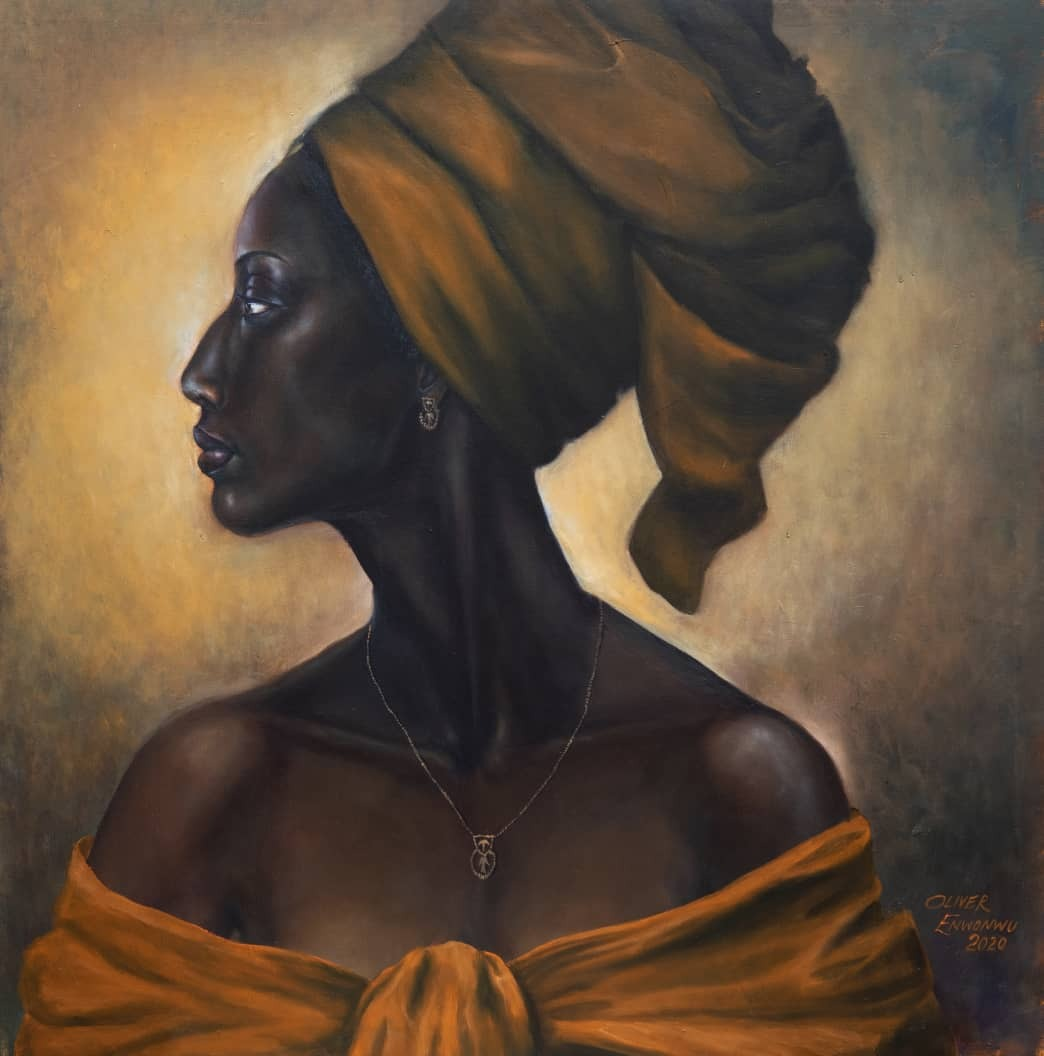
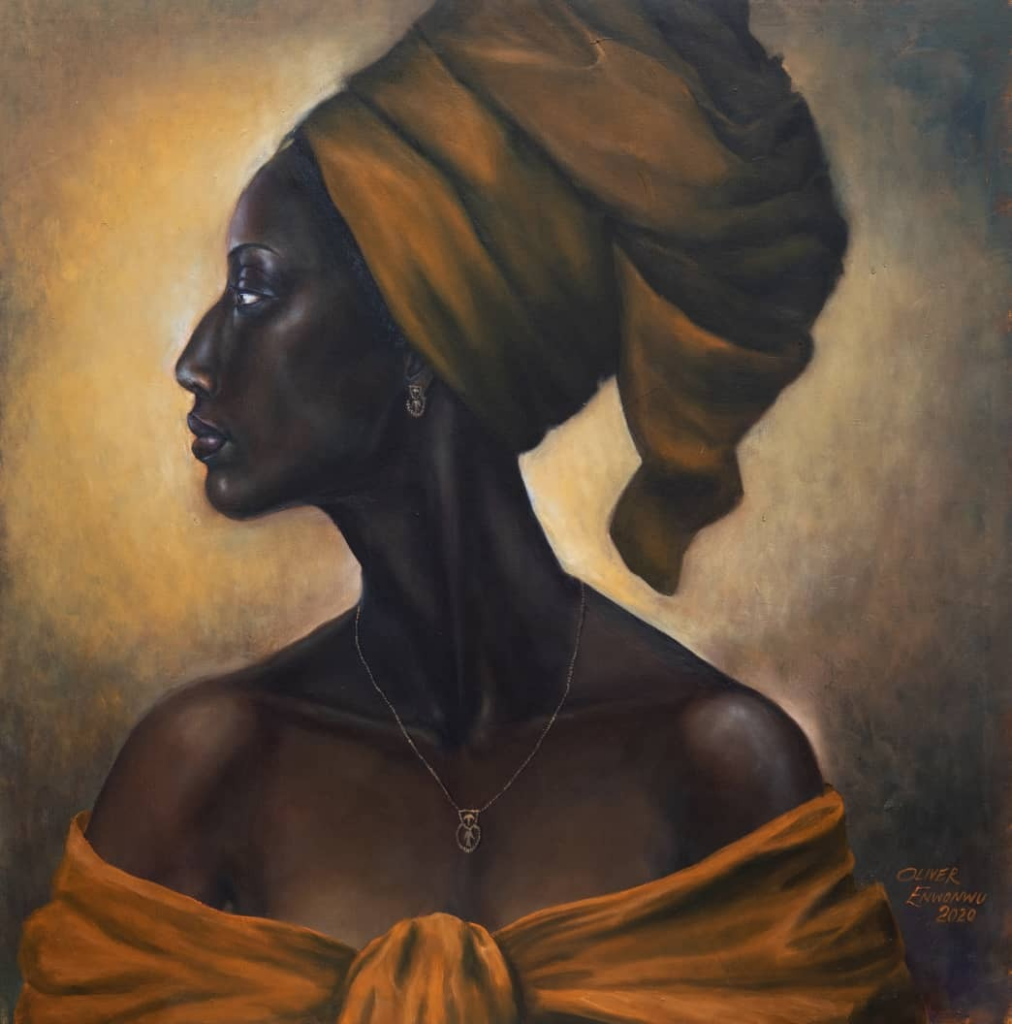
Through Enwonwu’s strong figurative style, ‘Politics of Representation’ interrogates the complex layers of history connecting the African continent with the West. His powerful portraiture celebrates the cultural, political, and socio-economic achievements of Africans and how these have affected the identity of the global black race. The exhibition contains works from Enwonwu’s ‘Body of Power’, ‘Signares’, ‘Belle of Senegal’, and ‘Wanderers’ series, which explore the effects of migration.
Some of the works in the exhibition are a homage to his late father’s masquerade series, highlighting the spirituality and rhythmic movement of the dance of the masquerade, a performance which transcends time and space to rest on a sensory level of liberation.
Oliver presents diverse portraits in the magnitude of visual classical poetry, exploring traditional dance as the ultimate form of creative expression, and tracing the history of female empowerment in West Africa, and its influence on trade and culture in Europe and beyond. He paints pre-dominantly female figures in aristocratic poise with stoic expression, observing their on-lookers with elegance, formality, and grace. There is a quiet aloofness which exudes from their gaze, as if in defiance of being forgotten, and finally being celebrated with proper recognition.
Oliver’s works are inspired by the absence of Black personages in European art history. This glaring omission fueled his desire to fill this huge void with vibrant portraits depicting black excellence. His female subjects are coiffed with elaborate, elongated and regal head-wraps, like symbols of a heightened mental and moral strength and fortitude. He presents graceful, athletic forms, some in classical dance poses, their flawless dark skin engulfed by folds of rich draped fabric.
In his ‘Black & Proud Series’ he paints most of his subjects in profile with long, graceful necks and pronounced décolletés, high foreheads and prominent cheekbones. They are clothed in defiant red, regal purple and rich earth-tones, like “Ebony”, whose confidence is obvious, as she consciously turns her head and ignores her audience, like a modern-day Queen Nefertiti.
Many of these portraits are inspired by the history of the influential “Signares” of Senegal, who originated from the Island of Goree, and were “African and Afro-European women who owned property and achieved high social standing.
It is no wonder that these legendary female business “tycoons” inspired Oliver, somewhat echoing his fathers’ famous “Negritude series” which reflected the African liberation movement spearheaded by the Senegalese politician and poet, Leopold Senghor.
Oliver’s portraits pay homage to the economic prowess and political leadership of women, and how they were the bedrock of trade across the African continent. This also attest to the inclusion of the regal painting ‘Ronke II” among the women with economic prowess.
Ronke, according to him, is a very pragmatic, serious and thoughtful economic powerhouse that needs to be reckoned with in the spheres of artistic impression. Ronke, a princess of the Oba Ademiluyi dynasty in the old Ife ruling house, also belongs to the lineage of the “Tutu”, the innocent princess painted and made popular by his father, Prof Ben Enwonwu, which attracted global interest in the auction house.
Many critics reacted to Oliver’s resurgence into active painting. They were however, of the opinion that it is a welcome development in the art industry, having a protégé of one of the famous Nigerian art modernist keep the fire burning.
“His works are odes to beauty, excellence and regality, reminding one of visual poetry in the style of a classical Shakesparen sonnet,” commented Sandra Mbanefo Obiago, the exhibition Curator and Founder & Artistic Director of SMO Contemporary Art.
“His brush strokes express stoic grace, poise and formality, at a time when figurative art in celebration of the black body have formed a critical backbone of the global movements around black identity, such as the recent Black Lives Matter generational cry of affirmation and power,” remarked Obiago.
“In Oliver Enwonwu’s solo exhibition, one encounters a unique archive of portrait paintings inspired by queries of absence of African personages in the artistic milieus of 16th to 19th century Western art history,” stated Samuel Egwu Okoro, Art History Professor in the Department of Fine Art and Design at University of Port Harcourt.
“Oliver finds ways to imbue his imaginary sitters with a sense of identity, allowing their distinctive features, clothing and compelling posture to give the otherwise unknown character a clear sensibility. Oliver’s vivid portraits, depicted in stylish, colourful attire, imbue his subjects with a strong sense of regality, autonomy and self-assertiveness,” commented Hannah O’Leary, Director of Sotheby’s.
This is an exhibition of paintings celebrating the works of Oliver Enwonwu where he has dug into his artistic reservoir. It is his first solo exhibition in over 20 years and it is so important because two of his strong figurative works, the females of Senegal and the masquerades are used to celebrate the absence of certain important things in the corner of art history specifically,” says Nneoma Ileogu, Manager and Assistant Curator at SMO Contemporary Art.
“Other works like the masquerades where he paid homage to his home town Onitsha, the Tauregs, depicting the culture of the nomadic movement and the painting of his mother, paying homage to his lineage, are works that speak about how Western meets Africa. Oliver is very much independent of himself as a person and he has developed and groomed his styles over the years,” added Ileogu.
An art collector, Osa Dahlton Ozigbo -Esere said, “I have known Oliver for a long time. He has been active in painting for some time, but later went to the background because of his numerous activities and responsibilities with the Society of Nigerian Artists (SNA) as the President.
However, I am glad he has find time to paint again and I am one of the people that have been pushing him to paint again. If you understand him well, you know that art is in his DNA, and he has the skills. Skill is just a word, but it is actually a genetic. I am very impressed with the finishing and also impressed with the spirit behind the works, because it is a history, a family history, so to say.”
Speaking with Oliver at the exhibition, he said: “It feels great and what is important here is that I have put a body works after a long time of absence from studio practice. I have had two exhibitions in the United States, and also had couple of successful group exhibitions. I am happy that I am having my second solo exhibition in Nigeria after the last one which was held in 1999. I am happy that my works has resonated to the general public and collectors are having a field day,” he said.
Talking about the colours and medium, Oliver stated that the dominant colours and techniques are for a purpose, to challenge and raise debate about how black people were represented in art by the old masters.
“For the colours I used in the entire body works, it actually stands for the old master colours and techniques. This is because I know that in the West, portraiture is one of the major kinds of art practiced. In the old masters portraiture works, you could see that black people are not well represented, and when they are, they represent them in servitude.
That is why I wanted to use classical poses, master techniques, colours and use of representations, using their own tools which they used to subvert us, to champion our own cause. That is what the exhibition and colour choice is about. Certainly, the project is to spark a debate and conservation about the politics of representation in art as it concerns the black race,” Oliver said.
Speaking further, he said: “In adapting sixteenth century old Masters’ modes of representation and techniques, I explore how for example, the mixed heritage French-African women of the Island of Gorée in Senegal negotiated their identities during the 18th and 19th centuries, “explained Enwonu.
“I celebrate the African woman in form and rhythm through jewelry, adornment, and apparel, drawing on historical narratives of black female defiance against cultural and political imperialism.”
Enwonwu holds a Master’s degree in Visual arts with distinction from the University of Lagos, Nigeria and is currently working towards his PHD in African Art History at University of Benin.
He comes from a long line of remarkable artists, such as his grandfather, a reputable traditional sculptor, and his father Ben Enwonwu, widely known and celebrated as Africa’s most celebrated pioneer modernist. He has participated in over fifteen exhibitions, spoken about the global art market at global conferences.
This exhibition is supported by Alliance Francaise and Louis Guntrum wines, and will run till October 10, 2021.
Disclaimer
Comments expressed here do not reflect the opinions of Vanguard newspapers or any employee thereof.