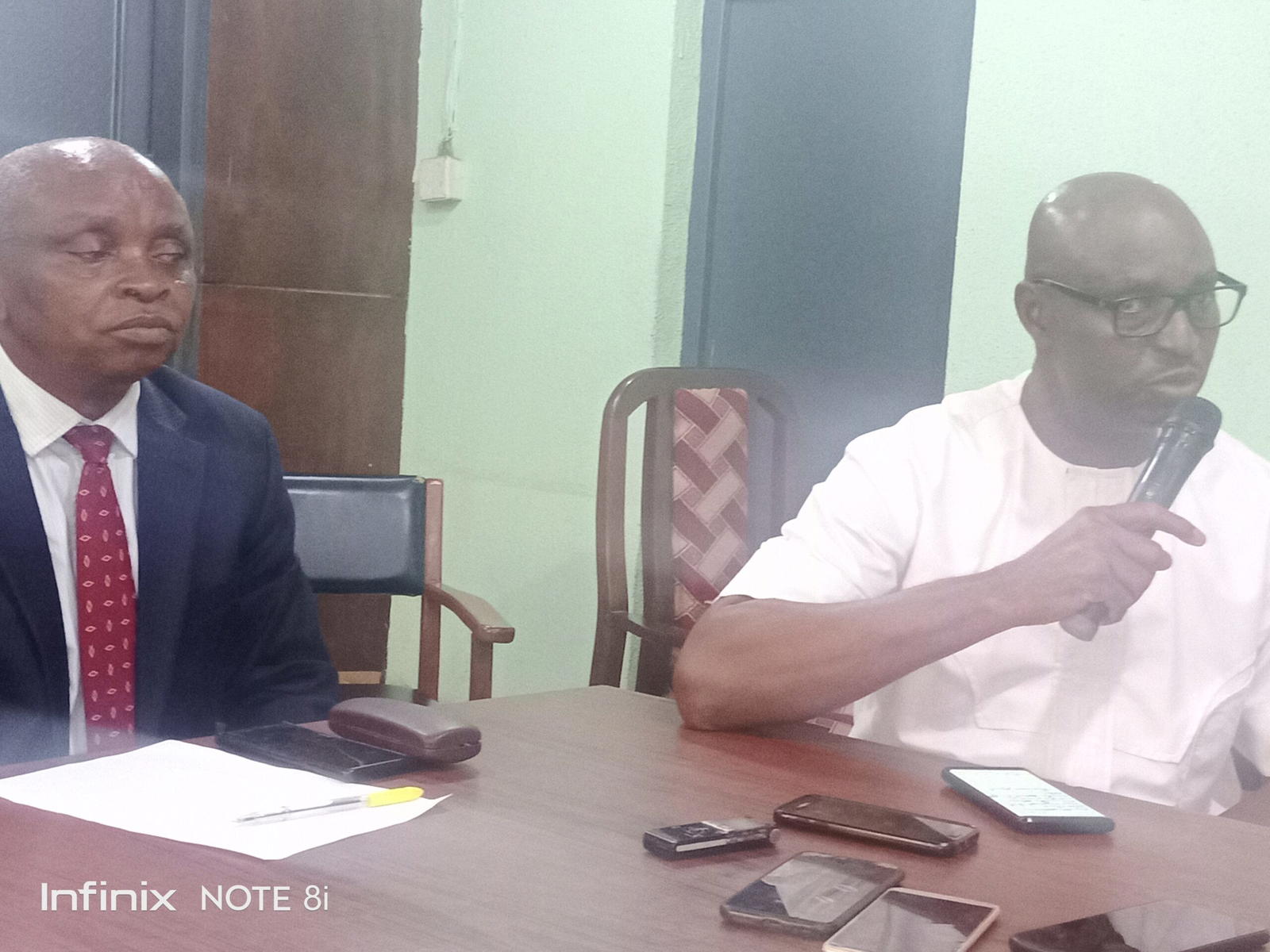
Chairman Board of Directors Enugu State Water Corporation, Engr. Innocent Diyoke and the Managing Director of the state Water Corporation, Engr. Martin Okwor speak on the state of water supply in Enugu and Nsukka urban cities and the future of portable water supply in the state. Excerpts:
By Dennis Agbo
What is the water situation in Enugu state right now?
When we came on board in the last three to four months, water supply was at an abysmal level in the state, it was very low as a result of the breakdown of pumping equipment at production centers at Ajali, and Oji River stations. But we stepped into action quickly and undertook a rapid assessment of the existing systems at Ajali and Oji River and came up with emergency rehabilitation measures that needed to be done to improve water supply immediately.
The Governor approved and released funds immediately to carry out those emergency rehabilitation measures. As we speak, these measures have resulted in improvement of water supply from about 10,000 to11,000 cubic meters when we came on board to about 40,000 cubic meters and above. What that means is that there has been some marginal improvement in water supply from what it used to be. We have also gone around the Enugu metropolis to confirm that as a result of improved water supply, some of the areas that had not received water in the past are now receiving water.
We have some photographs. We did the same rehabilitation measure in Nsukka. When we came on board, only one borehole was working in Nsukka but as we speak four boreholes are working at Nsukka today and in the next few weeks, six boreholes will work in Nsukka. We have already been given money and we have purchased the pumps to make it six and we are already on-site and they are going to be installed in the next two weeks. So in the next two weeks, we should have six boreholes working in Nsukka but as we speak we have four boreholes working at Nsukka. We attribute these successes to the swift intervention of His Excellency, the Governor of the state.
What other water interventions are being carried out in the state?
The Government of Enugu state under the leadership of Governor Ifeanyi Ugwuanyi has received a credit of fifty million US Dollars ($50 million) from the French Development Agency (AFD). This funding is already in place and it is being used to expand the Enugu Water Supply System including the production centers. As we speak, the Consultant for detailed Engineering has commenced work for over one month and he has five months to complete his studies, design and produces working drawings and tender documents for rehabilitation for a complete revamping of both Ajali and Oji River pumping stations; As well as the transmission lines from Oji and Ajali to Enugu that will involve 12 kilometers of 700mm diameters pipelines.
ALSO READ: Southern Governors’ Resolution: Stop heating up polity, YAF cautions
Then, the extension of pipelines in Enugu to areas that have not been severed as well as complete rehabilitation of the distribution system and changing some of the old asbestos pipes that are prone to breaking and bursting. All these are currently onboard and in the next one or two years, Enugu will be flooded with water from that project. The consultant is working very hard and the project is at the inception stage and in the next six months, the design and tender documents will be ready after which the bidding process will be let and then the contractor will be selected to carry out the implementation activities.
The government is also not resting in its oars, in the last two or three months, the government awarded a contract for the rehabilitation of the 9th-mile crash water programme. We have some existing 12 boreholes that have been out of use for some time and the governor awarded a contract of N600 million for the rehabilitation and revamping of that crash programme borehole site. Presently the work is in progress; eight of the 12 boreholes have been recovered and developed, ready and the contractor has ordered solar-powered pumps, solar panels, and treatment plants as well as pipes that will be used for rehabilitation. Very soon they will arrive and be installed and that will further improve the water supply situation in Enugu.
We have also been granted the permission to employ needed staff because part of the problem in Water Corporation is incapacity, of inadequate staffing, many staff have retired and no replacement. So when the Board came and did a quick evaluation of the staff capacity, we discovered that we needed to inject more staff, particularly younger ones to be trained under the consultants that are working under the AFD project so that they can be trained under the job and take over when the consultants finish.
The government also approved that for us and in the last two months we have been doing screening and still holding interviews up till now. We are looking for just under 100 people but we received more than 6,000 applications and we are using merit. We want to show that the government can get it done right.
We want to rebrand the Water Corporation, we want to revamp it; we want to show that we can do business. Our target is that by the time this water corporation is where we want it to be, the corporation should be self-sustaining. The corporation will not be needing money from the government, rather the corporation will be making a profit; Move our staff from the premium service condition and begin to pay them like the private sector they are. Water corporation staff are on essential duties, there is no reason why they should be receiving salaries as if they are civil servants. This is where we are and where we want to get to.
What is the AFD project all about?
The idea of the AFD project is that the water will be fully commercialized, we will show that water is an economic good as well as a social good. The high-income dwellers, the high valley districts will pay for water because the willingness to pay is there and the ability to pay is there. Those in the pro-poor areas, their payments will be subsidized. So you can ask me to pay N10,000 per cubic meter, for example, then the man who is a poor man living in a face me I face you will not pay the same N10,000 as the man living in a duplex or a mansion at Independence layout. The AFD programme is addressing the complete water system, the expansion of the existing network and the areas that are not served, and also ensuring that the areas that are served have water every day.
The water demand in Enugu today stands at about 150, 000 cubic meters, while the total production from Ajali and Oji River will be at 120,000 cubic meters but when the AFD project is completed we are going to be getting over 180,000 cubic meters per day. So there will be water everywhere. The pipelines will be there, people will smile but people should also be ready to pay for water bills.
What happened to the previous water intervention programmes in the state?
The first National Urban water supply scheme, a World Bank-financed project, was done between 2005 and the following years. Pumps were replaced at Ajali, Oji River, and others but because of our inherent deficiencies in the management of the business, we don’t budget for maintenance and capacity deficiencies here and there, some of those pumps died too early and that’s why they have now broken down and they are being replaced. The pipes that were laid are still there but the pipes will not flow if there is no water.
ALSO READ: Court remands 4 artisans for allegedly stealing wrappers
As I said, the demand for water and the capacity of Ajali and Oji River is 120, 000 cubic meters per day. When our Board was inaugurated, the supply was about 10,000 cubic meters and when you don’t have the supply, the pipes cannot flow. So the pipes that were laid are still there but the pipes did not cover all parts of Enugu. Now this AFD project is going to address that and that is why we have started with capacity building, engaging staff so that these staff that we engage will join the consultants as they are doing the design, as construction starts they will be part of it for technical management and operation when the job is completed so that the new equipment we bought will not decay too early. We are equally going to make the government understand that there will be a budget for operation and maintenance. Training of staff will cover financial management, bills collection, inventory, commercial activities and all that, so it’s a comprehensive programme.
If we continue to get the support we are getting from the government now, our target is that in the next year we should be having up to 100,000 cubic meters per day and the water is going to be generating revenue in the excess of N100 million every month. That’s our target, the target that this board gave itself and by God’s grace, we are going to meet that target.
What will happen to the areas that are yet to be connected to water?
I have mentioned that under the $50 million AFD water project all those areas will be serviced, pipelines will be laid in all those areas. As we speak, GIS mapping has already captured all those places. The engineering design consultant has just done one now and in the next two weeks, you will see him carrying out surveys of all those areas with a view to designing a water distribution network for those areas. So they will be accommodated.
In the areas yet to be served, there has been a lot of developments in Enugu, many new districts, housing estates have sprung up here and there and many of them don’t have access to water supply. Even the older districts that have access, what they have are old asbestos cement pipelines and we longer use them in the water supply because they are carcinogenic. They need to be changed and they are part of what we are going to do with the 50 million dollars AFD financed project.
Why is it that some areas in Enugu are getting water?
Specifically, right now in Independence layout areas such as Pasker & Jerks, Nza street, government houses areas are getting water right now, but NTA areas are not getting water now because the line which supplies them are asbestos cement, and most times when we pass water on the high-pressure line that supplies them, there will be bursts but what His Excellency has done is to release funds for us to be maintaining the pumps while the AFD project is going to replace it. We equally have to form a Rapid Response Team and the idea is that as soon as we pump water in those high brow areas and there are bursts, even if it’s in the midnight, they will go there and attend to the bursts.
What about Emene, Trans-Ekulu, Abakpa?
The lower part of Emene is getting water, but some sides of Emene don’t have water because the North-East tank is not receiving water and we have instruction from His Excellency that water must enter the tank and we have started work there. We have gone for an investigation and we are trying to resolve the problem that prevents water from getting into the tank. Very soon water will enter the tank and then Emene will be better served. In the cases of Trans-Ekulu and Abakpa, like I said we have to understand that we don’t have enough water supply.
There is a gap between the demand and what we are producing presently. The demand currently should be about over 150,000 cubic meters per day and even the combined production from Ajali and Oji is 120, 000 cubic meters, but what we are having now is 40 and we are hoping to get up to 100,000 cubic meters before the end of the year and so we will be scheduling. The Board has already done a timetable that could say on Monday we serve Trans-Ekulu, Tuesday we serve Uwani, Wednesday we serve another area, just like that. But there are areas because of their location and topography, whether you schedule them or not, they must get water because of their location and topography. So we are going to be scheduled until we have enough water supply.
Some parts of Trans-Ekulu are receiving water now but others don’t have but right now as I am talking to you, work is ongoing in a booster station at Tank close behind CBN quarters. The pump is being installed, the tank is being rehabilitated and his Excellency released money specifically for that area because Trans-Ekulu is a high brow area and we need to serve them. So by the time we finish the tank rehabilitation water can then enter the ground tank and we pump up and those areas down up to Dental College and other places will start getting water and this is as we are talking. Right now, under gravity, the areas that are getting water are the lower parts of Trans-Ekulu. Nike lake area is not on the map for now but will benefit from the AFD project which is the one that will be expanding the whole system.
What about the Nsukka area?
Almost all parts of Nsukka are getting water right now except in isolated cases.
Disclaimer
Comments expressed here do not reflect the opinions of Vanguard newspapers or any employee thereof.