James Ogunnaike
A Professor of History of Texas at Austin, Professor Toyin Falola, has called on agitators for the disintegration of the country to shelve the idea, rather, they should agitate for true federalism and devolution of powers to all the federating units in the country.
Prof. Falola said, it is better for Nigeria to remain as one indivisible nation, rather than for each tribe to go its separate ways.
The Professor of History made the call while speaking with journalists at the sideline at the sixth J. A. Atanda Lecture & Conference, with the theme, “Yoruba Culture & Society”, held at Babcock University, Ilishan-Remo, Ogun State.
He said, “in Nigeria, the agitation for secession began with Biafra, but they did not succeed. What I want the different groups to agitate for is true federalism or what many people called ‘restructuring’ of the country, whereby powers would be decentralized among the federating units.”
“Though the present situation in the country is not comfortable for everyone but calling for the disintegration of the country is not the solution, stressing that dissolution of power among all the federating units in the country would be the best solution to series of challenges facing the country.”
He said, “in Nigeria, we need power devolution or power decentralization. This means that we will all remain in Nigeria, while the centre transfers powers to various regions. That is what we had in the first republic, where all the three regions in the country were controlling their resources. They only paid taxes to the centre”.
“What we have in Nigeria today is overcentralisation of powers at the centre. Some people are calling for the return to the 1963 Constitution, which according to them will afford the country to go back to regional government.”
ALSO READ: Ubani kicks against FG anti-democratic policies, FHC practice direction, NDLEA drug test
“Every region and every part of the country is angry about something. So, how to minimize the anger from different quarters should be the main thing now, which should be devolution of powers by the federal government to the federating units”.
“In this case, each region should be allowed to control its resources, pay taxes to the central government. This will allow each region to develop at its pace”.
Prof Falola noted that “the argument of Professor Banji Akintoye, who is leading the crusade for the Yoruba nation is that the progress of the Yoruba region has been retarded by its membership of a republic. He does not want civil war or any breakdown of law and order. He simply wants a careful deliberation of the mapping of the country of regional autonomy of Yoruba nation.”
Speaking of the perceived notion by some people that Yoruba culture is going to extinction, Prof. Falola said, “the Yoruba culture cannot go into extinction with its population of about 40 million people.
He called on parents to cultivate the habit of communicating with their children in Yoruba language, saying that “before age 7, children have the ability to learn many languages. It is better we take advantage of that to teach our children our culture and language.
“We can also plead with Universities to allow their students write their Masters and Doctorate degrees thesis in Yoruba language. Also, the Senate should revisit the nation’s education policies for post graduate students to write their thesis in their mother languages”.
In his welcome address, the Vice Chancellor, Babcock University, Ilishan-Remo, Prof Ademola Tayo said the conference was intended to pull reputable scholars and academics, political and state administrators, leaders of different communities, including traditional rulers and the general public of many shades and various classes to converge and share ideas, thoughts and scholarly approaches to national development.
“The theme of this year’s event is titled, “Yoruba Culture and Society”, which has been carefully selected for the purpose of exploring the historical approaches of the Yoruba to addressing issues of nation-building with a view to distilling and applying ancient and indigenous ideals for the resolution of contemporary crises and challenges of statehood in Nigeria, Africa, and the world, at large.”
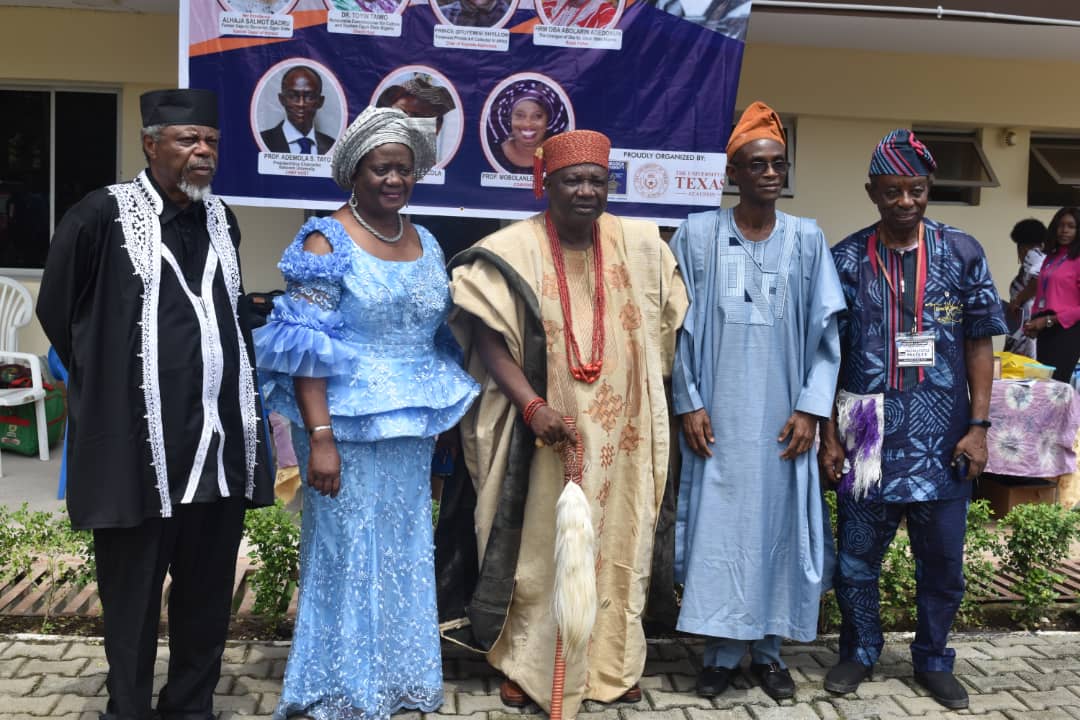
Some of the dignitaries at the three days event included former Deputy Governor of Ogun State, Alhaja Salimot Badru, Ogun State Commissioner for Culture and Tourism, Dr Oluwatoyin Taiwo, a foremost private art collector in Africa, Engr Yemisi Shyllon, and traditional rulers.
Disclaimer
Comments expressed here do not reflect the opinions of Vanguard newspapers or any employee thereof.