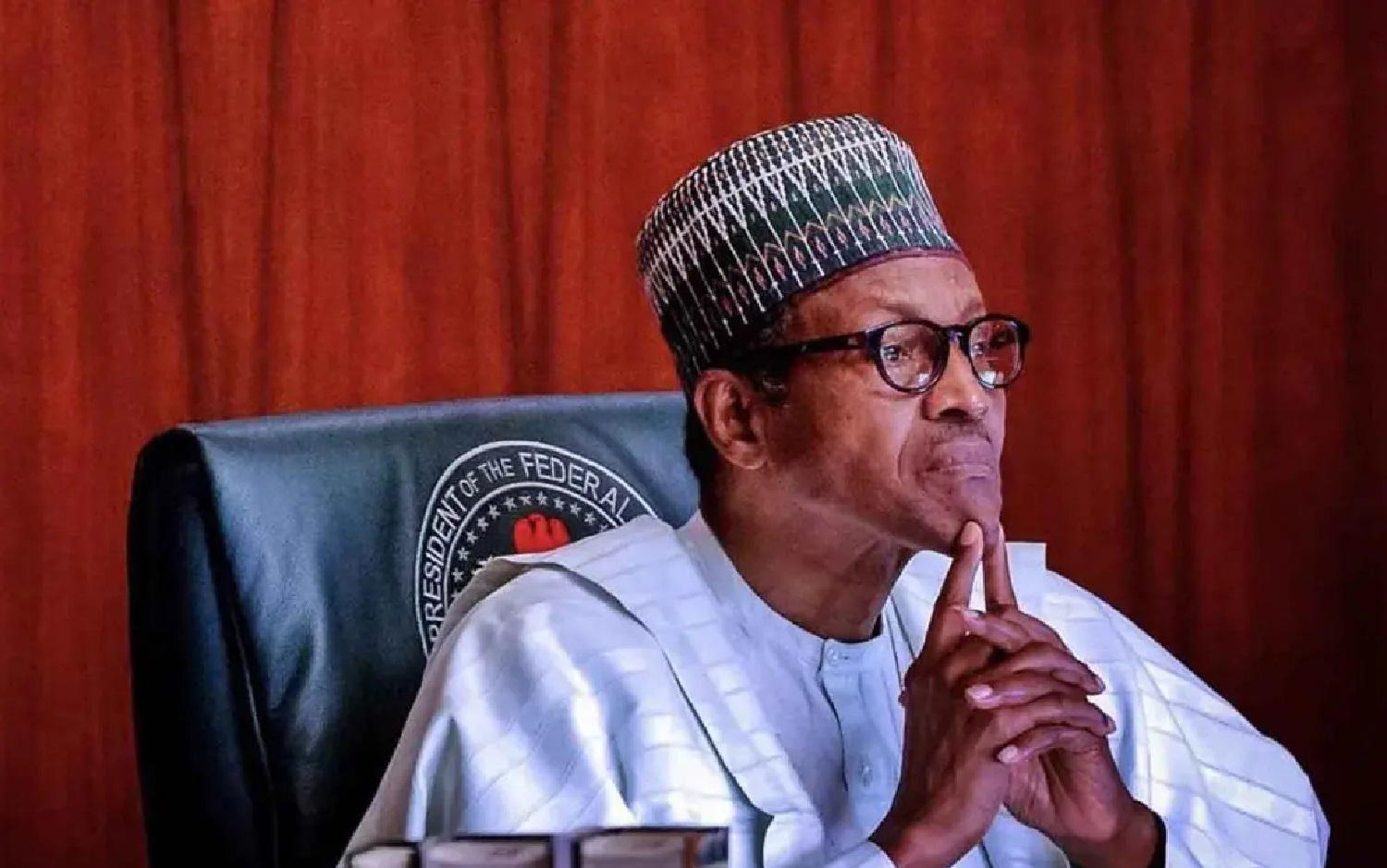
President Muhammadu Buhari
By Our Reporters
President Muhammadu Buhari.Cross section of Nigerians interrogated President Muhammadu Buhari’s claim of progress in economy, security, infrastructure and other key areas in his New Year letter, saying the country did not fare better in 2019.
They said the current state of the sectors requires the declaration of a state of emergency instead of what they described as lip service.
READ ALSO:Shame of a Nation! How Tafawa Balewa’s widow was abandoned after husband’s death(Opens in a new browser tab)
Armed with statistics of Nigeria’s place in various human development reports, cross section of the people urged Buhari to stop what they termed self-glorification and appreciate the real dangers facing the country in critical sectors.
Real dangers
The President had in the message titled: Nigeria’s Decade, pointed at gains and ongoing efforts in economy, rail transport, security, infrastructure, power, agriculture, and electoral process. But Nigerians of different classes, in their response, told Sunday Vanguard that the President’s claims that policies in those areas are working are inaccurate.
Economy: Policies working
On economy, Buhari said: “Our policies are designed to promote genuine, balanced growth that delivers jobs and rewards industry. Our new Economic Advisory Council brings together respected and independent thinkers to advise me on a strategy that champions inclusive and balanced growth, and above all fight poverty and safeguard national economic interests.
“A good example of commitment to this inclusive growth is the signing of the African Continental Free Trade Area and the creation of the National Action Committee to oversee its implementation and ensure the necessary safeguards are in place to allow us to fully capitalise on regional and continental markets.”
However, those who spoke to Sunday Vanguard had different opinions.
Do not take more loans – Mailafia
A former Deputy Governor, Central Bank of Nigeria, CBN, Dr. Obadiah Mailafia, warned against continuing with current approaches to economic realities.
$84.4 billion
He said: “In a matter of five years, our national debt has ballooned from $10 billion to a staggering $84.4 billion. And we do not have much to show for it. I would be wary of taking more debt without these guardrails of financial discipline. Some of us were involved in the Paris Debt negotiations in 2005/2006 that saw our debt cleaned up by the club of international creditors. At that time our external debt was about $36 billion. Even then it was a heavy burden on our public finances. We were spending something like $5 billion on debt servicing alone. In the deal that we negotiated with the Paris Club, we paid back something of the order of magnitude of $20 billion for the rest to be written off. I was acting for the Central Bank Governor at the time and I recall signing the cheque for the first tranche of $7.5 billion.
Public finances
“When I signed the cheque I caught fever immediately and had to have bed rest. I could not fathom coughing out such a staggering amount to pay off some rich people in the advanced industrial countries. It was a necessary surgical operation, but I felt the pain to the innermost marrow of my bones. I know what debt peonage is. Even the Western powers later regretted letting us off the hook. The Paris Club settlement broadened the fiscal space for us to re-launch our economic development process without the harsh IMF and World Bank conditionalities. Those who love our country and cherish our economic freedom and our very sovereignty as a country must be careful not to take that dangerous route again.
Dangerous route
“As matters currently stand, we are already spending 50 percent of our annual revenues in servicing our national debt. If a few variables undergo adverse changes, we could find ourselves in real difficulty. If, for example, our exchange rate falls with the dollar, we could find the debt compounding. And if oil prices fall again, we would find things even more difficult in terms of capacity to repay our loans. It is therefore evident that incurring additional loans, especially in the staggering amount being reported, will complicate our public finances the more.
Doomsday scenario
“If we are currently using 50 percent of our revenues just to pay back our loans, you can deduce that taking another $30 billion will take our total debt outlay to about $114 billion. As you know, we derive 50 percent of all our public revenues from oil. And the same product accounts for 94 percent of all our foreign earnings. This means we are not developing enough tradeables to boost our international earnings. It is prudent to always factor in the risks involved. Nothing in our integrated global marketplace is stable. Currencies and commodities will continue to fluctuate. It is also a truism that we are entering a post-hydrocarbon industrial civilisation.
Post-hydrocarbon
“Most of the advanced industrial economies have already given orders to their automobile manufacturers to move into production of electric cars. Within the next two decades 90 percent of the automobiles in the rich countries will be electric vehicles. That will wipe off 70 percent of the market for oil. Most of our leaders have given no thought whatsoever to this impending doomsday scenario. If we continue to borrow in the expectation that we will continue to earn enough from oil to repay our debts we would be living in a fool’s paradise.
Cost-saving
“We need a comprehensive programme of cost-saving and control of waste in all aspects of the administration. Such cost savings, including regular elimination of ghosts, are crucial to more prudent public financial management. I would imagine that the IPPIS payment system is the right step in the right direction. Such cost-saving will release considerable sums that could be redeployed into infrastructures and other sectors. I also heard recently that some statutory bodies have not been releasing funds into the federation account as required by law. We hear that Nigerian National Petroleum Corporation, NNPC, Liquefied Natural Gas ,LNG, and Federal Inland Revenue Service, FIRS, are allegedly among the culprits. I suspect that such funds would amount to some 2 trillion annually. We must do more to ensure that these agencies obey the law.
2 trillion annually
“In so doing we could boost the level of revenues required to finance infrastructures. We need to deepen macroeconomic and institutional reforms, including privatization. We must deregulate the downstream sector for power, for example, so that foreign and local private investors can invest in the power distribution sector, which currently remains a government monopoly. Through Public-Private-Partnerships, PPPs, we can get foreign investors to invest in key sectors, for example in railways, ports, and harbours. Such financing arrangements will lessen pressure on the treasury, therefore obviating the need to incur further loans. Finally, we must improve the extractive capacity of the state. Nigeria is among the lowest in terms of tax-to-GDP ratio. Ours stands at five percent compared to South Africa’s ratio 25.9 percent. In the OECD countries, the average is 70 percent. So we need to get the framework right. We need to boost investments in key infrastructures and put in place the right institutional support systems to boost businesses and especially Small and Medium Scale Enterprises,SMEs. But timing is important. In a time of slow and delicate recovery, you need demand-management and expansionary policies. You must also secure the common peace. In an atmosphere of insecurity, investors will not come. And local business will be undermined, and, with it, the social capital needs to build trust and confidence in the future.
Existential decision
“It was an existential decision that the Obasanjo administration undertook to give us a breathing space. You would recall that the economy grew by an average of seven percent during those years. What we paid was grosso modo, $20 billion in raw cash, not the $30 billion that you are suggesting. Recall that during those years 90 percent of our national debt was external and dollar-denominated. And most of it was owed to bilateral and multilateral donors. The local component of our debt was low because our capital markets were not as developed as they are today. The scenario today is different. Most of our debt is local. In principle, we could print more naira and pay it off. But we are obviously not going to do that because of the implications for inflation and the long-term value of our legal tender currency. The other dimension is China. China is becoming our biggest single creditor. The Chinese do not impose harsh conditionalities like the Washington institutions normally would. But the Chinese always insist on collateral if a debtor is unable to service his loans.
Declaring a moratorium
“Several Africans, notably Ethiopia, Djibouti, Madagascar, Kenya and Zambia currently face the prospects of having major national assets taken over by the Chinese for failure to service their loans. My advice to this government is that we should tread carefully. Only take loans that you are sure you can repay. We must never take loans for consumption. We must take them – if we must – only take for infrastructures and projects that have a guaranteed calculated return on investments. If the government is desperate, we could also declare an amnesty of three years for all the stolen wealth of Nigeria. It is estimated that Nigerians have squirreled abroad something like $170 billion. Declaring a moratorium would allow most of this money to be repatriated. We would only require that they bring the money and invest in the country, with no questions asked. However, after the moratorium has expired, we must pursue and hound the robber-barons down. It worked for Italy a few decades ago, and I don’t see why it wouldn’t work for us. It’s definitely worth try.”
We want revamped economy – Diwe
Similarly, National President, National Association of South East Town Unions, ASETU, Chief Emeka Diwe, demanded a better economy and well secured Nigeria.
He said: “First, we would want to see a revamped and diversified economy in which the recent increment in VAT would lead to greater dividends to people, and local manufactures aided through sound policy frameworks. We would want the federal government to revisit the automotive policy of past administrations and have a rethink on its deal with Hyundai to protect Nigerian indigenous carmakers.
“The government should urgently address the various security challenges in the country. The menace of the herdsmen against innocent vulnerable citizens is one thing the government must address.’’
Make economy competitive – Prof Agbedo
For the Head of Department of Linguistics, Igbo, and other Nigerian Languages, University of Nigeria, Nsukka, UNN, Prof Chris Agbedo, Buhari must ensure that his economic policy has positive impacts on ordinary Nigerians.
He said: “Although President Buhari has identified fighting corruption, security, tackling unemployment, diversifying the economy, enhancing climate resilience and boosting the living standards of Nigerians as main policy priorities his government seeks to pursue, it is not yet Uhuru for Nigeria as the Economic Recovery and Growth Plan established on three strategic objectives of restoring growth, investing in the Nigerian people and building a globally competitive economy is yet to impact positively on ordinary Nigerians, who are getting hungrier and angrier by the day.
“The World Bank review of the macroeconomic indices holds no hope for Nigeria as economic growth is constrained by a weak macroeconomic framework with high persistent inflation, multiple exchange rate windows and forex restrictions, distortionary activities by the Central Bank, and a lack of revenue-driven fiscal consolidation results.
No hope for Nigeria
“Nigeria’s human capital development remains weak due to under-investment, which explains the country’s ranking as 152 out of 157 countries in the World Bank’s 2018 Human Capital Index. With the 2019 fiscal year deficit at N3 trillion in eight months as reported in the media, it is obvious that Nigeria cannot continue to spend more than it earns, without getting into financial straits”.
Nepotism, favoritism
“Also, glaring instances of nepotism that clearly mark federal appointments in recent times tend to represent a drawback to the corruption fight.
“On security, Nigeria has never had it so bad given the incidences of rising insurgency and terrorism, kidnapping, serial killings, and other forms of violent criminalities.
‘’Therefore, I look forward to seeing Buhari’s government appreciating the urgency in reducing dependency on oil and diversifying the economy, addressing insufficient infrastructure, building strong and effective institutions, and re-jigging governance issues and public financial management systems.”
Govt taking gains of wage increase – Asogwa
Still, on the economy, a senior lecturer in the Department of Philosophy, UNN, Nicholas Asogwa, said more should be done in the sector to alleviate the sufferings of the masses.
Asogwa said: “Although government made a lot of paper promises in terms of policies that will revamp the economy, it does not seem to me that these promises had much impact on the lives of ordinary Nigerians, considering the level of hardship in the country. Prices of goods keep on soaring, while salaries of workers remain static.
“Government has increased the minimum wage but wants to take away the supposed gains, as it proposes to increase tax by 50 percent. The capital market remains all time down, depicting low investors’ confidence.
“Kidnappings, insurgency, ethno-religious crises, herdsmen-farmers conflicts, and senseless killings, among others have continued to be the order of the day.
“In fairness to this administration, it is doing fairly well in the fight against corruption. That notwithstanding, the corruption fight is not yet comprehensive as there is a belief that the President is shielding some corrupt persons in his administration, even in the face of petitions.’’
Govt lacks sound economic policies – Jonah
On his part, Programme Coordinator of Civil Liberty Organization, CLO, Eastern headquarters, Enugu, Comrade Kindness Jonah, bemoaned the state of the economy.
Borrowing, not best option – Audu
Economist and banker, Dr. Aliyu Audu, said:” Obasanjo is right in the sense that if we are borrowing for infrastructure and we are not spending the money on infrastructure the debt burden will be high. We are spending over 25 percent of our budget on debt servicing that is not good. Money meant for capital expenditure is being used to service debt. This deprives the country of money meant for capital expenditure. We must reduce our borrowing or we find alternatives to generate revenue. Also, borrowing from local banks is not good in the sense that banks are now looking forward to government borrowing which is far safer and less risky. They are not keen to lend to local businesses this is called crowding out.’’
Infrastructure
On rail transport, Buhari said:”On transportation, we are making significant progress on key roads such as the Second Niger Bridge, Lagos – Ibadan Expressway and the Abuja – Kano Highway. 2020 will also see tangible progress on the Lagos to Kano Rail line. Through Executive Order 007, we are also using alternative funding programmes in collaboration with private sector partners to fix strategic roads such as the Apapa-Oworonshoki Express Way. Abuja and Port Harcourt have new international airport terminals, as will Kano and Lagos in 2020.
“To recapitulate, some of the projects Nigerians should expect to come upstream from 2020 include: 47 road projects scheduled for completion in 2020/21, including roads leading to ports; Major bridges including substantial work on the Second Niger Bridge: Completion of 13 housing estates under the National Housing Project Plan; Lagos, Kano, Maiduguri and Enugu international airports to be commissioned in 2020.”
Infrastructure collapse is alarming – Diwe
On the contrary, Diwe said:”The infrastructure deficit in the country is alarming. There is hardly any federal road in the South East that is in good shape. Further, the pace of work at the Akanu Ibiam International Airport, Enugu is rather inexplicably slow, same with the Second Niger Bridge. Government should see to it that all these are speedily addressed. Mr. President needs to move beyond the orthodoxy of recurring rhetoric and the mantra of diversification as a hollow economic jingle to initiate the basic rudiments for economic recovery.”
PANDEF, religious leaders, others disagree on infrastructure
Contrary to the President’s remarks, Pan- Niger Delta Forum, PANDEF, Christian leaders and citizens in the South-South region expressed dissatisfaction at the manner the government tackled security and infrastructure last year, urging it to change strategy this time.
National Chairman of PANDEF and former Military Administrator of Akwa Ibom State, Air Commodore Idongesit Nkanga ,retd, who spoke to Sunday Vanguard in Uyo, said: “If I look at what they are discussing about security and what is in the budget, it may not go the way I would have wanted to see things this year. If you do not have the equipment, what can you really do? I expect a structural change in the security set up, but if the money is not made available, I do not think my expectations will come to pass.
“It bothers me because I do not even know what is happening to us. During the civil war, we moved personnel around, so for him ,Buhari, to say that we cannot do that now because we are in a state of war, he does not know the damage that is being done.
“Nigeria is a country that is grossly short of infrastructure and unfortunately no country can develop without infrastructure.’’
Insecurity:
On insecurity, Buhari said: “The federal government will continue to work with state governors, neighbouring states and our international partners to tackle the root causes of violent extremism and the networks that help finance and organise terror. Our security forces will receive the best training and modern weaponry, and in turn will be held to the highest standards of professionalism, and respect for human rights. We will use all the human and emerging technological resources available to tackle kidnapping, banditry and armed robbery.”
FG should fix roads in 2020 – Bishop Egbebo
However, Bishop of Catholic Diocese of Bomadi, Most Rev. Hyacinth Egbebo, told Sunday Vanguard, that: “Insecurity is one evil plaguing this country. I think the way to really arrest the security menace in this country would be the provision of jobs. Those who are having our money in their pockets and bank accounts overseas should think of coming to invest here so they can employ the teeming youths.
“On infrastructure, I will focus attention on Nigerian roads. Nigerians will be very happy if the federal government will do whatever it can to fix Nigerian roads because our roads are like deathtraps. We say all the prayers when we travel on the roads.
“On healthcare, I expect that there should be attention for the rural healthcare system to be put in place. For those of us living in riverine areas, it is not possible to access healthcare in a way that can prevent sudden deaths.’’
It’s scandalous – Bishop Adeleye
Similarly, Anglican Bishop of Cross River State, Arch Bishop Tunde Adeleye, expressed concern about the security situation and health infrastructure in Nigeria.
He said: “What the government should do is to improve the state of Nigeria police. There is this litany of complaints from police of lack of weapons. They should also be given training that is in tandem with modern crime-fighting.
“The health facilities in the country are in a state of complete decay. That is the reason the President visits the United Kingdom at the slightest opportunity for health checks. If the hospital in Aso Rock, which millions are budgeted for every year is not able to take care of the health needs of the President, tell me what would be the state of our hospitals that are not so privileged.”
FG should complete East-West Road — Uruah
The Youth Leader in Emohua Local Government Area of Rivers State, Mr. ThankGod Uruah, said: “We would want the government to speedily complete the East-West Road, which has lingered for so long.
“Some parts of the roads are now impassable like the Npkolu axis and Apajo area in Obio/Akpor and Eleme Local Government Areas.
“In the area of security, I want the federal and Rivers governments to declare a state of emergency in this area.’’
Abolish foreign medical trips
Leader of Egbema Voice of Freedom, EVF, Pastor Nicholas Evaristus, said: “This year, the only thing that will show that we are now responsible is the provision of security, health, and infrastructure. We are in a new decade and Nigeria should draw better health, security and infrastructure plans for the next 30 years. Enough of medical tourism.’’
Hide original message
On security, corruption, economy, Buhari passed – Akpama
Ex-governorship candidate and former Inter-Party Advisory Council, IPAC, Chairman in Cross River State, Mr. Goddie Akpama, however, differed with others.
He said: “The Federal Government under the leadership of Muhammadu Buhari has consistently stated that it will face three major issues. These are tackling corruption, fixing the economy and fighting insecurity. Since 2015, the government has taken several steps to achieve them. In its bid to tackle corruption, the government introduced the Whistleblowing Policy in 2016.
“On security, especially in the restive North-east region, the Buhari administration established the Multi-National Joint Task Force (MNJTF), aimed at combating trans-border crime and Boko Haram insurgency.’’
Disclaimer
Comments expressed here do not reflect the opinions of Vanguard newspapers or any employee thereof.