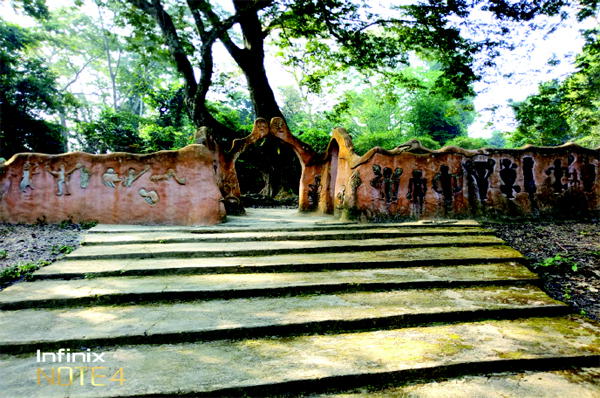
Entrance to the inner Osun Osogbo Sacred Grove. Photo: Osa Amadi.
By Osa Amadi, Arts Editor
Barely one week to Christmas, and we were deep inside the belly of nature called Osun Osogbo Sacred Grove with the minister.
Why I teach in public schools — Osun lawmaker
There, is an ancient forest nurtured by the grey Osun River which our guide, curator and site manager, Adekunle Fatai said was ‘agbo’ (local herb medicine) when the question was put to him as to whether some people drink the Osun River.
The river seems to circle the belly of the smoking and sloppy ancient dark-green forest created by hundreds of years old trees spreading their branches tall into the sky where packs of monkeys live and have funs, and bright Christmas flowers sparkled in the morning sun.
As you approach the grove, a feeling of peace and quietude envelopes you. Somehow you realise you are descending into a fertile, primordial realm where you achieve cosmic attunement with nature.
The sight of the grey river also, in subtle ways, tells the tales of the ancestral lives she had nurtured and sustained over the centuries. Mr. Fatai recounts that some ancestors of Osun people and monarchs had lived in the grove many years ago because of the ancient river.
Mr. Fatai is an excellent guide. Good guides who take tourists round destination are in short supply. I recall that we once met another excellent guide few months ago when we visited Victor Uwaifo’s museum in Benin City.
Fatai tells the history of Osun people whose lives intertwine with the Osun Osogbo Sacred Grove as he conducted us and the Minister of Information and Culture, Alhaji Lai Mohammed, from one destination within the destination to another.
We visited a cleared bank of the river where the story of Susan Wenger (1915 – 2009) who later became Adunni Olorisha after she was initiated into the cult of Soponna surfaced. Susan’s works and life are inseparable from the history of Osun Osogbo Sacred Grove and the Osun River.
Chief Susan Wenger was an Austrian-Nigerian artist who lived a substantial part of her life in Osogbo and worshipped Orisha, a Yoruba god. She found inspirations for her artistic works in the Yoruba culture and religion. She was said to have partnered with local artists in Osogbo to recreate the Osun Grove with sculptures and carvings depicting the various activities of the Orisha.
She championed the preservation of the Osun Grove which resulted in the grove being made a national monument in 1965, and was later inscribed as a World Heritage Site by the United Nations Educational, Scientific and Cultural Organization (UNESCO) in 2005.
Susanne Wenger studied Applied Arts in Graz in 1930, and later at the Higher Graphical Federal Education and Research Institute and the Academy of Fine Arts, Vienna.
Court remands three men over alleged rape
In 1947, Wenger traveled to Italy on a trip given to her as a prize for wining a poster competition. In 1949 she went to Paris where she met the linguist, Ulli Beier, who later became her husband. Their marriage was somewhat necessitated by Beier’s offer of a position as a phonetics teacher at the University College, Ibadan that same year.
A condition for acceptance of the teaching job was marriage. So, Ulli and Susan decided to get married in London and travelled to Nigeria to live in the outskirt of the city where the new college was located.They later moved from Ibadan to Ede village where Susan embraced parts of African arts and crafts and worked with batik designs.
At Ede, Susan met a priest of Obatala, Ajagemo, who bonded with her and introduced her to the Yoruba philosophy, language and religion.
After Susan and Beier divorced, she married a local drummer, Lasisi Ayansola Onilu. Later, she left Ede to Ilobu and finally settled at Osogbo in 1961.
Perhaps beckoned by the same irresistible pull of the peace, tranquility and mystery of the Osun Osogbo Sacred Grove and of the Osun River, Susan became interested in the shrines of Orisha.
Her creative genius and keen spiritual instincts led her to rebuild many of the religious carvings within sacred places in Osogbo. Subsequently she was commissioned by the Osogbo District Council to renovate many of the local shrines, especially those dedicated to the Osun River goddess.
Susan later became the guardian of the Sacred Grove of the Osun goddess on the banks of the Osun River in Osogbo.
Some of her works include the shrines dedicated to Alajere and Iyamoopo measuring about 20 feet in height and 50 feet wide at the base, all influenced by the Yoruba mythology.
In 2005, the Nigerian government admitted her as a member of the Order of the Federal Republic. For her efforts on behalf of the Yoruba, she was given a chieftaincy title of the Osogbo community by the Ataoja of Osogbo.
Chief Susan Wenger died on January 12, 2009, in Osogbo at the age of 93, and was buried somewhere in the bowels of Osun Osogbo Sacred Grove. According to Mr. Adekunle Fatai, Chief Susan Wenger does not wish her grave to be made public, nor does she wish to be celebrated by anyone.
We also visited Chief Susan Wenger’s three-storey residence in Osgobo, said to have been originally leased to her by her first husband,Ulli Beier when he was with the Institute of Mural Studies.
In 1965, Lasisi, the drummer boy and her second husband, moved into the house to live with Susan on the first floor while Ulli Beier lived on the second floor. Ulli Beier left the country in 1970, and Susan was later divorced from Lasisi.
Chief Susan Wenger’s residence is like a museum exhibiting her furniture and art with roots running deep downYoruba arts, culture and religion which consumed the attention ofAdunni Olorisha, the guardian of the Sacred Grove of the Osun goddess.
We also visited the Suspended Bridge across one end of the grove said to have been built by the British colonial masters and commissioned around 1936. Surprisingly, the bridge is still strong and serving, though erosion, age and wear and tear have taken their toll on the old rugged bridge which now begs for reinforcement and preservation as a monumental relic. The minister and all of us climbed the mysterious ancient bridge and felt it swing dully in the air. Mr. Fatai said it was built by the British for easy movement of goods (which they no doubt pillaged from the forests) as well as an escape route from the village during the Second World War in case of any attack by the enemy.
As we took selfies on the Suspended Bridge, an indigene who had witnessed many visitors to the grove warned us to be careful as many a visitors’ phones that tried to take selfies are lying at the bottom of the River below the bridge.
As we were wading through the grove seeing the monkeys sitting on top of the trees and watching us with keen eyes, one thought occupied my mind: the thought of spending Christmas in the deep belly of the Osun Osogbo Sacred Grove. Why can’t someone, or a tour operator, package a tour this Christmas to the grove. Surely, this is the type of place Jesus would have loved to come to pray the way he always went to the mountains and woods to pray during his days.
“If you come here with less noise and some bananas, all these monkeys you are seeing on top of the trees will come down and gather at your feet,” Okorie Uguru of the Tourism Desk of the Nation Newspaper said to me.
Osun Assembly puts budget consideration of 2 ministries on hold
I could not help imagining packing a bag of foods and drinks and blankets for a picnic and meditation all day on Christmas Day in Osun Osogbo Sacred Grove. Cultivation of such habit and pursuit of such lifestyle are things that develop domestic tourism. It’s something we have to start and sustain before foreign tourists would follow our examples. Fortunately for us, Chief Susan Wenger, a white foreigner by birth, has shown us the way by going beyond visiting the grove to living, dying and being buried in it.
This travelogue will not be complete if I fail to mention a little but grave incident that almost marred the trip for me. To my horror and shock, my group left me behind at Chief Susan Wenger’s house. I don’t know whether they wanted me to take over from the late Ulli Beier and Lasisi the drummer boy.
I had gone across the street to buy biscuit and soft drink because it was getting to 12 noon and we had not had breakfast, which amounted to poor planning and runs counter to the spirit of hospitality on the part of the ministry official who led the contingent of arts and culture journalists. I and a few others had, after covering the event at Susan’s residence, went and sat inside our bus waiting for the minister to come out. Then some people went down and across the street to buy biscuits and soft drinks. I also stepped down to do same.
I did not spend up to ten minutes there. As I was returning, I saw our bus suddenly zoom off. I ran after it, shouting on top of my voice and waving at the driver to stop for me. But the bus sped away from me. My phones which I had put inside my bag were inside the bus. All the vehicles left. I had no phone to call any of my colleagues inside the bus to find their next port of call. It was another flaw in the planning of the trip that a program of our itinerary was not provided to us.
Without phone and any knowledge of the place or where the contingent was headed, I became stranded. But luckily, I caught sight of someone in one of the pictures I took at the grove. He was Babatunde E. Adebiyi Esq., a legal Adviser at the National Commission for Museums and Monuments. I had sought for his identity at the grove and he had given me his call card. He was about to enter his car. I screamed my predicament to him.
“They are going to the governor’s office at Abeere,” the lawyer told me.
Luckily too, I had some money inside my pocket. I took a bus to Abeere and got down in front of the State Secretariat.Then I took a bike to the Car Park at the governor’s office where I met the driver of the bus.
“So, you people decided to leave me behind there!” I screamed at him.
“Oga, I told them that you were not inside the bus; that you just went down to buy something but they commanded me to move; that I should not wait for anybody,” the driver said.
“So where are they now?”
“They are inside there,” he said pointing at a house.
I inquired my way into the conference hall in the governor’s office where my colleagues were waiting for the governor and the minister to join them. I exploded in anger:
“So, you people abandoned me at that place where I didn’t know anyone? Even the driver told you people that I stepped down to by some biscuits and you commanded him to go!”
“There was nothing anybody could do. The convoy was leaving,” one of my fellow journalists said and I spat fire at him:
“Convoy? So, your convoy was more important to you than my safety? If I were inside that bus and you were the one about to be left behind, I would have stopped that driver from moving by all means! Where is the person that commanded the driver to go?”
I couldn’t find him. He probably saw the fire leaping out of eyeballs and ducked in the crowd.
Nigerian Universities lack capacity to drive development ― Gbajabiamila
After we left the governor’s office, we drove to a local restaurant where we ate delicious amala and pounded yam. We had a bumpy but free drive back to Lagos in spite of our apprehension of the usual traffic gridlock on the Lagos-Ibadan. I hardly knew when we arrived Lagos as I was busy pounding the keyboard of my laptop for a broad news story that appeared on the front page of Vanguard the next day with the headline, “Nigeria draws global attention to Osun Osogbo Sacred Groove as World Heritage Site …pushes for enlistment of others.”
Disclaimer
Comments expressed here do not reflect the opinions of Vanguard newspapers or any employee thereof.