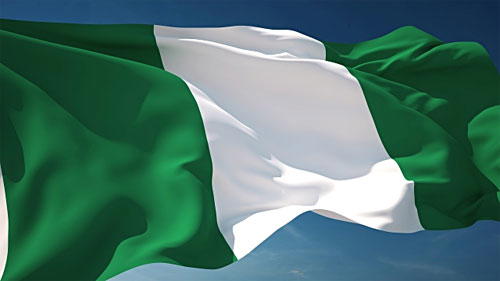
Nigerian Flag
By Sunny Ikhioya
I was privileged to be in the entourage of Chief Leemon Ikpea, Chairman Lee Group of companies, a man who is very passionate about indigenous engineering technology and his amiable wife, Mrs. Justina Ikpea, Managing Director, Trebet A1 Nigeria Limited, producers of Trebet table water. The trip to China was in respect of a new production line for Trebet water. The business part of the trip was a huge success; it was a great experience and eye-opener, especially in the areas of international business negotiation and diplomacy; but that is not the focus of this piece.
Nigeria has failed’
Investment in human capital: FCMB provides support for customers
What got me concerned, was the after-effect of seeing a country practically at work, making progress compared to another that is struggling to take off after 59 years of independence. When will the so-much trumpeted and expected change for this country begin? It is frightening that while others are progressing rapidly, we are retrogressing into the Hobbesian state where life is ‘nasty, brutish and short’. And our leadership continues to give us the impression that all is well.
I know that, like me, many people are wondering what our leaders – I mean those engaged in governance – go abroad to do? Because travelling abroad enables you to see the way that the system works in other countries. Of what use is our leaders traveling if they cannot come home to put the lessons learned into practice for the benefits of Nigerians? After all, it is the taxpayers’ money that they are using to embark on these journeys.
At some point in time, Nigeria and China were at par in the world development index; today, it is like light and darkness, both are at extreme end of both poles in the continuum: one at the beginning and one towards the end. Our leaders feel comfortable, gallivanting around the world and exhibiting their stupidity, while others come here and in humility take what they want and go back to build their countries.
Let us not be deceived by the propaganda of the West. In China they produce quality goods; it is what you request and pay for that you will get. While others are demanding quality standards from the Chinese manufacturers, our Nigerian traders and businessmen are asking them to reduce standards so that they can pay cheaper and make more profit. Meanwhile, our regulatory authorities sit idly and watch.
In China, things are working perfectly in every sector; you can see and also feel it. Beautiful cities with high rise buildings dotting the landscapes, good road networks with tree planting and beautification. You are wondering why they are bringing millions of people out of poverty annually? It is because even those in the rural areas have a good network of transportation to move to produce to the cities where you have the markets. Where there is no water, artificial rivers and lakes are created; so they have a perfect irrigation system.
You do not see cows or other animals competing with people on the streets. On the road, things are orderly. I won’t mention manufacturing, construction, and technological advancements because these ones are already known to all. By my estimation – and this is a conservative guess – China ranks amongst the first five beautiful countries of the world and they are still working at improving things. The picture that I am painting here is really based on a visit of a minimum of seven cities in seven days scattered across different provinces in China, with intelligent tour guides accompanying us where necessary.
We landed at the Beijing International Airport which is the capital city, travelled by road to Tianjin city which is cosmopolitan in nature, from there we travelled by air to Yangzhou, a city that has a great history. Next, we travelled by road to Zhangjiang city in Jiangtsu province, which has the concentration of production line manufacturers, especially in beverages, including alcoholic drinks. We left from there by road to the city of Sochu, where we enjoyed the hospitality of the famous Sangri-la hotel.
From there, another four hours drive to the city of Yiwu, where one of China’s biggest markets is located and a popular destination for Nigerian traders. It is from Yiwu that we took a bullet train, one and half hours ride, to the business capital city of China, which is Shangai, from where we took our flight back via emirates airline with a stopover at Dubai international airport. I must mention the advancement of China’s hospitality industry: great hotels, beautiful scenery, exotic meals, and great courtesy.
All of us – Nigerian elites – must begin to meditate on how we can move this country forward. The solution is not by running abroad for succour; we must seriously work at making change happen and this change begins with sacrifice, selflessness, and hard work.
The President must set the example, change must start with the head- the driver. There must be somebody that the people will be looking up to for direction and his body language must be right. It is not too late to begin again; we have gone too far into reverse, we must redirect our course. Is the leadership of this country listening from abroad?
Why is it so difficult for Lagos State to build a fast train track? Why must it take over ten years to get it actualised? Are our leaders discussing with their counterparts in developed countries? Don’t they feel ashamed when they go outside to discuss with their international counterparts? A new cabinet is now being put in place; where will these ones take us to? It is time for us to sit up.
We must institute the required discipline and it must be seen that the leadership is setting the right example. China did not start the way they are today, they are enjoying the benefits of a disciplined foundation set by the great Mao Tsetung and others in the 20th century.
Culture of integration of all – children belong to the state first and not to particular families and religion; so you will not find ethnic and religious strife so visible in China; everyone is working for the promotion of the country and you can see the excitement and dedication as they go about their duties.
What I discovered in Zhanhjiangang city, in Jiangsu province, are not too far from what you will find in Aba or Nnewi factories in Nigeria: people fabricating and putting steelworks together. In China, it is when you do not make any attempt that there is a problem; people are encouraged to try and not to be afraid of failure.
People are encouraged to go into production and manufacturing; they are not afraid of taking a risk because they learn from their failures and experiences. They are expert at reverse technology; you break the machines apart into completely knocked down, CKD, and you start putting them back together one by one without outside help. The state encourages that.
Our leadership must encourage indigenous production and encourage the patronage of locally manufactured goods. If we venture into reverse technology, the worst-case scenario is that we will be producing spare parts which will be as ‘original’ as any we import from abroad. It is time for Nigeria to begin again, from scratch.
Disclaimer
Comments expressed here do not reflect the opinions of Vanguard newspapers or any employee thereof.