“God grant me the courage to change the things I can change; the serenity to accept the things I cannot change; and the wisdom to know the difference.”—Anonymous Irish Prayer.
Every Election year, as the votes for President are being collated, I travel out of Lagos; go to the village; turn off my set for most of the day and stay out of touch with friends and associates who might want to bother me with the blow-by-blow announcements.

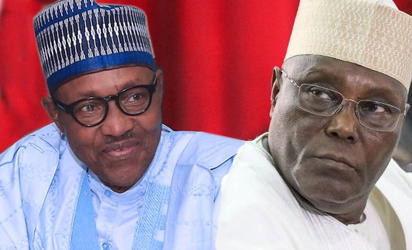
President Muhammadu Buhari and Atiku Abubakar
I have sufficient wisdom to now know that it is the total that counts. And, whoever is declared winner by the Independent National Electoral Commission, INEC, will be President for the next four years – irrespective of the merits or lack of them of opponents’ litigation. About one thing I was certain this time around. If Buhari wins, then for the All Progressives Congress, APC, and their candidate, it would have been a free and fair election. If he lost, then it would not be. An election is free and fair in Nigeria if our party wins. Jonathan, so far, has the singular honour of accepting a result which was unfavourable and calling the declared winner to concede the election just concluded.
So, permit me to first of all start by congratulating President Buhari for his victory and to wish his opponents better luck next time – for those who might want to try again. Next, without prejudice to the rights of the other candidates to seek redress in court, allow me to state quite clearly that it is costly and fruitless exercise in Nigeria. Granted, some governors (Ngige, Oyinlola, Osunbor, Oni, Agagu etc) and senators have had their elections voided, but, no President declared elected by INEC has ever had his election voided. It is doubtful if it will happen this time – for reasons too numerous to list and discuss. Buhari, God permitting will be the Nigerian President until May 2023. I tremble at the mere thought of it.
Perhaps, before proceeding, readers need to be reminded that just before the election, I had declared why neither Buhari nor Atiku would receive my vote. None did. The most important among the reasons Atiku, though a friend, was not considered can be summarised in two words – Obasanjo and PDP. As soon as Atiku was declared the Presidential candidate of the PDP and a campaign office was set up in Abuja, I went and dropped a message saying: “Your Excellency, on no account should you go to Obasanjo for his endorsement. There can only be one of two outcomes; none of which serves your interest. Baba will either publicly denounce you again, or he would embrace you. I don’t know which will be worse. His endorsement of you will however amount to the kiss of death. Nigerians will find it difficult to reconcile his new position with the idea he had planted in their minds about you.” There were a few other observations made which are not pertinent to this narrative.
Needless to say, Atiku went to Abeokuta together with Secondus and other PDP bigwigs to be received and to receive the blessings of Nigeria’s worst political chameleon. To me all the chances for victory were lost on that day. At any rate, the former President, who had encouraged a group of young Nigerians to start a political party, had abandoned them without the courtesy of a “goodbye”. One of the female members had been warned that they started on the wrong track by letting it be known that Obasanjo was involved in the formation of the party. OBJ was a negative force. She dismissed my observations – until events unfolded. By then it was too late. The man who was the beneficiary of cash and carry politics in 1998/9, despite his monumental self-righteousness and hypocrisy, laid the template for “do or die” politics in 2007. Nigeria has not stopped since then.
ALSO READ: Buhari’s victory belongs to Nigerians — Sanwo-Olu
In 2007 he single-handedly imposed YarÁdua when people like Odili Donald Duke and Victor Attah were candidates. He also decided the running mate – Goodluck Jonathan. Eight years down the line, Nigerians saw how stupid those selections were. That politically fatal error of judgment led us to where we are today. How anybody would want to tie their campaign to this man is a mystery.
The Peoples Democratic Party, PDP, was the second most important reason I could not with clear conscience vote for Atiku. Most of his party members were not only not remorseful for the unbridled corruption which pervaded the nation from 1999 to 2015, one could not avoid the feeling that they wanted to regain power in order to re-install kleptomania in government. The situation was made worse by Atiku’s promise of amnesty. To most Nigerians, it was another version of “all is forgiven” pronouncement by Adams Oshiomole. There would be no punishment for massive stealing. It was good strategy for keeping the members intact; it was bad strategy for winning votes. For weeks after that statement, all people asked me was: “What do you think of your friends amnesty for looters?” Without any other statement to make amendments to that ill-advised utterance, it was clear that Atiku had committed a serious political blunder from which he never recovered.
Now we turn to the victor – President Buhari. He will be the second person to be re-elected since 1999. Just as now, the ruling party assumed that their victory represented endorsement by Nigerians of the Federal Government’s economic and social policies. If politicians, irrespective of political party, are not all such consummate liars, they should have been paying close attention to the annual ritual which occurs every October 1. On that day, it matters very little which newspaper one reads, radio station to which you tune, or television station – except NTA – it was always lamentations galore about the low-level of development since 1960. Unfavourable comparisons would be made between Nigeria and Malaysia, South Korea etc. Nigerians and the global community would be reminded about our decaying infrastructure, dropping standards of education, twelve million or more school age kids out on the streets etc.
On October 1, 2019, two other items will be added to our catalogue of woes. First, Nigeria has now become the poverty capital of the world. Furthermore, whereas India, until recently the world champion, is reducing the number of those living in extreme poverty, Nigeria will add almost five million more people living on slim hope by December 31, 2019. There is no comprehensive plan to reverse the trend. But, we have just re-elected the President who got us here. We will have no reason to complain if by 2023 twenty million more Nigerians have dived below the poverty line. We asked for it.
ALSO READ: Presidential election: What Moghalu told Al Jazeera
“We used to have normal rainfall. But, the rain pattern has changed unlike before. “
Taolu, 80-year-old maize and wheat farmer. THE NATION, February 24, 2019.
Agriculture, for time immemorial provided the support millions in rural areas needed to escape from grinding poverty. But, Baba Taolu’s statement was taken from a heart-rending story by Olugbenga Adanikin titled “Failed contracts, communities neglect mar Great Green Wall project”. The article points to how an enemy whose threat is potentially worse than those of Boko Haram, herdsmen and bandits is already ravaging eleven Northern states – Adamawa, Bauchi, Borno, Gombe, Kano, Katsina, Kebbi, Jigawa, Sokoto, Zamfara and Yobe.
According to Adanikin, “the nation is also reported to be losing 351,000 hectares annually, thus moving at the rate of 0.5 kilometres yearly.”
I was in Kano, Sokoto and Zamfara three times last year, and having invested in rice farming and milling in the axis in the late 1980s, naturally took a great deal of interest in the developments there. The situation in 2018 was pathetic and pointed to greater loss of farmland to desertification if nothing is done about it.
The National Agency for the Great Green Wall, NAGGW, has been charged with the responsibility of checking loss of farmland due to climate change. NAGGW is losing the battle waged on our behalf very badly for the same reasons why “nothing works in Nigeria”.
First, it is understaffed. The area threatened is just too wide for the staff of NAGGW alone to cover effectively. Partnerships involving the agency, the states and local governments are indispensable. Second, NAGGW is under-funded. Unlike fertiliser-supply, which still allows those in charge to line their pockets, NAGGW is engaged in thankless work. While its success will help a great deal in reducing the number of Nigerians rendered poor by harsh climate, most urban dwellers are not even aware of the collateral damage desertification causes to our economy. Yet, as hundreds of thousands of families are driven off the land by desertification, out import bill rises. The North is our food basket. Third, despite its slim budget allocation, corruption still creeps into the ugly picture. Abandoned projects and failed contracts are common. According to Adanikin, “Plants are no longer green”. That is only part of the story. If he had looked more closely, it would be easily observed that stunted growth is now pervasive; aggregate yield per hectare will continue to decline until the farmers stop trying altogether. Finally, because all the staff of NAGGW are paid monthly, they have become the targets of kidnappers who claim ransom. Here we are witnessing a typical case of the Nigerian Factor – a few bandits and criminals actually preventing the staff of NAGGW from doing the work of saving Nigeria from the impacts of climate change.
None of the contestants for the presidency made a serious case for prioritising climate change as a great challenge which we must face; perhaps because none of them knows one of the major sources of the increasing number of people living in extreme poverty. But, unless Buhari comes up with a plan to reverse the trend, Nigerians would have voted for having more people living below poverty than above it.
Meanwhile, if the votes reported by INEC are correct, or close to being correct, the results once again demonstrate that the poorest Nigerians have voted massively for the government which met them poor; made them poorer and has no plan to get them out of destitution. One of the “beauties” of democracy is that it allows a stupid majority to pull down everybody. But, for all its imperfections, it is still the best form of government.
OPEN ADVICE TO OBASANJO
“You’ve had your share of mirth; of meat and drinks. It’s time to quit the scene; it’s time to think.” Elphinston.
Perhaps now that Nigerians have told Obasanjo where to go, the old boy will now stop behaving as if he can anoint anybody he wants as President. The young politicians who asked for his blessings are now licking their wounds. Atiku now realises that the man commands few votes. He can run for the Senate if he wants. But, he will be trashed in a free and fair election – even in front of his mansion in Abeokuta.
APC LEADERS: BUHARI IS NOW BEYOND YOUR REACH
“Be careful what you wish for. You might just get it.” Anonymous.
They worked like galley-slaves to ensure Buhari’s re-election. But, I have bad news for them. All the APC leaders who made Buhari’s victory possible are in for the shock of their lives. Oshiomole, Tinubu, Amaechi, Ngige, Amosun etc have now become totally powerless. They can make no demands on the President; they can only beg for favours. He will grant what he wants.
Disclaimer
Comments expressed here do not reflect the opinions of Vanguard newspapers or any employee thereof.