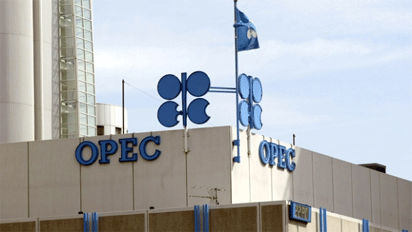
After about 58 years of membership of the Petroleum Exporting Countries, OPEC, the Qatari government on Tuesday January 1, 2019, finally exited the oil cartel which it joined in 1961.

OPEC
On December 3 2018, three days before the OPEC meeting in its Vienna, Austria headquarters, the Middle Eastern member, through its Minister of State for Energy Affairs, Saad Sherida al-Kaabi, sent an official notification of disengagement from the 15-member oil producing countries.
The Minister expressed that his country’s decision to quit the bloc was the desire to strengthen its position as a reliable global energy supplier, and cited its wish to focus efforts on liquefied natural gas production.
Qatar with a population of 1.6 million people is one of the smallest oil producers, but the world’s biggest exporter of liquefied natural gas, LNG. Since 2013, the amount of oil Qatar produced has steadily declined from about 728,000 barrels per day in 2013 to about 607,000 barrels per day in 2017. The Gas Exporters Countries Forum, GECF Headquarters are located in its capital, Doha.
We know that Qatar is not the first member to leave OPEC, but what would make this small but influential member of OPEC to leave the global oil cartel? In the 1990s Gabon and Ecuador exited but returned years later.
Guterres calls for credible probe of Khashoggi’s murder
Indonesia left the OPEC twice with the last in 2016. Although Doha had claimed that its decision to leave the oil cartel was a technical, strategic, and not politically motivated, it is known that the feud with its Gulf Cooperation Council, GCC members was a causative factor.
The Gulf Cooperation Council is a political and economic alliance of six Middle Eastern monarchies—Saudi Arabia, Kuwait, the United Arab Emirates, UAE, Qatar, Bahrain, and Oman. The alliance is rooted in Arab and Islamic cultures. Qatar is embroiled in a row with some GCC members in OPEC that believe it has been contrarian in recent years; a habitual opponent of accepted policies, opinions or practices.
And going against the spirit and letters it subscribed to since the GCC formation in Saudi Arabia in 1981 are the ‘sins’ of the smallest nation in the fold. Qatar is believed to have strong links with Iran and Turkey, reinforcing the view of countries like UAE and Saudi Arabia that Qatar may sell it to either the Turks or the Iranians.
Qatar is the first Middle East country to quit the oil producing cartel. Qatar’s exit some believe may fracture OPEC most powerful bloc, the Gulf States; believed to be the Arab worlds only functioning trade bloc. Qatar’s withdrawal has fuelled the suspicion that Qatari leaders are seeking to irritate their regional rival and de facto OPEC leader, Saudi Arabia. Qatar has been accused of quixotic foreign policies that run contrary to the tenets of the GCC.
The GCC members issued 13 demands, which include cutting ties with Iran and the “terrorist” Muslim Brotherhood. The most prominent is that Qatar should close Al Jazeera, whose gritty reportage, the monarchies may not be comfortable with. Analysts’ believe that Qatar’s exit from OPEC was a reaction to a diplomatic and economic embargo imposed on Qatar by Saudi Arabia and the United Arab Emirates, Bahrain, and Egypt in 2017. The blockade might have pushed Doha into the arms of Turkey and Iran.
The embargo was designed to punish Doha over allegations by Riyadh and Abu Dhabi that Doha was supporting terrorism; a charge Qatar denied. Observers say Riyadh has also been irked by Qatar’s perceived efforts to promote political Islamist movements across the Middle East via its news channel Al Jazeera.
For years, the quartet of Saudi Arabia, Kuwait, the UAE and Qatar, all GCC members, had gathered to co-ordinate before all other OPEC members—including their regional rival Iran, met to discuss any changes to crude oil production. Since the embargo, Qatar has been barred from these closed-door discussions.
Buhari to migrants : Stay at home, Nigeria will be better
With its vast gas fields, Qatar is the richest emirate per head in the Middle East. It holds almost 14 percent of total world natural gas reserves making it world’s third largest natural gas reserves after Russia and Iran. It is the largest supplier of liquefied natural gas globally though challenged now by Australia.
Last September it announced would increase capacity from 77 miilion tones per annum, Mta LNG production to 110 Mta in 2024 when it plans to add a fourth production line from the North Field. Qatar leaving the OPEC may not have a very big impact but it is a sign that a crack is on the wall of the 59 year old organization that needs to be papered. Some other aggrieved members may take the Qatari option if it is not well managed.
OPEC’s expected production cut to shore up prices may not be realized as Qatar is off the production cut quota; now being a non OPEC producer making oversupply prospects to increase. An analyst believes the world may have many more choices in the energy sources which a global economy would have to adjust to; a more chaotic, less predictable energy environment.
Disclaimer
Comments expressed here do not reflect the opinions of Vanguard newspapers or any employee thereof.