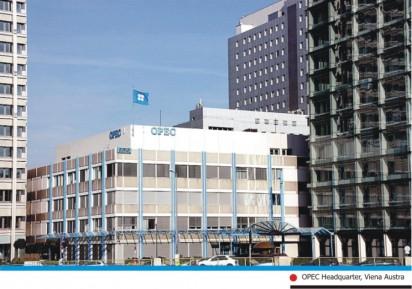
OPEC
By Sonny Atumah
Former President Richard Nixon in an address to the nation about national energy policy on November 25, 1973 was for steps America must take to solve what had almost become intractable problem. It was about the sudden cutoff of oil from the Middle East that had turned the serious energy shortages of that winter into a major energy crisis. It was an oil embargo.

OPEC
In that address, Nixon was clear that as far as energy was concerned, American will hold their fate and their future in their hands alone. Subsequent administrations have had an abiding faith in that address that sounded prophetic.
The Democrats and Republicans that have alternated power have a bipartisan approach regarding energy by investing billions of dollars in research as a development imperative. From either side of the political spectrum the goal is to break the OPEC manipulative tendencies in global crude oil supply as well as find alternatives to fossil fuels.
Compel FG to probe $12.7bn stolen oil, Falana tells oil workers
Successive administrations have deployed whatever was available in their arsenals of research strategies to destroy the incentives to cartelise crude oil exports. The Donald Trump White house is continuing in his America First Energy Policy. Could one be tempted to believe that America is winning the war if not the battle through the shale revolution?
Many may pick holes in the method adopted by the United States to reestablish itself as an energy superpower having lost it when its oil peaked in the early 1970s that made it possible for the OPEC and its de facto leader Saudi Arabia to slam embargo in crude oil supplies. But the strategy is what oil dependent nations must study and copy the determination inherent in the American Dream for energy self-sufficiency. Some market analysts called the shale revolution a Ponzi scheme; the unconventional horizontal Fracking of shale from rocks. That America is becoming a price giver means there is a lot to learn from it.
Since 2011, the world has watched the United States emerge from the financial crisis occasioned by the 2002-2007 real estate securitization bubble to what is now the petroleum revolution. With petroleum prices at US$100+ per barrel from 2011 to 2014, it was a nexus of technology deployed to see off many oil producing countries in the production share challenge.
Some watchers believe that OPEC blinked when in November 2016 it invited the 12 non-OPEC countries led by Russia for a production freeze, but it indeed, resulted in a twofold increment to reestablish OPEC as a major global player in crude exports. It was the case of living to fight another day. It was about market share in the ding-donger. President Barack Obama’s administration and the Energy Department formed the Advisory Commission on shale gas to examine the environmental hazards from shale gas after the BP Deepwater Horizon Gulf of Mexico oil spill.
FG woos UK bitumen investors, promises job security
It was viewed in quarters as a coordinated attempt to hide unpleasant facts because the commission was headed by former CIA director John M. Deutch who sits on the board of the LNG gas company Cheniere Energy’s Sabine Pass project, one of the two US projects to create an LNG terminal to export US shale gas to foreign markets. Deutch was also on the board of Citigroup, one of the world’s most active energy industry banks, a board member of Schlumberger, which along with Halliburton, is one of the leading companies doing hydraulic fracking.
Deutch panel member and shale fracking booster, Daniel Yergin, himself was a member of the National Petroleum Council. The Deutch report on shale gas was that it has the potential to displace liquid fuels in the United States. The smart move may have paved the way for the December 2015, US Congress votes that lifted the 40-year long standing export ban of its crude. The legislation opened up US grades including West Texas Intermediate (WTI), Bakken, Eagle Ford, Mars, and Thunder Horse to the global market.
The United States is indeed, striving to become the world largest oil producing nation. The production growth rate has averaged about 7 percent growth rate between 2009 and 2017. The S&P Global Platts Analytics predicts that the US crude oil exports will nearly average 4 million barrels per day in 2020 rising from 1.1 million barrels per day in 2017 to 2.2 million barrels per day average in 2018.
Honduran migrants gather at Mexico border despite Trump threats
It also predicted a production rise to 12.3 million barrels per day from a nadir of 3.8 million barrels in 2008. Ten years ago Nigeria sold well over 1 million barrels per day of crude to the United States. Nigeria’s light sweet crude has now been displaced by the American domestic production that has compelled it to look for new markets in Asia sometimes at discounted rates because America is also competing in the same market.
Many Asian refiners whose tenders were supplied by Nigeria are taking advantage of the American WTI. As the Nigerian presidential election temperature rises we may need to have discussions on the Nigerian crude and its future in the global arena.
Disclaimer
Comments expressed here do not reflect the opinions of Vanguard newspapers or any employee thereof.