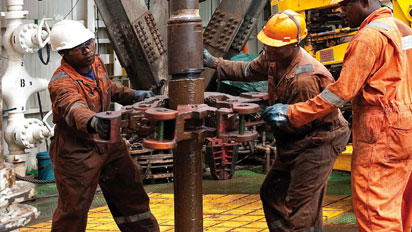
Men at work
By Sonny Atumah
The price of oil is still heading up. Crude oil prices for Wednesday rose with the Brent trading at $79.92 while WTI traded at $70.93.
It is heading to the cliffhanger in what appears to be a serialized drama that is leaving the audience eager to know the unresolved ending of the plot. Oil prices are determined by a variety of factors including the economy, weather and competition between retailers and from other fuels.

Men at work
These are the volatilities that play out in the market that enable speculators, investors and traders to interpret and make forecasts on the forces of demand and supply in global energy. We are approaching autumn and winter in the northern hemisphere when the demand for oil increases to heat up homes.
The importance of crude oil as a major global energy source is the attraction to investors. Investors look for the variables including information, geopolitics, government policies, conflicts and disasters that characterize the cyclical industry. Oil stocks like activities in every rational activity still in the ‘buy low, sell high’ cyclicality are dynamics that cannot be taken away. The Organization of the Petroleum Exporting Countries, OPEC Secretary General, Nigeria’s Mohammed Barkindo has projected 100 million barrels per day crude oil demand globally.
To him, OPEC with Russia and other producers have implemented a deal since January 2017 on cutting 1.8 million bpd from output to prop up prices that fell below US$30 a barrel in 2016 from over US$100 in 2014. Would the price of oil hit the rooftops as it happened in 2014 before going down?
The impact of US sanctions on Iran is dominating the market. Speculations by crude oil traders and investors would increase as they try to make the best of opportunity from crude oil trades. Many have expressed fears that the Iranian sanctions by the Trump administration, due to commence on November 4, 2018 would send prices to unacceptable levels. Who is sure where oil prices would be heading? Not even the United States President, Donald Trump that revoked the Iranian Nuclear Accord would know the outcome of the new Iranian sanctions.
The United States imposed full economic sanctions on Iran to block access to international trade and finance including billions of dollars in oil revenue and assets. Declining oil production in Iraq, Venezuela, and Iran is keeping the global oil market suspect. Venezuela Venezuela’s production is falling quite strongly, by 50,000 barrels per day.
This means that the market may not balance soon. Renewed violence has threatened Libya and its oil industry that has been struggling to recover from the attack on oil ports in June and a subsequent port blockade that reduced oil shipments in the second quarter of 2018. Governments come together to find middle course grounds for energy pricing. Russia’s Energy Minister Alexander Novak believes that the huge uncertainty on the market. Countries which buy almost 2 million barrels per day of Iranian oil from Europe and the Asia Pacific region have been enjoined to act, with the right decisions taken.
Russia, Turkey and Iran reached an agreement to conduct bilateral trades in their own currencies to avoid the use of US dollars, Turkey’s state-owned Anatolia news agency was reported. Iranian President Hasan Ruhani, Turkish President Tayyip Erdogan and Russian President Vladimir Putin in held a meeting to solidify this in Tehran on Friday. Supply surges from Saudi Arabia and Russia, are to cushion the production shortfall from Iran.
Again, the hurricane in the Atlantic Basin is impacting on oil demand in the near term. For oil and natural gas, the storm could be bearish because of the risk of demand destruction. After a major storm hits, that demand could surge back during the rebuilding stage. The hurricane could impact oil operations and refineries. Hurricane Florence which made its landfall two days ago had an estimated US$30 billion in economic impact and damage. The Category 4 hurricane affected North Carolina, South Carolina, Virginia and Maryland States that declared emergencies.
The 16 nuclear reactors in North Carolina, South Carolina and Virginia States were expected to suffer the damage from Florence. Florence will most likely affect Duke Energy Corp’s 1,870-megawatt (MW) Brunswick and 932-MW Harris nuclear plants in North Carolina and, if it turns north, Dominion Energy Inc’s 1,676-MW Surry plant in Virginia, Roger Hannah, spokesman for the U.S. Nuclear Regulatory Commission’s (NRC) Region 2 office in Atlanta said on Tuesday. One megawatt can power about 1,000 U.S. homes. Nuclear operators checked on backup diesel generators to make sure they have enough fuel, and secured loose equipment that could become a projectile in the wind that hit the coast as a major hurricane yesterday.
President Trump had called on the OPEC to increase output to bring down oil prices. The lower for longer principle of pricing in the crude oil business would have positive effect. Otherwise crude may be abandoned earlier than expected for renewable energy sources. Analysts believe the methods and directions in which the governments and other agencies seek to influence the price of commodities are yet to be full proof.
Disclaimer
Comments expressed here do not reflect the opinions of Vanguard newspapers or any employee thereof.