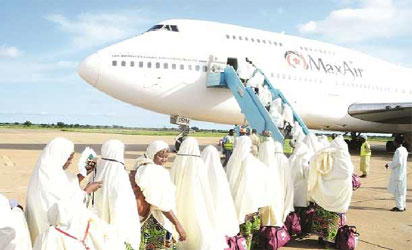
•Nigerian Pilgrims
By Haroon Balogun
The person who intends to perform Hajj must do so with the express niyyah of attaining Allah’s pleasure, and to fulfill one’s fardh, and also to diligently carry out the commands of Allah and His Messenger. Just as the Prophet said, actions shall be judged according to intention,” you must make your intention clear so that you don’t miss the reward inherent in the performance of holy pilgrimage.

•Nigerian Pilgrims
One of the thoughts and actions that could ruin one’s hajj even before departing from home is when your hajj is driven by the desire to be called Alhaji or Alhaja, and making a gold or silver tooth, or other showmanship. Your desire and intention must be clear – only for the worship of Allah. Consider that you have the privilege to be graciously called by Allah to the holy land. It is not by your bank account though, a prerequisite, but by the mercy and grace of Allah to visit His House. There are people with deep pockets but have no grace to visit the holy land. Since hajj is an act of worship, it must be performed in peace, with utmost devotion and the highest form of taqwa.
After having the right intention, you must also be in the right frame of mind. You must have the physical and mental readiness for the journey and the rites.
The Prophet sallallahu ‘alayhi wa sallam said: “He who performs Hajj and does not speak obscenely or commit evil will return clean from his sins just as the day his mother gave birth to him.” [Sahih al-Bukhari, vol. 2, p. 347, no. 596]. If he did so, his Hajj would be righteous (mabrur). Allah’s Messenger sallallahu ‘alayhi wa sallam said: “The righteous hajj has no lesser reward than Jannah (Paradise).” [Sahih Muslim, vol. 2, p. 680, no. 3127]
The ‘ibadaah of hajj has the exclusive status of being fardh only once in a lifetime, for those who can afford it. It is, therefore, important that the sincerity of intention must be given due regard. In other ‘ibaadaat and devotions, it is possible to gradually develop ikhlaas, whereas the time available for hajj is usually limited. The need for ikhlaas is vital because a fardh hajj can never be repeated. During your journey to hajj, a concerted effort towards developing this all important sincerity must be made.
It is important that hajj should be kept free of ulterior and worldly motives. Joining worldly objectives with religious aims is like adding water to milk.
Early preparation is advised against physical discomfort, emotional aggravation and monetary expenses. It will also enable you to perform hajj in relative peace of heart and mind. Therefore, it makes sense to be as ready as possible for this spiritual rejuvenation.
Settlement of debt
If you have monetary debt or are responsible for any moral transgression, then fulfill your debt or have it waived, and have your moral violations forgiven. It is important that one settles all outstanding matters and transactions, and has his faults and shortcomings forgiven. All amaanaat (trusts) and anything borrowed must be returned. A detailed and final will must be made regarding all important matters. It is not to suggest one is preparing for his last but Islam has thought us to always approach every ibadah and every other thing we do as if it would be the last.
You must make an honest effort to resolve your outstanding differences with others and seek forgiveness from those you may have hurt in any way in the past. This is based on specific instructions of Prophet Muhammad (s.a.w) and must be followed for the hajj to be meaningful.
Education
Do not forget all what you have been told during seminars and training on hajj rites. Consider your hajj as if it is your last on earth. Do it with outmost vigour, unshakable faith and unrelenting readiness to do all ibadaah. You may also note down some important dua and supplication that are required in some certain areas. Memorise them and internalise them for you may not have the opportunity to carry along all the time your notebook.
Food and luggage
There is no need for you to carry everything. Stay light. Keep your baggage to the essentials. Some foodstuff may be okay, so as to eat well and stay healthy. But it is essential to note that Saudi authorities do not allow perishable food items to be brought into the country in significant quantities anyway. You may, however, prefer to use your own food immediately upon arrival but almost everything you will need is there. The State Pilgrims and National Hajj Commission, NAHCON, are doing their best to make every pilgrim feel at home. They serve good and delicious meals both at Makkah and Madinah. I remember, most of the items I went with last year, were donated to the have-nots when returning because there was no need for most of them as far as food is concerned. Your hand luggage must not be more than 8 kilogrammes while check-in luggage should not exceed 32 kilogrammes, while going and returning.
Departure
When you are ready to leave your house for the journey, observe a two rakaah prayer, pray for forgiveness of sins, pray for your family and a successful journey and acceptable hajj. The effect of sincerely repenting and then proceeding for hajj will be that one will be favoured by Allah and blessed with the strength to continually do good deeds. Depart with happiness from home. A hajj which is performed with a feeling of love and keenness is conducive to religious upliftment. Inconvenience during travel should not hamper this love and keenness. Kiss your wife and children and bid them farewell.
While on the journey, be at your best behaviour amongst your brothers and sisters in Islam.
Assist them in their needs. Be of help to them within your capacity. The person who helps his companions on this journey will be regarded as a mujaahid (one who strives to uplift Islam).
Disclaimer
Comments expressed here do not reflect the opinions of Vanguard newspapers or any employee thereof.