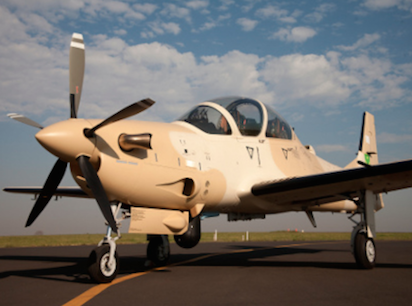
Tucano jets
By Sani Mohammed
IN the past few weeks, one of the issues on the front burner has been the transparency of the process that led to the payment of $496,374,470.00 for 12 Tucano jets by the Federal Government to the US government without the National Assembly’s Approval.

Tucano jets
Although the President is empowered to authorise withdrawal of money as prescribed in Section 82 of the Constitution, it must have the blessing of the National Assembly in fulfilment of the doctrine of separation of powers. What that simply means is that there can be no expenditure without approval from the legislative arm of government.
To ameliorate the outrage on the unconstitutionality of the purchase, President Muhammadu Buhari, in his letter to the Presiding officers of both chambers of the National Assembly, sought anticipatory approval for the release of the money that was paid directly to the treasury of the United States government.
After the letter was read in both chambers, motions sponsored by Hon. Kingsley Chinda in House of Representatives and Sen. Matthew Uroghide in the Senate questioned infractions in the process.
While both chambers of the National Assembly are yet to come out with a firm report from the motions, it is imperative to understand the position of the law in the United States as regards doing business with other countries and why they looked beyond an approval from the Nigerian parliament before accepting the briefcase of dollars for the Tucano Jets.
Democracy makes governmental authority a public trust and, as a result, the United States believes it’s people (including corporations, since they are people,too) ought not to induce violations of public trust – corruption – in other countries. Foreign Corrupt Practices Act, FCPA, which is termed the jewel in the crown of America’s fight against international bribes and corporate favours, promote American business and foreign policy ideals around the world, and gives US companies a tool to battle corruption abroad.
The big questions begging for answers now are:
1.Did the US violate it’s own law just to accept the millions of dollars for the Tucano Jet?
2.Was there a third party in the transaction and did the third party influence the Nigerian government to release the money quickly?
3.What is the position of the US Congress as regards the transaction taking into consideration that the Senate President of Nigeria was quoted as saying he was contacted when talks was initially going on?
The Foreign Corrupt Practices Act, FCPA makes it illegal for companies and that supervisors to influence foreign officials with any personal payments or rewards. The Act applies to any act by U.S. Businesses, foreign corporations trading securities in the U.S., American nationals, citizens and residents acting in furtherance of a foreign corrupt practice whether or not they are physically present in the U.S.
The entire grasp of the FCPA is to the effect that foreign participators in the American market do not use its economy as a veritable tool to conveniently siphon funds, embezzle money and perpetrate fraud. Thus, it stipulates certain prohibitions which foreign participants should be wary of when trading with the U.S.
The Act governs all foreign persons i.e.. individual, corporations and even institutions. To this end, the Tucano jet contract fails within the eagle eye of the FCPA and, seeing the dust raised by it and the obvious violation of constitutional provision, the questions, as laid above, earnestly craves an answer. However, what appears to be the blood on snow is the rumour of Americans’ role in aiding the Federal Government to accept Nigeria’s fund at a time Nigeria’s economy is in dire need of money.
In the not too recent past, business transactions between companies in America working with corrupt foreign business interest have been found culpable by the Foreign Corrupt Practices Act and made to cough out heavy fines.
In 2012, Japanese firm Marubeni Corporation paid a criminal penalty of US$54.6 million for FCPA violations when acting as an agent of the TKSJ joint venture. Between 1995 and 2004, the joint venture won four contacts in Nigeria worth more than $6 billion. It is alledged that this was as a result of having paid US$51 million to Marubeni to be used to bribe Nigerian government officials.
In 2009, former Representative William J. Jefferson, Democrat of Louisiana, was charged with the FCPA by bribing African governments for business interests.
Be that as it may, the news of the jets being for the fight against Boko Haram and other insurgent activity, I share the sentiment but I recognise as well the abuse of laid down rules and fear that it in a matter of time, this deal might boomerang like the HP Russian contract case which embarrassed the whole of Russia after 10 years of investigation.
Respectfully, President Trump has gone beyond the bounds of not just the U.S law but has also proved his disdain for Nigeria. It is only human to pray that this matrimonial relationship between both leaders doesn’t turn sour.
Sani Mohammed, a public affairs commentator, wrote from Abuja.
Disclaimer
Comments expressed here do not reflect the opinions of Vanguard newspapers or any employee thereof.