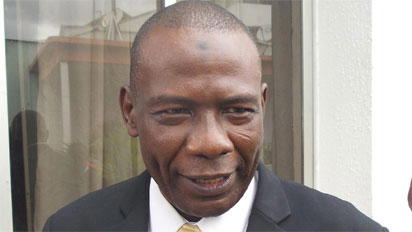
Aminu Gwadabe, President of Association of Bureaux De Change Operators of Nigeria (ABCON)
By Babajide Komolafe
There are over 3,000 bureaux de change (BDCs) in the country, licensed by the Central Bank of Nigeria (CBN) to conduct retail, across the counter foreign exchange services. In this interview, Aminu Gwadabe, President of Association of Bureaux De Change Operators of Nigeria (ABCON), the umbrella body of all BDCs in Nigeria, highlights the roles played by its members in the achievement of the relative stability in the foreign exchange market, as well as the challenges it posed to their operations. Excerpts:

Aminu Gwadabe, President of Association of Bureaux De Change Operators of Nigeria (ABCON)
WHAT was the role of BDCs in the achievement of forex stability in recent times?
Overtime, there have been arguments about the role of BDCs. Some even went to the extent of saying the BDCs are no longer relevant. If you remember the single exchange market that came in 2014, it did not even recognised the role of BDCs.
However, that regime did not last because they did not consider the role of the BDCs. But after consistent agitation by the association, that there is need to acknowledge the role of the BDCs and include them, so that we can continue with what we have been helping the CBN and the economy to achieve, which is exchange rate stability, the CBN reviewed its stance by allowing us to come into the market, and also offered us what they call the International Money Transfer Operations (IMTO) proceeds, and since then there have been significant achievements.
Significant achievements
One, we have also disappointed the pundits that predicted that the dollar exchange rate will hit N1000 before December 2017.
Two, we have helped in eliminating the spike, volatility and uncertainty of exchange rate. Before people cannot plan, manufacturers were crying, but now the manufacturers are opting for the exchange rate above the inflation rate due to the stability been witnessed in the market.
No more spike, people can plan, I think for the past six months, we have seen the dollar stable between N360 and N365 even at the parallel market. So this is a great achievement for the manufacturers, for economic planners.
At least people can plan, people can order their inventory without much stress. That has been one of the important roles BDCs play, in eliminating the spike, and also the gap between the exchange rates, which created opportunities for rent seeking. There is no more rent seeking. Speculation which also used to be the other of the day in the forex market has also been eliminated. Also currency exportation, which is also an opportunity just because of the opportunities for rent seeking, is also not the order of the day.
All these are great achievements that the BDCs have helped in ensuring that the economy is stable, to the point that we have even come out of recession.
For an economy to grow, there must be some sectors doing the hard job. I can assure you that for this convergence that we have seen, the commendation should go to the BDCs, because it is their hard work that made it happen.
Parallel market rate
Now, most of the BDCs because of the convergence, most of the BDCs are not even in operations because the parallel market rate is even lower than that of our rate, so we have brought down the rate. Even below the parallel market rate, with difference of about N1 to N1.50, so there are a lot of achievements.
Also, in the process BDCs created employment, we are about 3,500 licensed BDCs now and each BDC have at least nothing less than six staffs. So if you multiply six by 3,500, we are talking about 21,000 Nigerians that are dependent on the BDC subsector.
Is there need for CBN to continue dollar sales to BDCs to sustain the stability in the market and convergence of exchange rates?
For the past one year, we are not even relying on the CBN sources. Our sources have been diversified from the CBN sources to IMTO sources. So all that the CBN needs to do is to see, in conjunction with the association how we can deepen the market. It is all about deepening the forex market. We can come in with other products; we can come in with other sources. Even the Investors and Exporters (I&E) window, as far as I am concerned should be another window for the BDCs to be buying money.
The CBN, like what they are doing right now, coordinating the IMTO proceeds, they should also begin to coordinate the proceeds of the (I&E) window so that we have enough of liquidity for the BDCs to ensure the stability is maintained.
Even the Diaspora remittances, you see the association is working on a lot of automation projects to enhance standards, to enhance competition, global competitiveness, in terms of our visibility even for the world to see that there is honesty and transparency in our system. So we are building confidence and we are working with the Nigeria Interbank Settlement System (NIBSS) to ensure that most of our operations, most of our systems are being transparent and very soon our members will start doing online real time rendition of their returns. We have perfected that with the CBN, we are only waiting for the tokens to be provided. So our members will not need to go to CBN branches to submit their returns, they will now be doing it from the comfort of their office.
So it is germane for CBN to continue to deepen the forex market, and statistics, experience has shown that the only reliable and efficient tool to achieving this convergence is the BDC subsector.
What is the position of the BDC industry now vis-a-vis recent agitation for increase margin and other challenges of operators?
Right now the BDCs are operating under what I call the challenges of multiple exchange rates. That has been a very key issue in terms of also continued transparency and stability of the forex market.
Continued transparency
However I am also not unaware of the fact that the sovereignty of the currency is the sovereignty of that nation , so the CBN is having two or three different exchange rates to ensure liquidity, but you see that has been posing a challenge because you see even the bank rate, the CBN is selling to them at N358 per dollar and we are buying N360 per dollar from the CBN.
So it is a very big challenge for our members to operate. So that has been something that is making the business very very unprofitable.
It is very unprofitable, some members are not able to meet up with their overhead cost, salaries, you know I told you each BDC have about six staffs, and another challenge is the bank charges. What the banks are charging on BDC transactions is usually high, and these are some of the potent challenges we are facing.
The CBN should allow a level playing field and competitive rates among the various operators in the forex market. A situation where banks buy dollars from CBN at N358 per dollar and sell the same dollars to BDCs at N360 does not represents a level playing field or fair completion, given the fact that we operate in the same market segment.
But we have hope, from all indices and parameters, one of the trends or the way to go, you will see the CBN also coming to review their position on the exchange rate. I am sure we are all working now on inflation, once they can achieve single digit inflation, then they will begin also to ensure that the exchange rate is headed southward so as to ensure growth, output and more employment.
Is it possible to eliminate multiple exchange rates as we have it now?
It is very possible. When you look at determination of the exchange rate now, we have what we call managed float. And if you look at even where the exchange rate should go, if not the inflation rate that is higher than the MPC rate, am sure by now, the prediction of dollar should be N250 per dollar, it would have been feasible.
But you cannot control the currency of imports, the currency of imports is the dollar, and it is very difficult to control. So what we are doing now, diversification of exports and reduction in food imports will help a lot in removing multiplicity in the exchange rate and ensure more prosperity. It is very possible.
What is your outlook for the naira in 2018?
My outlook for the naira, ceteris paribus, I see the naira going to say, N300 to the dollar
The basis for my outlook is that, one, we are going to have a robust external reserve buffer, two, we are cutting our food import, and we are diversifying our export, and then corporate governance.
You see that in all we are doing now, everybody is imbibing the rules of corporate governance, Know Your Customers (KYC), Anti money laundering manual and what have you, to ensure that no more breeches.
Disclaimer
Comments expressed here do not reflect the opinions of Vanguard newspapers or any employee thereof.