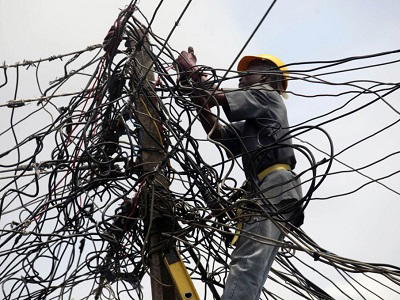
DISCO official disconnecting lines on electric pole
IN line with the Federal Government’s effort to diversify sources of power, stakeholders in the industry have harped on the need to invest massively in embedded power generation.

electricity
This came even as the Benin Distribution Company, BEDC, stated during the PwC Power Roundtable in Lagos that it has already received about 1,600 megawatts, MW, offer from consumers within its network for embedded power.
Embedded generation is the term used to describe the process of generating electricity at a specific location and then connecting that supply into the electricity network. The Nigeria Electricity Regulatory Commission, NERC, had developed a regulation on embedded generation which allows for power generation plants (including renewable energy) to be directly connected to and evacuated through a distribution network.
The system would also provide a window for investors, communities, state and local governments to generate and sell or utilize power without going through the transmission grid.
According to the Managing Director and Chief Executive Officer,, Benin Distribution Company, Mrs. Funke Osibodu, “BEDC is in a gas producing zone and because gas is the largest, from day one, when we got there, we had so many people that came and said they wanted to be embedded with us.
“What we take from the grid ranges between 300 and 500 MW for the four states in our network. What we have, in those who have approached us to start embedded as at today is 1,600MW, which is three times of what we currently collect, and of course we have a lot of customers who do not have power.”
Also, the Deputy Director and Project Manager, Nigeria Power Sector Reform Program, BPE, Mr Amaechi Aloke, stated that, embedded generation is the great solution to the failure in power experienced across the country, which will help the distribution company to easily negotiate, maybe 20MW and below which will just go straight to their account and solve any immediate problem.
“When you say embedded generation, even if you put a plant in a particular location, it may be a bit difficult to hand pick the households that will get the new power you have. You may still have to supply a particular area, and if the losses they are sustaining in that particular area is still huge, those losses will affect the service.”
He further noted that, “There is no problem that we are facing today, in this sector, that has not been with us for the last fifty or more years. What has happened is that the reform and privatization programme has thrown up these problems for the general public to now see what has been hidden and going on.
“In the past, people, just cried NEPA and were helpless. They didn’t know what the issues were because NEPA was one huge entity that wasn’t broken down. Nigerians are now seeing clearly, what the issues are, and it gives me hope because as you now begin to see what the issues are from generation to transmission to distribution to gas, we are now beginning to look at possible solutions,” Aloke added.
Disclaimer
Comments expressed here do not reflect the opinions of Vanguard newspapers or any employee thereof.