By Ovie Edomi
How many of our compatriots in today’s Nigeria would take the time to find a holistic solution to the nation’s broad problems or explore themes, ideas and ethics within the Nigerian context, with a view to providing suggestions on how to rightly lead Nigeria? It requires enthusiasm, patriotism and deep courage for anyone to find the commitment and time to write about leadership and governance in Nigeria.

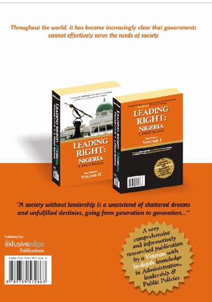
Ikechukwu Philip Ejiofor’s Leading Right: Nigeria on leadership, published by Exclusive Edge, will make serious revolutionary impact on millions of people across the country.
Indeed, Leading Right: Nigeria, a-two-in-one book made up of 579 pages cites lack of understanding of several dimensions of leadership obligations by politicians, poor political leadership based on poor value systems, principles, political ideologies, financial impropriety and corruption as bane of leadership in Nigeria, is a new addition to leadership issues and knowledge that cannot be brushed aside.
He defined “Political Leadership as the selfless sacrifice offered by those in public service, who carefully seek to bring the fundamental principles of democracy and human rights to the citizens in fulfillment of their socio-economic needs.”
Writing about the Nigerian state from the era when federal system of governance was adopted in 1954 to the restoration of democracy in 1999, the author argues that there has been so much concentration and centralisation of resources and power at the center.
In Chapter the author argues that federalism and good governance are designed to bring the fundamental benefits of leadership and governance closer to the citizens and guarantee their freedom and right to live peacefully.
The author explains the consequences of the failure of leadership and the aftermath on the socio-economic and political development of the nation in chapter 5. He gave the example of the Civil Service, where there is no sense of urgency and commitment because the Civil Servants have become complacent and used to clichés like “Government work no dey finish” ”Government work no be your Papa work”, ”Tomorrow is another day”.
In Chapter 6 the author examines the executive arm of government and extensively reviewed the general approaches used by different governments to bring the fundamental principles of democracy, directly to the people, while Chapter 7 which is the beginning of Volume Two focused on the legislature, its composition and structure at the federal and state levels.
Chapter 8, which is about the Judiciary, discusses the ways the National Judicial Council could maintain the integrity of the bench. The author describes the Civil Service as the repository of knowledge through which strong public institutions of reckoning could be built.
Chapter 10 calls on professional journalists to dissociate themselves from political bias, political role, political influence, commercial priorities, audience pressures, audience appeal, audience, and maintain value principles that are essential to fair reporting and journalism.
In Chapter Eleven, the role and participation of citizens in the democratic process with emphasis on voting, membership of political parties and participating in governance processes are discussed. Where citizens refuse to participate in the democratic processes, the author argues, leadership and democracy suffer at the mercy of political power grabbers.
Non-Governmental Organizations were described in the eleventh chapter, as the mouthpiece of the voiceless, and the unseen arm of government. The author referenced NGO’s that play exceptional leadership roles using the principles of transparency and accountability.
The last chapter, 13, provides the summary and suggestions of the author’s mindset about how to “lead right”. Some of the suggestions proffered by the author include: the need to build correctional facilities in the six geo-political zones where deviant and corrupt citizens will be incarcerated to learn the invaluable dignity in labour to reform their characters and encouragement of whistle blowing and rewarding of those who are bold enough to blow the whistle against social deviants in government and our communities among others.
All those who aspire to lead the people at any level of governance will certainly find Ejiofor’s Leading Right: Nigeria very useful.
*Edomi, a Mass Communication scholar, is the editor-in-chief of South-South International Magazine
Disclaimer
Comments expressed here do not reflect the opinions of Vanguard newspapers or any employee thereof.