OSINBAJO
By Sonny Atumah
It takes courage to admit mistakes. It is ones wish to commend the Federal Government for a soft pedal on modular refineries implementation which was not well thought out. The mercurial personality of the Acting President Professor Yemi Osinbajo who steeled himself to visit the troubled zones of the Niger Delta is the present calmness we experience for more crude produced and exported to beef up revenue.

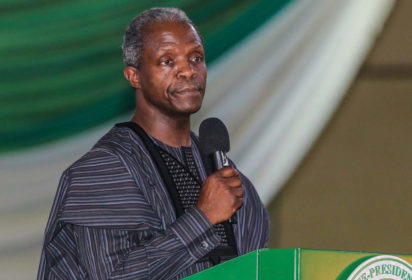
AG PRESIDENT OSINBAJO DEMOCRACY DAY CHURCH SERVICE 1. Acting President Yemi Osinbajo during the 2017 Democracy day Church service at the Economical Center in Abuja.
One joined this administration’s mid-term frenzy to ‘smuggle’ this memo to your Excellency on the state of our refineries and associated valued infrastructure. Out of the 745 refineries in the world are four in Nigeria that are comatose which ordinarily was having a combined capacity of 445,000 barrels per day. Our refineries can refine 40,067,164.2 litres of PMS, 7,832,000 litres of DPK and 17,019,342.9 litres of AGO among others per day.
The 17th century English writer Izaak Walton discovered: “That which is everybody’s is nobody’s business.” Liken this to the allegories of the village goat which died of starvation because nobody cared about its food or drink. The dead goat was given a ‘befitting’ burial to prevent the stench that would disrupt village square activities. This character out of fables typifies the Nigerian refinery in oblivion now being dubiously sold.
The Acting President should undertake tours of our refineries for first-hand information. They require cursory and technical assessments for rehabilitation and possible upgrades. Our refineries are not old as operators canvass. The World’s oldest refinery Digboi Refinery in Assam, India constructed in 1901 is still functional. Shell constructed the first Port Harcourt refinery in 1965; upgraded and taken over by the Federal Government in 1971. The Warri Refinery and Petrochemical plant was constructed by an Italian firm in 1978. The Kaduna Refinery and Petrochemical plant was constructed by a Japanese firm in 1980.
The second Port Harcourt Refinery was constructed by a consortium of Japanese and French firms in 1989 now allegedly sold. The Eleme Petrochemical was constructed by a consortium of Japanese, Italian and French firms in 1990 at the sum of US$2.4 billion. The plant was mismanaged and sold for US$215 million in 2006. It was turnaround maintenance between August and October 12, 2006 that brought the plant to life.
The NNPC was established in 1977 for refining, treating, processing and generally engaging in the handling of petroleum for the manufacture and production of petroleum products and its derivatives. NNPC abandoned its mandate to become petroleum products importer in the last 24 years.
Our petroleum plants have linkages with: the PHCN, Ajaokuta Iron and Steel, Delta Steel Aladja, Steel Rolling Mills in Jos, Oshogbo, Katsina, National Iron Ore Mining Company, Itakpe, Machine Tools Oshogbo, DICON, old PAN, Volkswagen of Nigeria, Leyland Ibadan, Fiat Kano, Steyr Bauchi, ANAMMCO Enugu; Nigeria Airways, Private airlines; Nigerian Railway Corporation, Nigerian National Shipping Line, Nigerian Textile Mill, UNTL, KTL, Afprint, Asabatex, Aba Textiles, NITEL/MTEL, Agriculture projects etc.
Many of these enterprises were run as if they were for the managers to repossess. The issue is less of ownership structure or government being in business as often argued because many private organisations have also gone down. The CBN variously use public funds to bail out private banks, airlines and power distribution companies. Transparency, accountability, technical and managerial competences are lacking.
We have comparative and competitive advantages in petroleum refining to induce investments, create employment, increase GDP and increase revenue. Value additions in state own refineries are strategic for energy, technology and skills. Nigeria’s diversification strategy should be investments in these plants for fuels, synthetic fertilisers and pesticides for agriculture. Other direct linkages are lubricants, asphalt, medicines, plastics, synthetic fabrics, synthetic rubber, and cosmetics, among others.
We gauge daily crude price movements per barrel of the West Texas Intermediate, WTI. A fortnight ago Nigeria jostled its way to trading companies to swap crude for one or two petroleum products out of about 6000. These traders from net consumer producing nations refine our crude and sell products to us at 10 times what we sold a barrel.
The PMS pump price increment by 67 percent from N86 to N145 per litre on May 11, 2016 and subsequent currency devaluation by about 80 percent in June 2017 we lost businesses as our consumption rate dropped by about 75 percent from about 35 million litres to 20 million litres per day. Through value addition we can earn as much as US$120 billion annually as against a paltry US$24 billion estimate in 2017 budget.
The Acting President who is now the Chairman of the NNPC should not allow this to continue. We should find solution to crude export which we started in 1958 when the first ship laden with 5000 barrels of crude set sail for Europe. I wish you the assurances of my highest consideration.
Disclaimer
Comments expressed here do not reflect the opinions of Vanguard newspapers or any employee thereof.