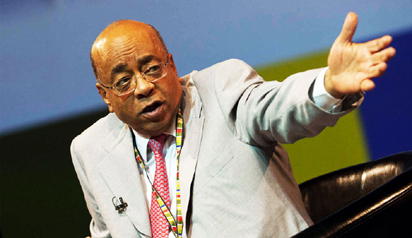
Mo-Ibrahim
By Onome Amawhe
MO Ibrahim is one of the most famous characters in Africa. According to Time Magazine, he is one of the 100 most powerful men on the planet. Yet, this accolade doesn’t mean a thing to him. Instead, his wish is that Africans should say of him: “He was one of us, he was lucky, he succeeded, but he did not forget us.” At 66, Mo Ibrahim is philanthropist of a particular type, who built his fortune on mobile telephony.
Born in northern Sudan in 1946, Mo Ibrahim received a scholarship to Alexandria University, in Egypt, and graduated with a degree in electrical engineering in 1968. After several years working for Sudan’s state telecommunications company in Khartoum, he left for the United Kingdom to study mobile communications, first at the University of Bradford, for his master’s degree, and then at the University of Birmingham, for his Ph.D. He spent several years at British Telecom before quitting in frustration, and in 1989, he founded his first company, Mobile Systems International, or MSI, which provided software and advice for cellular networks. His second company, Celtel, created its own cellular networks across sub-Saharan Africa and eventually served 24 million customers in 14 countries. After selling Celtel in 2005, he established the Mo Ibrahim Foundation, which publishes an index of African governance and awards cash prizes to African leaders who leave office peacefully.

Mo-Ibrahim
WHAT are the most important qualities for an entrepreneur to have?
The initiative to try to do something that other people shied away from. That self-belief, that can-do spirit, that nothing is impossible. Then there’s focus: if you start the mission, you need to eat, drink, and sleep it.
Are entrepreneurs successful because of their own personal qualities or the context they find themselves in?
They complement each other. I left Sudan when I was 25 or 26 years old. If I had stayed, I would never have ended up being an entrepreneur. You can have the qualities, but if you don’t have the environment, you just wither away. It’s like a fish: take it out of water, it will not survive.
Why would things not have worked out had you stayed in Sudan?
It was a stifling society with government controlling all aspects of life. You could not get funding for any sort of project. There was no infrastructure to support you. And there were a lot of social pressures too.
Why do you think your experience of doing business has been so much more successful than most pundits would have led us to expect?
I think there was a very clear market. I just couldn’t believe why other people and companies could not see it. There is very little fixed communication on most of the continent and yet we have vast distances where communication is so essential. Africa was not as bad a business proposition as it was perceived. Some years ago I gave a lecture about the problem with the media images presented from Africa. When the media only had a very short space of time with a bulletin that is 15 minutes long and they have just one minute for Africa, they just don’t have time to go through it all.
They’ll often show just Darfur and Zimbabwe and then they change the subject! But there are 50 other African countries which are doing fine and we don’t hear about them. There is a gap and, when there is a gap between perception and reality, there is always good business. Persuading the banks that there is an opportunity, well that is another problem but we started getting operating licenses country by country. I think the first one was Uganda, then Zambia. By the time we finished, we had 15 countries, all in sub-Saharan Africa …
The governance prize you initiated is considered the most valuable individual prize in the world. It recognizes good governance, leaders who have raised living standards, governed well and then stepped aside under the law. Since that time, there have been a couple of years – in fact, most recently in 2016 – when you haven’t awarded the prize. Are you disappointed?
I don’t offer the prize. The prize is offered by the prize committee and so we have to observe good governance ourselves. It is a very credible committee and this is a prize for excellence. It’s not a pension, so what we’re looking for is excellence and excellent leadership is something rare.
Do you think that the prize is having its intended effect?
I think so. What we wanted out of the prize, really, is draw attention to the issue of governance and leadership. The week before we announce the winner or the week after, this is the main subject of conversation in every dinner table in Africa. People say, oh, well, why my president didn’t get it? Why this guy got it? Why? Once people start to talk about governance and leadership that is all what we wanted. Once a civil society gets hold of this issue, then our job is done.
How would you rate the current state of Africa’s financial governance regimes?
We are seeing many positive trends on the continent, including greater interest in equities. It is a vote of confidence in Africa and its future, and governance across the board has been improving since 2000. However, investors and businesses must not believe that this is just the responsibility of governments. The importance foreign investors place on better governance and, of course, the way they operate is vital. There is still considerable scope for improvement in corporate governance on the continent.
Corruption is a major barrier to progress. For every $1 poor nations receive in foreign aid, it is estimated that $10 flow back to developed countries illicitly. Emerging countries cannot stop these transfers of capital on their own. We need all countries to cooperate in order to regulate activity across the global financial system. We also have to provide incentives for money to be invested in the countries where it is made. These vary from dealing with liquidity issues to ensuring the rule of law is upheld. Underpinning all of this is that governments must be held to account to ensure a well regulated and enabling business environment. But the same levels of scrutiny and governance must also be applied to private sector practices.
In what ways can access to information be improved throughout Africa, and what benefits will this bring?
Getting robust data on income inequalities in Africa is crucial, as neither every person nor every community is sharing in the continent’s new wealth. Fostering inclusive, job-creating growth is the key challenge we will face over the next decade in Africa. Accurate information is vital to see where action is needed, to measure the progress of policies and programs, to build support for courageous decisions and to consolidate political legitimacy. Nations that still depend on institutions to measure national progress and basic statistics cannot be fully autonomous in their policy-making.
Closing these gaps requires more funding and support for national statistical offices. We also need a stronger and more coordinated approach to gathering data within regional economic communities. African governments are increasingly aware of the importance of reliable, robust data. Ghana and Nigeria’s recent revisions to their GDP statistics are two examples of progress. But we also need to see the private sector making more of its own information available.
With private investment increasing, what role is there for donor aid in Africa?
There is no silver bullet to Africa’s challenges. Neither aid nor trade alone is the solution. Of course, being aid dependent is not desirable and the quicker we can help countries move beyond this position, the better. But aid is necessary when countries cannot access alternative sources of finance. We have to be careful not to throw the baby out with the bath water.
Ensuring everyone benefits from rising prosperity is not a challenge in Africa alone. Inequality is growing across the world and, unless this is tackled, it will undermine development and spark broad social unrest.
What can be done to enhance access to credit for start-ups and small and medium-sized enterprises?
Poor access to finance is a major barrier although there is some variation from country to country. According to the Gallup World Poll, Algeria has enabled some 30 per cent of its youth to access the money they need to start a business, whereas in Benin, Senegal and Madagascar, the figure is much closer to five per cent.
We need local funds and local investors to become involved. As well as governments to create conditions that enable entrepreneurship and job creation by simplifying and modernizing licensing, taxation and regulatory regimes, and by eliminating red tape. Right across the continent, young African entrepreneurs are working hard, creating businesses, seizing opportunities, taking risks and developing innovative technologies.
Disclaimer
Comments expressed here do not reflect the opinions of Vanguard newspapers or any employee thereof.