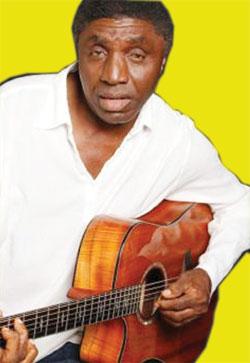
Bongos Ikwue
When Thomas Edison deaf at the time, invented the phonograph, he probably never anticipated popular music, let alone musician such as Bongos Ikwue. The possibilities Edison imagined for the recording industry began with the spoken word and ended with classical music. However, it was through the phonograph that Bongos comprehensively defined his relationship to himself and the world around him out in his music, getting attention anyway anyhow anytime he could with a cheap guitar and an expensive attitude. Bongos’ style of music blossomed to a full-fledged cultural phenomenon. He had for one thing the courage to stand on his philosophy.

Bongos Ikwue
The phenomenon known as Bongos Ikwue is singularly significant and unprecedented as to virtually defy comparison. Forty years have passed since widespread public interest in Bongos Ikwue was instigated by EMI recording company’s release of his first album record. The younger generation might well ask, “What do Bongos Ikwue sound like; what kind of music does he play and who did he sound like?” Bongos Ikwue sounds like Bongos Ikwue only. The music he plays sound like Bongos Ikwue music only. There were/are no comparable musical entities. With the swinging sixties Bongos gifted with a voice of great flexibility, range and sweetness, tonal accuracy and precise diction skilfully sang broad range of material from Jazz, Rock, Funk, Soul and folklore with dreamy sound and poetic quality.
Bongos Ikwue is an Idoma by birth and identity as a being. With such a voice that has character and can command any song, Bongos Ikwue was almost a musical genre in his own right. With real music that always had something to say, Bongos songs are born out of struggle that charged and moved forward the whole time so that people can be in-tune with reality. Bongos’ generosity of spirit; His songs were the cornerstones of what he had done and still doing for the betterment of mankind and society. Bongos Ikwue records are virtual diary of all the important statement that reflected his believe. He did not just talk moral, he lived it and this galvanized his fans. He had a missionary education from Otukpo to Jos, Kaduna back to Jos then Zaria, and had government education at Okene and Zaria at a higher level. His English is excellent and had a gift for interviews; an impressive man with impressive words; a real recording artiste and performer, a man of principle and a man of action. By and large Bongos’ quiet, peaceful, productive life, a respectable life and most importantly God-honouring life brought him fame, wealth and healthy life. Each record of his is a reminder that the paths Bongos explored were unknown then and even today, remain something of a mystery for most. For those who wish to recall or to discover how truly exceptional and memorable Bongos and The Groovies were should try and get the group discography from Double KK Resort Otukpo.
Bongos sound is dense, the lyrics almost impenetrable but the import was undeniable. His music was embraced most by the intellectuals’ middle-class. If there is such a thing as a genius Bongos is one and if there is not I don’t think he cares. He didn’t become something because of material wealth or when people heard about him. He had been like that all his life.
In the pantheon of music in Nigeria and to some extend in Africa there is no more towering presence than that of Bongos Ikwue. Bongos found fame for his technical ability matched by an equally great sensitive. Like many of the greats, Bongos took up singing as a young child. He added unusual style and sophistication in his kind of music. However, what set Bongos Ikwue apart was his bravery in creating a unique brand of music that stands him out of his contemporary. A music that insist that the ideal of peace and love could never grow outmoded; Bongos created out of the Idoma folklore the joy needed to sustain any kind of human life. His word was music and his language was distinctively his own. The songs he likes to sing and have sang have help created his legend and declared his street savvy more than a decade ago. People have always counted on him to remind them of their collective past-and the media have been willing in this shared enterprise, fuelling his legend about the old days with a rose-coloured magnifying glass. However, what he does off-stage and outside the recording studio rhetorically are the songs he likes to sing.
To be continued next week.
(An excerpt from his yet to be publish biography “BONGOS IKWUE SONGS HE LIKES TO SING” written by Idibia Ojabo)
Disclaimer
Comments expressed here do not reflect the opinions of Vanguard newspapers or any employee thereof.