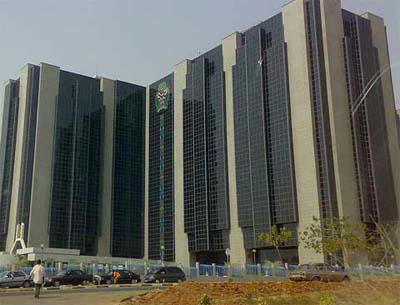
The Central Bank of Nigeria, CBN, headquaters, Abuja
By Emeka Anaeto
LAGOS— World’s leading economy and corporate rating agency, Fitch Ratings, has revised the Outlook on Nigerian’s four leading banks to ‘Negative’ from ‘Stable’.
However, on Long-Term Issuer Default Ratings, IDRs, the agency affirmed the four banks in addition to seven others.
The IDR Outlooks on two of the banks (both at B+) have been revised to Negative following a recent similar action on Nigeria’s (B+) Outlook.
Banks’ viability ratings
The IDRs of all the banks are driven by Fitch’s assessment of their standalone creditworthiness as captured in their Viability Ratings, VRs. The IDRs are all in the ‘B’ range, indicating highly speculative fundamental credit quality, and factor in the banks’ weakened credit profiles due to challenging macro-economic conditions and market volatility.
Fitch’s verdict referenced the banks’ operating environment which continues to be affected by the oil price shock, slow GDP growth, continuing pressure on the Naira, scarcity of hard currency in the foreign exchange interbank market and policy uncertainty.
Fitch also noted that the banks’ VRs have continued to be pressured by tight foreign currency liquidity, asset quality deterioration and limited capital buffers.
Banks’ profitability
However, Fitch indicated that the adverse environment notwithstanding, the banks’ profit outlook remained positive, though largely boosted by currency devaluation.
It stated: “The sector remains largely profitable, but operating profits in 2016 were inflated by foreign currency revaluation gains (due to the sharp depreciation of the naira in June 2016).
“Foreign currency-adjusted ‘normalised’ operating profit, although still healthy, is vulnerable to rising loan impairment charges (LICs). As a consequence, the banks VRs remain in the highly speculative ‘b’ range.”
Fitch said it was monitoring the banks’ ability to meet maturing external obligations, given current difficult market conditions and limited supply of foreign currency from the Central Bank of Nigeria (CBN).
It stated: “The

The Central Bank of Nigeria, CBN, headquaters, Abuja
new foreign-exchange regime has provided limited respite in accessing foreign currency in the interbank market.
“FX forward contracts provided by the CBN since June 2016 have helped the banks access foreign currency to reduce a large backlog of overdue trade finance obligations. These were either extended or refinanced with international correspondent banks.
“Further depreciation of the Naira against the US dollar would negatively impact banks’ regulatory capital ratios due to the translation effect of risk-weighted assets (RWAs).”
“Some banks have limited buffers over regulatory minimums and further erosion of capital ratios beyond our expectations could be credit-negative.”
Individual bank’s ratings
Fitch noted that GTB and Zenith are the highest rated banks in Nigeria with Long-Term IDRs and VRs of ‘B+’ and ‘b+’ respectively, adding that these ratings are driven by solid company profiles, management quality and strong through-the-cycle performance.
However, the Negative Outlooks on their Long-Term IDRs reflect Fitch’s view that they cannot be rated above the sovereign due to the close correlation between the domestic operating environment and their credit profiles, including large holdings of government securities.
For other banks, Fitch stated: “UBA’s VR reflects the bank’s strong franchise and company profile, which includes a broad pan-African footprint, as well as healthy financial metrics, including adequate capital and leverage ratios and resilient earnings.
“Access’s VR reflects the bank’s expanding franchise and market share as well as a strengthened business model and good track-record of execution. The rating also considers the bank’s healthy financial profile, including strong asset quality and capital ratios.
“FBNH’s and FBN’s VRs reflect the group’s traditionally strong franchise and company profile in Nigeria and regionally and a large retail network. The VRs also factor in the bank’s very high non-performing loans (NPL) ratio, large loan concentrations to the oil sector and weak capital position. The Outlook on the Long-Term IDRs is revised to Negative to reflect continued pressure on capital as addressing its substantial asset quality problems will likely take time.
“Fidelity’s VR reflects the institution’s strong second-tier franchise and sound capital ratios as well as sensitivity to high credit concentrations and weak earnings.
“FCMB’s VR reflects the bank’s limited company profile, exposure to higher-risk segments, tight foreign currency liquidity and weak earnings generation.
“Union’s VR reflects a high NPL ratio compared with peers, tight foreign currency liquidity and modest, albeit improving, revenue generation. It also reflects pressure on regulatory capital ratios, which the bank intends to address by raising core capital.
“Wema’s VR reflects the bank’s small franchise, modest earnings and profitability and still low capital buffers. It also reflects a lower proportion of foreign currency assets and liabilities than peers’, meaning it is less affected by current liquidity pressures.
Support ratings
On the support profiles of the banks in event of adverse incident, Fitch stated: “The Support Ratings of ‘5’ and Support Rating Floors of ‘No Floor’ for all the banks reflect sovereign support is possible but cannot be relied upon.”
Fitch believes that the Nigerian authorities retain a willingness to support the banks, but their ability to do so in foreign currency is weak due to Nigeria’s low foreign currency reserves and revenues.
In addition, it stated: “We have limited confidence that any available reserves will be used to support the banks rather than to execute other priority policy objectives.”
Disclaimer
Comments expressed here do not reflect the opinions of Vanguard newspapers or any employee thereof.