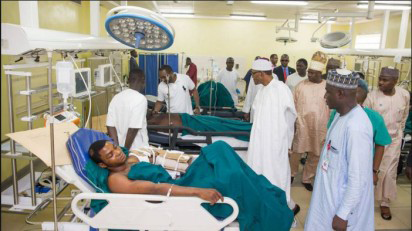
President Muhammadu Buhari during a recent visit to the National Hospital, Abuja
By Chioma Obinna
Seventeen years after the entrenchment of democracy in Nigeria, the dividends are still being awaited, particularly in healthcare. The health sector has continued to struggle for desired change from inadequate budgetary allocations, industrial disharmony, and resurgence of infectious diseases among others.
The persistence of brain drain, shortage of health workers, poor infrastructure and obsolete equipment among others continue to mar the system.
Today, despite advancement in medical care globally, Nigerian health professionals in the country are practicing with little or no modern medical equipment. It is a common knowledge that the country cannot boast of a hospital that can actually reduce the capital flight for medical treatment abroad. Currently, our health indices cannot be compared with that of the western world.

President Muhammadu Buhari during a recent visit to the National Hospital, Abuja
But industry watchers have blamed government and stakeholders in the sector for failure of the system to ensureg viable health care delivery in the country.
In the past and to date, Nigeria has consistently failed to meet the Abuja declaration of and WHO recommendation of 15 per cent budgetary allocation to health.
Overview: An overview of healthcare financing in Nigeria published January 2, 2015, in the International Journal of Health Policy Management, showed that the Nigerian government funding for the health sector has been unsatisfactory over the years.
The report revealed that by the early 1980s the annual government allocation to health was estimated at $533.6 million but nose-dived, reaching a dip of $58.8 million in 1987.
Between 1996 and 1999, there was an increase in allocation, and by 2002, it rose to $524.4 million, then climaxing to about $1.79 billion in 2013. The poor state of the nation’s healthcare may not be unconnected with the irregularity in budgetary allocation to Health as reflected in the percentage of total yearly budget.
Irregular pattern
From as low as 3.6 per cent in 1996 increasing to 5.0 per cent in 1997; then declining to 2.7 per cent in 2000 and then rising marginally to 5.6 per cent by 2013. Also, a report by the Nigerian Medical Journal titled: “Community based healthcare financing: An untapped option to a more effective healthcare funding in Nigeria, “between 1996 and 2000 Federal budgetary allocation to health in Nigeria has ranged from N4, 838 million in 1996 to N17, 581.9 million in the year 2000. Health budget as a percentage of total Federal Government budget had adopted a rather irregular pattern from as low as 3. 4 per cent in 1996, increasing to just 5.0 per cent in 1997 and declining to a paltry 2. 7 per cent in the year 2000.
Nigeria was ranked 187th among the 191 United Nations member states in 2000. That same year, Nigeria spent $4 per capita on health, below WHO’’s minimum benchmark of $14 per capita for developing countries.
In 2013, a total of N279 billion was allocated to Health. According to the Nigeria HealthWatch, N262 billion ($1.7 billion) which is about (6.3 percent)was allocated to Health in the 2014 budget out of which 82 per cent was spent on recurrent expenditure.
Irregularities: In 2014, only 6.3 per cent of the budget was allotted to health and it nose-dived again to 5.7 per cent in 2015; and in 2016, only a paltry 4.3 per cent of the total budget was allocated to the health sector.
Following the irregularities in the nation’s health budget, experts say it is a critical factor in the attainment of universal health coverage for all Nigerians.
In the views of the National President, Healthcare Providers Association of Nigeria, HCPAN, Dr. Umar Oluwole Sanda, the health of Nigerians is paramount and any budget that is not measurable in line with WHO recommended allocation is not good for the health sector.
According to Sanda, Nigeria has achieved little in the health sector with the 2016 budget and cannot move forward with the percentage allotted to health in 2017.
“With this recession, drugs that cost N800 before now cost N2, 400, a packet of needles that was N100 and syringes, N600, now cost about N3,500. How much percentage increase is that? How are we going to survive?
Percentage increase
“Again, with the 2017 budget now that is slightly above 6 per cent, how are the government hospitals going to survive not to talk of private hospitals, so something should be done? I know we will soon get out of the recession, but before we get out of recession must we die?”
Industrial harmony: in 2016 the health sector was also marred with industrial actions. All government owned federal and state hospitals had their fair share of strikes called by medical doctors and health workers.
The strike embarked upon by the resident doctors under the auspices of National Association of Resident Doctors, NARD, was significant. the year opened with a strike threat by the Nigerian Medical Association, NMA, and closed with a strike threat by members of the National Association of Resident Doctors, NARD.
Among their demands are a uniform template for the Residency Programme, infrastructure for tertiary health facilities, proper grading of doctors and payment of outstanding salaries.
Brain drain: The acute shortage of medical doctors and health workers remained a challenge throughout the outgone year. Many health workers are exiting the service. reports show that no fewer than 20 medical doctors of the Lagos University Teaching Hospital, LUTH, left the service in 2016.
A professor of medicine and Chairman, Association of Colleges of Medicine of Nigeria, Prof Folashade Ogunsola,once noted that Nigeria needs no fewer than 237,000 medical doctors to meet the World Health Organisation, WHO, standard.
Ogunsola, who is the Provost, College of Medicine, University of Lagos, said the WHO’s ratio for any country to have enough doctors for its population is one doctor to 600 persons (1:600 ratio).
Despite the shortage, little or nothing appears to be done either to retain trained professionals or attract those in the diaspora. With an estimated 193 million population, medical tourism may continue to thrive.
Medical tourism
It is no longer news that Nigeria ranks high in medical tourism with a percentage of 42.4 due to the country’s poor medical healthcare. According to the Minister of Health, Prof Isaac Adewole, Nigeria spends over $1 billion on medical tourism abroad to countries such as India, Malaysia, China, Egypt, United Kingdom and others, with 60 per cent of the fund spent in four major areas of cardiology, orthopaedic, renal dialysis issues and cancer.
The rising demand for international best practices and rapid growth being experienced by the medical tourism industry has opened up some lucrative investment opportunities.
If the promises made by the present administration to reposition the sector in a manner that would strengthen the quality of service delivery and discourage medical tourism are anything to go by, the health sector is capable of yielding four-times the revenue generated by the hotel industry for the same amount of investment.
In Nigeria, we need infrastructural development and human resource optimisation. There is need for government to invest in high quality, specialised care, low cost, reduce waiting time, improve access, and international accreditation.
Disease outbreaks: The resurgence of polio in the North East however dashed hopes of eradicating polio. Precisely on the 11th of August, 2016, the Federal Government reported that two children were paralysed by the disease in Borno state. Since then, the country has been confronting complacency, scaling up efforts on surveillance and encouraging routine immunisation would help to end the dreaded disease.
Another major disease outbreak that manifested in 2016 was Lassa fever. According to the Centre for Disease Control, NCDC, between 2015 and 2016, Nigeria recorded one of the largest outbreaks of Lassa fever in its history- reporting 273 cases, including 149 deaths.
Infrastructure/ Equipment: Cancer patients in Nigeria were hard hit by effects of obsolete and broken down medical equipment. Most of the cancer centres across the country suffered frequent breakdown of equipment which forced many cancer patients out of treatment while some in the process lost their lives. A case in point was in September, 2016 when all the machines broke down and patients spent months waiting to either complete or begin their treatment. Unfortunately, the development has persisted for years but last year it became unmanageable as a result of alarm raised by patients and their relatives who throng the centres daily. Findings revealed that managements of the affected hospitals are complaining of lack of money to buy forex and bring foreign experts to fix the machines.
PHCs : Earlier in 2015, the Minister of Health, Prof Isaac Adewole had flagged off the “one PHC per ward” programme. The initiative was to ensure access to healthcare delivery by all Nigerians. Unfortunately, the programme is yet to be completed.
However, since announcement of the 2017 budget for the health sector, observers are of the view that the change mantra of the present administration should reflect in future budgets. They say Nigeria should provide leadership in Africa having failed since 2001 as no nation will be productive with a sick and under developed workforce.
It is also important for the National Assembly as the only organ that could mitigate in this looming disaster to look dispassionately without any partisan sentiments at what should be done to substantially Increase the allocation to the health sector in order to deliver better healthcare to the populace.
Disclaimer
Comments expressed here do not reflect the opinions of Vanguard newspapers or any employee thereof.