By Etop Ekanem
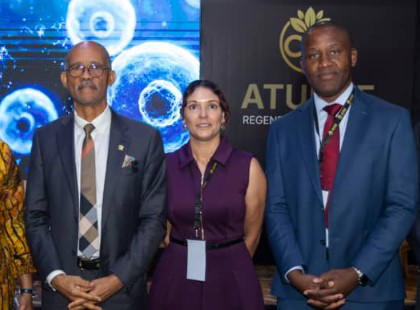
LAGOS — Atunse Healthcare has launched in Lagos with plans to manufacture and distribute advanced regenerative biologics in Nigeria, in a move aimed at reducing medical tourism and building the country’s capacity in advanced healthcare.

The company also plans to train Nigerian scientists and clinicians in specialised areas of regenerative medicine, with a long-term objective of ensuring that Nigerians can access advanced medical treatment without travelling abroad.
Speaking at the launch, held during the African Regenerative Medicine and Longevity Summit in Lagos, President and Chairman of Atunse Healthcare, Prof. Kamar Adeleke, said the company was established to end Nigeria’s dependence on foreign countries for advanced medical care.
Adeleke said, “For a generation, the most advanced medicine available has been something Nigerians travelled for — if they could afford the journey.
“Atunse was established on the position that they should not have to, and that the capability to deliver and eventually produce such medicine belongs on the continent rather than at the end of an import chain.”
He disclosed that the company was already treating patients across six service lines, including aesthetic medicine, longevity and vitality, men’s wellness, women’s wellness, musculoskeletal support and neurological care.
Adeleke said Africa imports approximately 99 per cent of the vaccines and more than 95 per cent of the medicines it uses, while producing less than one per cent of its own vaccine supply.
According to him, the cost of the continent’s dependence on imported healthcare products was evident in Nigeria, with an estimated $2.39 billion leaving the country in 2024 as Nigerians travelled abroad to seek medical treatment.
He, however, said the greater cost was borne by Nigerians who could not afford to travel abroad for advanced treatment.
“Atunse Healthcare is a partnership between KweHealth, LLC of the United States, which contributes an established scientific and manufacturing platform, and Tri-State Healthcare System of Nigeria, which contributes clinical delivery and institutional depth.
“The company is Nigerian-domiciled and Nigerian-based,” he said.
Four-pronged strategy
Adeleke explained that Atunse was developing four major capabilities simultaneously: clinical delivery, advanced biomanufacturing, research and clinical translation, and regulatory capability.
He said the company’s clinical delivery would be anchored by a treatment centre in Nigeria, while its advanced biomanufacturing programme was working towards cGMP-grade production of advanced biologics in the country.
According to him, the manufacturing roadmap would eventually extend to vaccines and, in time, cell and gene therapies.
He added that the company would also focus on research and clinical translation to ensure that discovery and evidence generation take place in Africa, with African patients participating in the science rather than merely receiving its outcomes.
On regulation, Adeleke said Atunse was working in active alignment with the National Agency for Food and Drug Administration and Control, NAFDAC, on the pathway for advanced biologic products.
He also stressed the importance of developing local expertise alongside manufacturing capacity.
“Biomanufacturing, quality assurance, regulatory science and clinical research are high-skill, durable roles, and Nigeria has few of them because it has had little to practise them on.
“Atunse’s position is that a country which manufactures without training its own scientists, and without governing its own standards, has substituted one dependency for another,” he said.
He noted that the African Union had committed the continent to producing 60 per cent of its health products locally by 2040.
Dangote: COVID-19 exposed Africa’s vulnerability
Speaking as keynote speaker at the event, President of Dangote Group, Alhaji Aliko Dangote, represented by Fatima Aliko Dangote, Group Executive Director, Commercial Operations for Oil & Gas, Dangote Industries, said the COVID-19 pandemic exposed the dangers of Africa’s dependence on imported healthcare products.
“COVID-19 taught us a very important lesson: dependence is a vulnerability. When a crisis comes, every country first looks after itself, and we saw what happened with vaccines, diagnostics, medicines and other essential health technologies,” he said.
Dangote said Africa must move beyond being a consumer of advanced medicine and develop the capacity to produce medical technologies locally.
“That is why initiatives like Atunse are important. We must begin to ask ourselves: how do we move from being consumers of advanced medicine to becoming producers of it?
“Nigeria has the talent, the entrepreneurial energy and the market to do this. What we need is to bring those things together — investment, science, enterprise and the right partnerships — and build the capability here,” he said.
He added that the future of healthcare in Nigeria and Africa could not be built by government or the private sector acting alone.
“It should be built where public focus meets private capability, where policy creates an enabling environment, and enterprise brings execution, investment, innovation and scale,” Dangote said.
Abayomi: Initiative can reverse brain drain
Also speaking, Lagos State Commissioner for Health, Prof. Akin Abayomi, who represented Governor Babajide Sanwo-Olu, said initiatives such as Atunse could help attract Nigerian doctors and scientists working abroad back to the country.
“We need our own experienced specialists back to do this. When we start seeing initiatives like this, it starts to encourage our own experienced specialists to come back home,” he said.
Abayomi described regenerative medicine as one of the exciting frontiers in healthcare, saying Lagos must develop the science, workforce and institutions required to benefit from the emerging field.
He said Nigeria had a significant gap in its health workforce and needed to train more professionals, strengthen institutions and find ways to bring expertise back into the country.
“Government cannot do this alone. We need the universities, the researchers, the healthcare providers and the private sector working together,” he said.
Abayomi also emphasised the importance of data in shaping the future of healthcare.
He disclosed that Lagos State had launched the Smart Health Information Platform, SHIP, to digitalise public health facilities, adding that the state wanted the private sector to be part of the system.
“When you bring the data, the technology, the specialists and the private sector together, you begin to build a health system that can respond not only to the needs we have today, but to the needs we will have tomorrow,” he said.
‘We intend to build the capability here’
The Chief Executive Officer of Atunse Healthcare Ltd., Dr Sola Oluwole, said Nigeria’s medical tourism challenge was costing the country more than money.
“What Nigeria loses is not only money. It is the demand, the capital and the clinical talent that need never have left.
“That is not a shortage of resources — it is an absence of capability. We intend to build it here: the treatment, the manufacturing, the distribution, and the people who will run all three,” Oluwole said.
NAFDAC pledges support
The Director-General of NAFDAC, Prof. Mojisola Adeyeye, represented at the event by Khadijah Ade-Abolade, Director, Vaccines, Biologics and Medical Devices Registration Directorate, said the agency was restructuring to meet the demands of emerging medical technologies.
Adeyeye said Nigeria must encourage innovation while ensuring that new therapies meet required standards for safety, quality and effectiveness.
She pledged NAFDAC’s support for ethical innovators but warned against unverified claims by wellness centres and online vendors marketing unapproved stem-cell products.
“The distinction is critical as regenerative medicine attracts growing global investment and public interest,” she said.
Adeyeye stressed that effective regulation was necessary to prevent legitimate scientific advances from being confused with unproven therapies that could put patients at risk.
The launch of Atunse Healthcare comes amid growing calls for Nigeria and other African countries to strengthen local pharmaceutical and medical manufacturing capacity, reduce dependence on imports and build a healthcare system capable of retaining patients, capital and medical expertise within the continent.
Disclaimer
Comments expressed here do not reflect the opinions of Vanguard newspapers or any employee thereof.