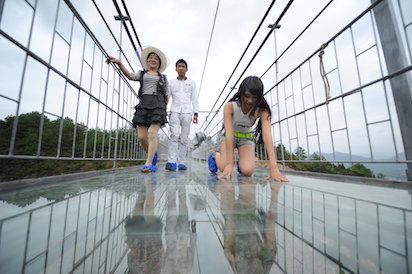
China’s longest glass bottom
By Owei Lakemfa
NIGERIA, the most populous Black country in the world, on January 11, in Abuja, sat with China, the most populous nation in the world, to sign a Bilateral Agreement recognising the One China Policy.
The Policy, like a proclamation of monotheism declares that the Chinese have no other country, but the Peoples Republic of China and that any other nation proclaiming itself a Chinese republic, like the Republic of China (ROC, Taiwan) can only be a ‘Made in Taiwan’ counterfeit.
Nigeria declared that: “there is only one China in the world, that the Government of the Peoples’ Republic of China is the sole legal government representing the whole of China, and that Taiwan is an inalienable part of China’s territory.”
The United States, the world’s third most populous country had signed a similar policy agreement with China in 1979 after a thirty-year delay in recognising the Peoples Republic of China as a country. However, Mr. Donald Trump who takes over the White House today, is threatening the policy. Two days after the Nigerian declaration, he told the The Wall Street Journal: “Everything is under negotiation, including ‘One China.’ ” Trump had also said in a television interview that he does not feel “bound by a One-China Policy unless we make a deal with China having to do with other things, including trade.” So to Trump, it is not about Taiwan or her so called national interest; it is about America using Taiwan as a bargaining chip in negotiations with China. While America does not recognise it as a country, its 1979 Taiwan Relations Act, commits it to assist Taiwan militarily.
Trump is stating the obvious; Taiwan has been nothing more than a pawn in the American chess game with China. It is primarily, an American military base. Additionally, Taiwan in a myopic manner, expends billions of dollars buying American arms. This is more as a bribe in the hope that in case of conflict with China, America will come to its aid. Taiwan needs to study history; Americans do not spill their blood defending another country’s interests; it needs to find out from the Ukrainians and the Georgians.
Taiwan which was colonised at various times by the Dutch, Spaniards, Japanese and French, was part of China until it was ceded to Japan in 1895 under the Treaty of Shimonoseki. However, with the 1945 defeat of Japan during the Second World War, China under the Kuomintang regime led by General Chiang Kai-shek regained sovereignty. There was a civil war in which the communists led by Chairman Mao Tse Tung in 1949, defeated the regime. The Kuomintang retreated to Taiwan and established a government in exile declaring itself as the authentic government of China.
At this time, the Cold War had set in and the Western Bloc recognised the Chiang Kai-shek government in exile with capital in Taipei, Taiwan, while the Eastern Bloc recognised the Chinese Republic based in Beijing. But from the 1970s, recognition of breakaway Taiwan has waned, and virtually around the world, recognition of Taiwan has been as a ‘Trade’ or ‘Cultural’ centre not a diplomatic mission.
The ability of China to feed and cater for its 1.344 billion populace, its incredible economic and technological development which trust it from a Third World backwater into a developed country, its military strength, vast production system and assistance to countries across the globe has made it a global player. It has gone on to spear head an international economic coalition, the Brazil, Russia, India, China and South Africa (BRICS) to challenge the established global financial institutions. It has deployed these enormous advantages to get the rest of the world accept its One China Policy.
China’s aim is to reunite Taiwan with the rest of the country as it did with Hong Kong on July 1, 1997 after a 137-year British colonial conquest. By the 19th Century, China had existed as an empire for thousands of years and thought it was self-sufficient. But the Europeans insisted on trade with the Empire. Tragically, the main trade was the 1825 British introduction of opium into China. Soon, the Empire had a huge drug problem.
China banned the importation, sale, possession and use of opium, but the British smuggled the drug into the Empire and the situation degenerated. The Emperor in 1839 ordered Commissioner Lin Tse-Hsu to stamp out the problem. Mr. Lin sent a passionate appeal to Queen Victoria. He told her: “We have heard that in your own country opium is prohibited with the utmost strictness and severity; this is a strong proof that you know full well how hurtful it is to mankind. Since then you do not permit it to injure your own country, you ought not to have the injurious drug transferred to another country, and above all others, how much less to the Inner Land! Of the products which China exports to your foreign countries, there is not one which is not beneficial to mankind in some shape or other. There are those which serve for food, those which are useful, and those which are calculated for re-sale; but all are beneficial. Has China (we should like to ask) ever yet sent forth a noxious article from its soil?”
The British did not honour Lin with a response and an angry China destroyed all the opium it could lay hands on in the Empire. Britain was furious; as far as it was concerned, opium was part of free trade and China had no right to ban it. It invaded the Chinese Empire to impose hard drugs on it. After a three-year war, it defeated China, and part of the war booty, was to force China pay a large indemnity, and handover Hong Kong. That was the First Opium War. The Second Opium War which British and French forces won, was from 1856-1860. This time, the victorious Europeans legalised opium, gave immunity to their traders and abolished Chinese tax on imports. In 1898, Britain leased Hong Kong and the Kowloon Peninsula for one hundred Years.
In 1979, China opened talks with Britain to reprocess the territories, but the latter wanted an extension of the lease. In talks with then British Prime Minister Margaret Thatcher, Chinese Premier, Deng Xiaoping told her to agree for a peaceful transition or “I could walk in and take the whole lot this afternoon” . China proposed a ‘One Country, Two Systems’ approach under which it would allow a capitalist system in Hong Kong for a period.
China’s approach to reunification with Taiwan is more on the diplomatic and economic track. The support of Nigeria and many countries for the One China Policy is not just political and economic, it is also a moral issue.
Disclaimer
Comments expressed here do not reflect the opinions of Vanguard newspapers or any employee thereof.