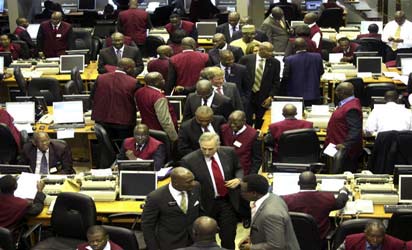
Nigerian Stock Exchange
By Nkiruka Nnorom
Companies listed under the industrial goods sector of the Nigerian Stock Exchange, NSE, took the worst hit from the protracted economic recession that threatened most businesses in the country in 2016.
At the end of the year, the sector recorded -26.37 percent negative return, the worst in the market, a development market analysts and operators attributed to weak consumer demand occasioned by low disposable income. It was also attributable to the foreign exchange crisis which hampered the companies’ ability to import their inputs.

File photo: The floor of Stock exchange
A cursory look into the third quarter financial report and accounts of key players in the sector for the nine month period ended September 30, 2016, particularly Dangote Cement Plc, Chemical and Allied Products Plc, Ashka Cement Plc and Lafarge Africa among others showed a declining revenue and profit after tax.
According to market operators, the negative return recorded in the sector was a reflection of the lackluster financial performance by the companies. Mr. Charles Fakrogha, Chief Executive Officer, Foresight Securities & Investment Limited, attributed the development to harsh operating environment , the issue of forex and the general uncertainty of the policy direction of the federal government during the period.
In his own view, Mr. Tola Odukoya, Chief Executive Officer, FSL Asset Management Limited, said: “A critical look at the composition of this sector as listed on the Nigerian bourse shows that it is amongst the major sectors of the manufacturing industry of the domestic economy. Meanwhile, the sector was amongst the worst hit by the contraction in domestic output as a result of the headwinds that hindered economic growth and development in the last fiscal year.
“This was as a result of the combination of the weakening of the domestic currency, lower household income and weaker savings rate amongst others.
Another important factor is the relatively high interest rate within the economy, which, in part, has impaired the ability of domestic producers – especially SMEs – to borrow long term funds at sustainable rates in order to be able to generate higher domestic output”.
Affirming the views of the operators, Mr. Oscar Onyema, CEO, NSE, in his review of the capital market performance for 2016, said: “The bottoming out of crude oil prices and a drastic decline in domestic oil output curtailed crude oil export proceeds, which accounts for roughly 90 percent and 70 percent of Nigeria’s FX earnings and government revenue , respectively.
This resulted in foreign exchange liquidity challenges during the year, as the supply side of FX into the CBN dropped by over 70 percent , despite heavy domestic demand. Accordingly, the oil price shocks and associated prolonged FX dilemma, coupled with challenges to policy implementation, drove the Nigerian economy into its first recession in over 20 years by Q2’16.
“Capital markets tend to act as barometers of any economy, and in Nigeria’s case, the prolonged economic downturn directly impacted an array of products and asset classes on the Nigerian Stock Exchange. The NSE Industrial Index recorded the steepest drop of the year at 26.37 percent, a result of severe difficulties faced by companies in accessing capital for imported raw materials.”
Disclaimer
Comments expressed here do not reflect the opinions of Vanguard newspapers or any employee thereof.