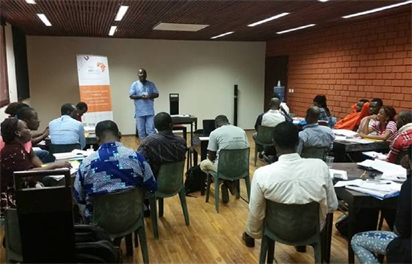
• One of the presentations during the ceremony
By Japhet Alakam
THE ARTerial Network hasbeen in the vanguard of promoting art in Africa by bringing artists, cultural organisations, art businesses and culture activists together, with the conviction that the continent has enough cultural capital to build lively national art sectors. Recently, the CORA Foundation/Arterial Network Nigeria united the creative milieu of Lagos for an energetic closing ceremony and end of year ceremony at Freedom Park where they looked at their activities for the year.
The evening’s programme which included among other things, an AGM, two panel discussions, live performances and a tribute to some of Nigeria’s finest who passed away during 2016 was a real mix of art and culture as it afforded the stakeholders opportunity to reflect on the way forward.
The day opened with an address by CORA Foundation/Arterial Network Nigeria Chairperson, Jahman Anikulapo. This was followed with the presentation of a concise review of activities from 2016 and a summary of resolutions taken during the Arterial Network General Council meeting in Zimbabwe in October where Arterial Network Nigeria was commended for being a model of best practices that is contributing to the overall strength of the network.
Dependence on foreign expertise
Arguably one of Arterial Network Nigeria’s biggest successes in 2016 was the launch of the cultural management programme that was rolled out in Lagos and Port Harcourt. The programme aims to promote continuing professionalisation of the sector and limiting the dependence on foreign expertise through local workshops and courses. Next was the work of Arterial Network’s Artwatch Africa project which was explored through a panel discussion that focused on the topic: Establishing the extent of political will to create conducive environment for freedom of artistic expression in deepening democracy in Nigeria.

• One of the presentations during the ceremony
During the course of 2016, there have been a number of alarming artist rights violations that have taken place in Nigeria, including the arrests of writer Nenghi IIlagha and performance artist Jelili Atiku, as well as the demolitions of Artist’s Village (when artist, Owie Smart, was shot in the leg) and IlÍjÍ Bar (Casa do Fernandez), a 161 year old Nigerian national monument in Lagos. On these, Arterial Network Nigeria made great strides in their efforts to lobby for artist rights by assisting artists like Jelili Atiku and Owie Smart during their trials.
The panel discussion was moderated by Funke Treasure Durodola, General Manager of Radio One. The panelists included Philomina Ahiable, Executive Director of the Human Rights Advocacy Centre – Ghana (who represented the Artwatch Africa project), Ade Bantu (Founder of Afropolitan Vibes), Lanre Adebayo (Office of Public Defender – OPD, Lagos State), Yomi Animashaun (Partner, Lawshield Legal Practitioners) and Tope Babayemi (Coordinator of Artists’ Village). Philomina Ahiable gave a brief overview of the Artwatch Africa project and announced the launch of the new e-book compilation, How Free is FREE? Reflections on Freedom of Creative Expression in Africa.
Relating to the specifics of legal restrictions on freedom of creative expression in Nigeria, Lanre Adebayo and Yomi Animashaun elaborated that the constitution provides for freedom of expression, but that the guarantee is not absolute as it is limited by the rights of others. As Animashaun explained, “the right to swing your hand ends where another person’s nose is.” Tope Babayemi lamented the fact that artists cannot censure those in power who act as benefactors without fear of undue retribution. Adebayo added to this by denouncing the fact that artists are pushed to self-censor which is contrary to the essence of their practice.
Ade Bantu spoke more about the daily influence of the Nigerian police who profile artists based on their appearance and often approach them with unnecessary aggression or arrest them without probable cause.
Relying on figures of authority
Adebayo called for members of the police to be educated in order to be sensitised when they deal with artists – to overcome their prejudice and treat artists as they would other citizens. Philomina Ahiable responded by explaining how artists are treated in Ghana and emphasising the fact that artists need to come together in order to enact change, rather than relying on figures of authority to do the work.
The second panel discussion explored the topic: Creative Industry Funding: bridging the gap in 2017. The discussion was moderated by Arterial Network’s Cultural Policy Officer Malaika Toyo, and the panelists included Audu Maikori (President of Chocolate City Group) and Oke Madu (Creative Industry Group, Bank of Industry). The major points of discussion centred around the fact that the banking system does not fully understand the scope of the creative industries yet, and similarly, artists tend to not know how they can work with banks to grow their practice.
Variety of live performances
This lack of understanding is something that needs to be improved in future.
In between the instructive meeting, closing ceremony and panel discussion sessions, the evening was punctuated with a variety of live performances, including DJ sets, spoken word poetry by Efe Paul Azino, an excerpt from the play Oh how dearly I detest thee by Oxzygen Koncepts and music by the Extasi Gang.
In the midst of the high energy celebration, the evening paused to acknowledge the passing of two greats of the Nigerian arts and culture sector in 2016. The late Chief Rasheed Gbadamosi (writer, dramatist and key member of the artistic milieu in Nigeria) and Samuel Olagbaju (art collector and Chairman of the Visual Arts Association of Nigeria) were honoured with a special tribute delivered by Prince Yemisi Shyllon (art collector and owner of the Prince Yemisi Shyllon Museum of Art) who reflected on their position as critical thinkers who transformed the sector for the better. He concluded that, “The best legacy is in the number of lives you are able to transform and not the amount of money left in your bank account.”
Disclaimer
Comments expressed here do not reflect the opinions of Vanguard newspapers or any employee thereof.