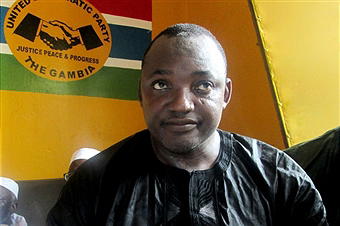
Gambia Opposition candidate, Adama Barrow
By Owei Lakemfa
NOT many saw it coming. The electoral defeat of Yahaya Abdul-Aziz Jemus Junkung Jammeh, the Gambian strongman who has ruled the country for twenty two years. A second surprise is Jammeh’s acceptance of defeat. A third issue, is the possibility of a smooth power transition in January, 2017.
While many expected him to resist electoral change – the historical error committed by Laurent Gbagbo in Cote d’ Voire – Jammeh simply went on air and said: “Gambians have decided that I should take the backseat. You have voted for someone to lead our country. This is our country, and I wish you all the best…Allah is telling me my time is up and I hand over graciously with gratitude toward the Gambian people.”
Jammeh who had in 1994 shot his way to power removing ineffectual veteran politician, Dawda Jawara, and subsequently won elections four times, is regarded by some as delusional. One of the reasons for this is his love of titles; he is not only President, but also Sheikh, Doctor, Professor and Alhaji.
In January 2007, he made scientifically unsubstantiated claims to cure HIV/AIDS and asthma. He makes similar claims to cure high blood pressure and infertility in women. He is also known to be intolerant. When in April 10-11, 2000, students engaged in street demonstrations, a dozen of them were killed. People are known to have disappeared under his watch and the press is under the heels. A newspaper Editor, Deyda Hydra was shot dead, while some journalists fled the country.
That is one side of Jammeh. Like Papa Doc of Haiti and Kamuzu Banda of Malawi, Jammeh is not all brute force; he is a highly intelligent man. He is also a fierce patriot and Pan Africanist dedicated to the development of his country and defence of the Blackman’s dignity.

Gambia Opposition candidate, Adama Barrow
The British colonialists in four hundred years reportedly built only one high school; the Armitage High School, established in 1927 while Jawara in 32 years as Prime Minister and President of Gambia, has no record of any high school built. Jammeh not only built many schools, but also established The University of the Gambia.
Believing that food insecurity is a deadly weapon, he not only established his private farm which he personally tends, but has gone lengths to encourage agriculture in Gambia including hunting for experts across Africa.
Like Muammar Ghadaffi who was murdered for Libyan oil, Jammeh is quite protective of the mineral wealth of tiny Gambia which is estimated to have four billion barrels of oil in its bowels. He told the story of an investor who proposed a ridiculous percentage for Gambia as its share in its oil exploitation, and he told the man to “go to hell” advising him never to set foot in the Gambia again. In his interview in the November 18, 2013 edition of the AFRICAN BUSINESS Magazine, Jammeh said:
“One of the crimes I am supposed to have committed is to say we are not going to accept 5% from our petroleum resources, and the rest going to the foreign oil companies exploiting our resources. … So, they expect me to have diamonds in the Gambia and go to my people and tell them, ‘Oh, don’t worry we are getting only 5% of what God has given us, and a Western company is getting 95%.”
A retired Nigerian ambassador remarked to me at a conference in Algiers last week that Africa is the only place in the world where the producer of a commodity does not fix the price, rather it is the buyer that does. This is explaining the exploitative commodity market. Jammeh puts this in graphic detail: “I spend all day working on the farm, harvesting the coffee beans, washing them, drying them, and then they come and say I will buy your coffee at so-and-so dollars, that is the world market price. So the buyers of African raw materials are always wealthier than the African producers of raw materials, and the status quo doesn’t seem to change.”
He has an interesting analogy on the African economy “If the butcher is wealthier than the owner of the herd of cattle, where he is buying the cattle from, then there is a problem, which is what is happening with African resources”.
The Gambia is 90 percent Muslim, and Jammeh who wears his religion like a collar, declared the country an Islamic Republic. This ill-advised move however does not tell the story of a very good culture of religious tolerance amongst Gambians or by Jammeh. A friend who was on diplomatic posting to the Gambia some years ago, told me a story. Some parents trying to take advantage of the dominance of Muslims decided to wear veil for their children in Saint Mary, a Catholic School near Banjul. It became quite controversial. But Jammeh simply ruled that all students must obey the rules of the school they attend and that parents who want their children to use hijab or any religious wear, should send them to schools where such is accepted. He threatened to punish parents whose children violate school rules. In any case, he added, it was hypocritical that students would wear veil to school, and after school, wear skimpy dresses to the beach under the prying eyes of tourists.
Forty six percent of Gambian girls were getting married while under 18 and female circumcision was rife; Jammeh made child marriage and the circumcision illegal. Of course his strident rejection of homosexuals and same-sex marriage is not pleasing to the ‘international community’ but Jammeh has Africa behind him on this issue; cultural and collective rights must be respected.
He helped in the mediation between Senegal and the Casamance rebels assisting on December 10, 2012 to free captured Senegalese soldiers. He sent peace keepers under the United Nations to the Ethiopia- Eritrea border. He reasons that organisations based on colonialism or colonial legacy, are not for Africans. Hence he pulled Gambia out of the British-owned Commonwealth. He also decided that Gambia pulls out of the International Criminal Court, ICC, which has targeted Africans including serving Presidents.
Barrow says he would reverse the Jammeh policies. Restoring press freedom, releasing political prisoners, ensuring secularism and independence of the judiciary, are worthy steps. But retaining and improving on Jammeh’s social programmes and Pan-African policies are necessary; Barrow singing the praises of Britain and the ICC, is not a good beginning.
Jammeh faces local and international challenges which can be summarised in his own words in the 2013 interview: “A Gambian proverb says an enemy is an enemy, and even if you dance in the water, he is still going to complain that you are raising a lot of dust and making him cough.”
Disclaimer
Comments expressed here do not reflect the opinions of Vanguard newspapers or any employee thereof.