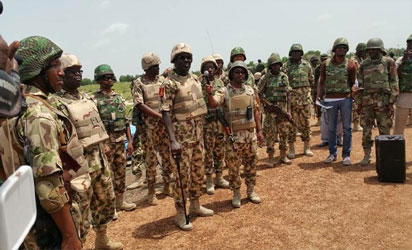
Nigeria Soldiers
By Rotimi Fasan
OVER the Christmas weekend, news finally came that Sambisa forest, stronghold of the Boko Haram insurgency, has fallen to the superior might of the Nigerian military. The actual time of capitulation was the afternoon of Friday, 23 December. Report of the fall of Sambisa forest has been confirmed by President Muhammadu Buhari, and this should call for some celebration.
But it appeared Nigerians were slow to take this piece of apparently good news to town and celebrate it. But by Sunday there were signs that the news was beginning to sink in even if the first set of people to openly acknowledge it were state governors and other government officials who congratulated the president on the conquest of the most murderous group of extremists in the annals of Nigerian history.
It should perhaps come as no surprise that news of the fall of Sambisa which in a sense should signal the end of Boko Haram was slow to resonate the among Nigerian populace. Several months ago both the military and the Nigerian government announced the death of Boko Haram following a series of victories on the battlefield. But the group would shortly after respond with its own series of spectacular attacks that confirmed it was far from a spent force. It turned out then that Nigeria celebrated too soon. Hopefully this is not the case this time around.
So far it looks like the government may be getting somewhere with its engagement with the insurgents. The latest news had been preceded by unconfirmed reports of the capture or killing of Abubakar Shekau, leader of the insurgents, on the war front. There was nothing to confirm this report and soon it fizzled out. We may have to wait a few days or, perhaps, weeks more to know if truly Boko Haram is history and now belongs to history’s dustbin as President Buhari would want the world to believe.

President Buhari interacts with troops of HQ 1 BDE in Dansadau Zamfara State as part of the 2016 Nigerian Army Day celebration on 13th July 2016
If news of the defeat of Boko Haram is eventually confirmed and proven beyond any shadow of a doubt, it can then be said that the Buhari government has fulfilled one of the cardinal objectives of the president before and on assumption of office. The question of insecurity, especially as it pertains to the activities of Boko Haram, was one President Buhari promised to address while on the campaign trail. For the most part, Boko Haram grew into the monster it became under Goodluck Jonathan. The former president was simply at his wit’s end addressing the insurgency problem. This somehow became symbolic of the failure of his government to protect the territorial integrity of the Nigerian state in its widest sense. There were, among other challenges, food and job insecurity. Both of these have since been aggravated under the Buhari government.
But the threat posed by Boko Haram, a group that at a point declared a caliphate in the North-east, was raw and visceral. After it hoisted its flag and declared a caliphate it seemed it was a matter of time before it annexed other parts of the country south of the Niger River. The government seemed helpless even as our military suffered series of disgraceful defeats on the battlefront. Soldiers were fast becoming deserters and informants of the insurgents.
They were destroying their own weaponry; that is the little that was available for them to prosecute their campaign. Officers were no longer gentlemen as they led troops to battle and abandon them to their fate. Soldiers either beat a retreat or took themselves out of action with self-inflicted wounds. Rumours were rife and had started circulating of lorry loads of poisoned food and crops being sent down south. There were reported sightings of Boko Haram members in Lagos, ijebu-Ode and other far-flung places well away from their known habitats.
The blame game between troops on the field, their desk-bound generals and administration officials and politicians was very much alive. Matters came to a head when groups of soldiers reportedly mutinied and refused the orders of their superiors. Clearly discipline had been compromised and soon the Jonathan government would seek to make an example of a group of soldiers and officers that were accused of less than soldierly conduct on the battlefield.
They were court-martialed. Found guilty they were sentenced to death which was later commuted to prison terms. Their appeal for clemency and reinstatement is still before President Buhari. With investigations now proving the criminal pilfering of funds meant for arms procurement by politicians, top military officers and the service chiefs, it can be said that the Nigerian military as an institution cannot be held responsible for the mishandling of the counter-insurgency war. Following the announced defeat of Boko Haram, President Buhari should now consider reprieving the court-martialed soldiers and others like them sent to fight blood-thirsty insurgent hounds literally with their bare hands.
This is the time to celebrate our military and by extension members of the paramilitary agencies, the men and women, working to keep the rest of us safe. Many of them gave their best but were unfortunately lost on the battlefield. In this holiday season when the rest of us are safely at home gorging ourselves on choice meals and drinks and praying for a prosperous 2017, pain is palpable in and joy is far from the homes and families of these selfless and gallant citizens who gave their lives for ours. We must salute the ingenuity of these men and women who rose to the occasion and ensured our collective security with next to nothing.
Leaving homes and loved ones to confront the threat and actual destruction of hate mongers, our military personnel have given a great account of themselves. They deserve our respect and must, going forward, be protected from the contamination of Nigerian politics.
The Nigerian military must now be returned to the path of professionalism. Our armed forces must no longer be made to face the disgrace of defeat at the hands of ragtag militias. We must remember that any threat to our military is a threat to us all.
While they should be accountable to civil authority and be compelled to operate within the bounds of legality, everything should be done to ensure that the military is not unduly exposed to the everyday politics of responding to threats from religious, ethnic and political groups. The kind of pollution that led to the military being openly challenged by groups such as the Shiites should be avoided.
No group should be allowed to feel so superior as to count itself over and above those principles that bind us together or define our commonality as Nigerians. Otherwise, there would be chaos and unnecessary flexing of muscles. If that is the case then we would not be far from the kind of heavy-handed overreaction that led to the alleged summary execution of hundreds of Shiite.
Disclaimer
Comments expressed here do not reflect the opinions of Vanguard newspapers or any employee thereof.