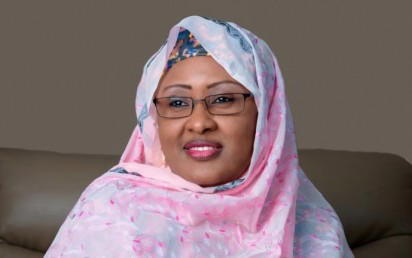
Aisha Buhari
By Morenike Taire
For the first time ever, gender matters have come to the front burner of Nigerian politics, forced on to that position by the influence of global politics by no other than Mr. President himself.
The narrative has become all too familiar: The wife of the president, Aisha Buhari, had granted an interview to the British Broadcasting Corporaton (BBC) Hausa service, in which she had criticized her man’s style, as well as that of the party he represents at the presidency.
Of course the BBC Hausa service is perhaps the most influential media platform on the continent of Africa, and perhaps even the world. Not only does it boast of a listenership that cuts across the whole of political-conscious West Africa, it also appeals to a wide sector of the Diaspora. Most importantly, it appeals to the grassroots as much as to the elite, and it is said that even the Fulani nomad is connected directly to the world via his transistor radio and the BBC Hausa service. And so it was that Mr. President in responding to his wife’s willfulness in Germany, committed the most astounding diplomatic gaffe ever.

Aisha Buhari
Proof of marital freedom
The consequences will be far reaching, international and will change the way the world sees our leader forever-for better or worse. Most importantly, the polity at home will never again take for granted.
Ironically, there appears no greater proof of marital freedom than the very idea that the First Lady was prancing around giving political opinions to the mass media in the first instance. And it will not be the first time leading partners would be openly declaring opposing political opinions.
A famous case in point is the power couple of California, Arnold Schwarzenegger and Maria Shriver: he, the invincible ‘Terminator’; she the glamorous Kennedy. He, a sworn Republican; she a sworn Democrat. She was once quoted as saying, “The Republican Party is the stern father. The Democratic Party is the permissive parent. Arnold has taken the strength of both parents. People say to me, ‘I can’t vote for a Republican,’ but I say, ‘Why not?’ People get so caught up with labels”.
In the end they went their separate ways, but not for political reasons. But in Buhari vs Buhari the unspoken political question- one that has far reaching political connotations- is the question of just how much of the view expressed by Mrs. President is a reflection of the ideas of the president himself, possibly gathered in that very “other room”. The plight of Mr. President might have been a bit like that of an embarrassed parent whose precocious child has openly expressed a view about a family friend that is clearly a reflection of the parent’s view. That parent has no choice than to cover up with a very bad joke
Disclaimer
Comments expressed here do not reflect the opinions of Vanguard newspapers or any employee thereof.