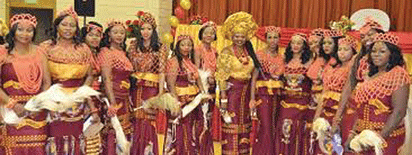
Umuada Ndigbo in diaspora
By Fouglas Anele
So, let us try to consider as dispassionately as we can, on the basis of available data, whether the first military coup was indeed an Igbo coup, as alleged by some writers such as Isama Elaigwu, in Gowon: The Biography of a Soldier-Statesman and Karl Maier, in This House has Fallen Nigeria: in Crisis. But before we do that, certain basic points must be highlighted.
The allegation that the coup was an Igbo coup -you can substitute the word ‘Igbo’ with the name of any other ethnic group but that would not affect the validity of my argument – can be justified if there is evidence that some Ndigbo in positions of power and influence, whether military or civilian or a combination of both, met and agreed to execute a coup plot to bring about Igbo domination of other ethnic nationalities in Nigeria.
Now, there is no evidence whatsoever that such a meeting ever took place or information about any speech by a prominent Igbo politician or military officer to suggest an inclination to execute a coup in the interest of Igboland.
Secondly, the allegation would make sense if the Igbo have good reasons to believe that there is a deliberate systematic attempt to marginalise Igboland and its people in key sectors of our national life, as is the case in the present dispensation of President Muhammadu Buhari. Given the primus inter pares status of Ndigbo in the years shortly before and after independence in October 1, 1960, it would be foolish indeed for the Igbo to seek to change existing status quo in which many of them were playing prominent roles in the federation.
Consider this: a year before the first military coup, Major-General J.T.U. Aguiyi-Ironsi, an Igbo from Umuahia, capital of Abia state, was already the most senior Nigerian military officer in the country and the first General Officer Commanding the Nigerian Army. Also, because the British colonial masters were largely responsible for promoting Nigerians to the top echelons of the army before independence and, thus, were more likely to give greater weight to professional competence than ethnicity in the process, Ndigbo dominated the officer corps of the Nigerian army by the time Nzeogwu and his colleagues struck.
Of the 24 Nigerians that were commissioned officers who joined Ironsi and few others at that level, fifteen were Igbo from both sides of the river Niger, four were non-Igbo speaking easterners, three came from the old northern region, and one each was Yoruba and Urhobo respectively. The first Nigerian to be appointed Quartermaster-General of the army was Lt. Col. A.C. Unegbe.
Outside the military, Ndigbo were well represented as well. In the coalition parliamentary government of the First Republic formed by the Northern Peoples Congress (NPC) and the National Council of Nigerian Citizens (NCNC), Dr. Nnamdi Azikiwe was the first indigenous Governor-General and later President of Nigeria, while Dr. Nwafor Orizu was the Senate President. Dr. K.O. Mbadiwe and Chief R.B.K. Okafor were ministers, whereas Sir Louis Mbanefo was a justice of the Supreme Court of Nigeria.
There is another reason why the January 15, 1966 coup could not have been an Igbo coup: the military officers who ought to have been involved in the plot but who actually did the most to abort it were Igbo. Frederick Forsyth in The Making of an African Legend: The Biafra Story; Maj.Gen. David Ejoor (rtd), in Reminiscences, and Chuks Iloegbunam, in Ironside, have documented how Ironsi took bold measures in Lagos, which ultimately led to the collapse of the coup attempt. Meanwhile, Lt. Col. Unegbe, the Quartermaster-General of the army who was in charge of the ammunition store at Ikeja barracks, was shot dead for refusing to hand over keys of the armoury to the coup plotters. Maj. John Obienu, an Igbo, was one of the conspirators.
He was commander of the second reconnaissance squadron at Abeokuta. His mandate was to bring the armoured vehicles of his squadron to the Ikeja airport junction as a backup for the operation in Lagos. But Obienu not only failed to attend the meeting scheduled for the evening of January 14 at Maj. Emmanuel Ifeajuna’s residence, he did not deliver the armoured vehicles as planned. Why would an Igbo officer deliberately fail to deliver equipment needed for the success of a coup if the plot was an Igbo coup?
Yet, if the coup was not an Igbo coup, why were the dissidents mostly Igbo? How can one explain the very low casualty rate among prominent Igbo politicians and military officers? Before answering the first question, we must state unequivocally that the low casualty rate is a positive development, because it would not have been beneficial to the country or to any individual for that matter if Drs. Azikiwe, Mbadiwe and Michael Okpara had been killed during the coup. Violence is abominable; it self-replicates and always worsens a bad situation.
Therefore, it is a good thing if the number of deaths arising from any violent activity is minimal. At any rate, the late Ken Saro-Wiwa who, typically, was not a friend of Ndigbo, had given a plausible explanation for the preponderance of Igbo officers in the coup plot. According to him, “a coup is a [deadly] conspiracy, and only friends and trusted associates engage in it. Such friends may be schoolmates, people from the same village or ethnic group, etc. If, therefore, we find a large number of the Igbo in the coup of [January] 1966, it is not surprising.”
The fact that Dr. Azikiwe and other prominent Igbo politicians of the period were not killed was largely fortuitous – those ignorant of the laws of probability do not appreciate the fact that incredible coincidences, though rare, do actually occur. As at the time the coup was executed, Dr. Azikiwe was in England for medical treatment.
Maj. Ifeajuna and Major David Okafor committed a tactical blunder by not detailing an officer of appropriate rank and motivation to take charge of Enugu, capital of the eastern region and one of the cities ringleaders of the coup intended to take over. Troops of the First Battalion, garrisoned at Enugu had surrounded the Premier’s house by 2 a.m., on 16 January 1966, and were waiting for orders to move in.
But by the time Ifeajuna and Okafor could drive all the way from Lagos to Enugu with some soldiers in Mercedes Benz and Volkswagen cars to give those orders, Ironsi and soldiers loyal to him had already taken control of affairs in Lagos. One of them, Major Ejoor, boarded a plane in Lagos and got to Enugu before Ifeajuna and his group, took over the garrison and withdrew the troops that had surrounded Dr. Okpara’s home. At the airport later that morning, a frightened Dr. Okpara said goodbye to the Cyprus leader, President Makarios, who was concluding his tour of Nigeria in Enugu.
In the Midwest, troops mandated to execute the coup were withdrawn on the orders of Maj-Gen. Ironsi. The coup had crumbled to dust. It is instructive to note that, aside from the seven majors of Igbo extraction detained after the coup, at least seventeen other Igbo officers of the same rank had nothing to do with it. Yet, those who insist on justifying the mindless killings of Ndigbo in the revenge coup of July 29, 1966 are not interested in this kind of information.
As part of deliberate distortion of history motivated by ethnic hatred, it has been alleged that Ironsi, after consolidating his power, surrounded himself with Ndigbo by his appointments. This is utter nonsense: if the dead could respond to lies against them, Ironsi would have done so with the loudest voice he could muster. Iloegbunam has masterfully debunked the falsehood of Igbo bias in his work cited earlier that no reasonable person who reads his well-researched arguments would entertain the notion of nepotism against Ironsi for a second.
For example, Iloegbunam reports that the composition of the nine-member supreme military council (SMC), the highest decision-making body in the country, was as follows: Ogundipe, Wey, and Fajuyi (Yoruba); Ironsi and Ojukwu (Igbo); Katsina (Hausa-Fulani); Kurubo (Izon); Ejoor (Urhobo), and Gowon, (Angas, a northern minority tribe).
The Federal Executive Council (FEC) had the same membership as the SMC until it was expanded later when Attorney-General of the federation, Gabriel Onyiuke (Igbo), and Inspector General of Police, Alhaji Kam Selem (Bornu), were invited to join the council. Ironsi reappointed the twenty-one permanent secretaries he inherited from the defunct Tafawa Balewa administration. Of that number, three were Igbo, four were from Yorubaland, five were northerners and seven came from the Midwest. In April 19, 1966, Ironsi appointed four Nigerians to top positions in the federal government. Alhaji Sule Katagum was made chairman of the Public Service Commission of the federation; Mr. Howson-Wright, chairman of Nigerian Railway Corporation; A.I. Obiyan, chairman of Nigerian Ports Authority; and Mr. H.O. Omenai, chairman, Nigeria Airways. None of these appointees was Igbo.
It is equally untrue that Ironsi was nepotic in the promotions he authorised in the army.
To be concluded.
Disclaimer
Comments expressed here do not reflect the opinions of Vanguard newspapers or any employee thereof.